










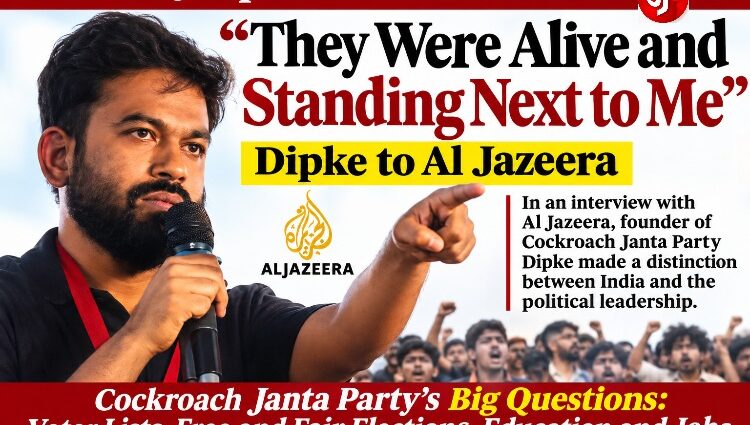
In an interview with Al Jazeera, founder of Cockroach Janta Party Dipke made a distinction between India and the political leadership.
Friday, November 27, 2026
“What is wrong with India’s democracy?”
It was a direct question from Al Jazeera interviewer Anna Burns-Fran to Abhijeet Dipke, founder of India’s Cockroach Janta Party, a youth-led political initiative established barely three months ago. His answer opened up a much wider conversation about electoral transparency, the independence of institutions, the treatment of dissent and the growing frustration of young Indians who believe that the country is not delivering on its promises to them.
Dipke did not begin by questioning India’s democratic history. He made a distinction between the country and its political leadership.
“I can certainly say that India is the mother of democracy, but I cannot say the same for the Prime Minister, whether he’s democratic or not, because the way he has been cracking down on the protests… that is certainly not a trait of a democratic person,” he told Al Jazeera.
He cited halted trains, closed metro stations and internet restrictions ahead of protests as examples of measures that, in his view, undermine the democratic right to dissent.
But it was his account of alleged irregularities in electoral rolls that brought the discussion to a particularly troubling point. Dipke described travelling to Bengaluru, where he said he met people whose names had been deleted from voter lists on the grounds that they were dead.
“I personally went to Bangalore, where I stood with the people whose names were deleted from the voter list, saying that they were dead. But they were standing next to me. Those people who were deleted from the voter list, claiming they were dead, they were alive and standing next to me.”
The statement is startling because the right to vote, however fundamental it may be in constitutional terms, becomes meaningless if an eligible citizen finds that their name has disappeared from the electoral roll.
Dipke also questioned changes to Form 6, the application used for inclusion of names in electoral rolls. He argued that the process had become more difficult for young people and first-time voters. He directed particular criticism at Chief Election Commissioner Gyanesh Kumar, questioning whether the Election Commission was exercising the independence expected of a constitutional institution.
These are serious allegations, and they deserve scrutiny. The Election Commission’s responsibility is not simply to publish electoral rolls but to ensure that every eligible voter has a fair opportunity to register, correct errors and exercise their franchise. Equally, allegations of wrongful deletion must be examined through verifiable records and transparent procedures.
Dipke’s criticism then moved beyond electoral administration to the larger question of political power and the government’s response to opposition.
“Narendra Modi is turning into an autocrat because he clearly understands that he is losing the ground, he is losing the support of the people. So for just to stay in power or just to prolong his term, he is doing whatever is necessary to crush down the protest to… scare the people to not be vocal against his government.”
The accusation is uncompromising. Dipke believes that restrictions on protests and pressure on critics are creating an atmosphere in which young citizens may hesitate to challenge those in authority. His remarks reflect his political assessment of the government’s conduct, rather than an independently established finding about the Prime Minister’s motives.
Yet the significance of the interview lies in the fact that Dipke’s concerns are not restricted to the familiar confrontation between the ruling establishment and its political opponents.
He is also speaking about a generation facing a very different set of anxieties: the cost and quality of education, the scarcity of employment opportunities and the uncertainty surrounding its future.
The Cockroach Janta Party has sought to bring these concerns into the political conversation, demanding better-quality and affordable education, solutions to unemployment and free and fair elections.
For millions of young Indians, these are not abstract political demands. They are immediate questions. How does a student from an ordinary family obtain a good education without falling into financial difficulty? What happens to those who spend years preparing for competitive examinations but cannot secure employment? What does a degree promise when jobs remain elusive? And what happens when young citizens who are finally eligible to vote encounter difficulties getting their names onto electoral rolls?
India’s demographic dividend is frequently celebrated in political speeches. Its young population is presented as the country’s greatest asset and the engine of its future growth. But the promise of a demographic dividend depends on whether young people can actually find opportunities, acquire meaningful skills and participate in the decisions that shape their lives.
Dipke’s appearance on Al Jazeera brings these questions together under an unusual political banner. The Cockroach Janta Party may have an unconventional name, but the concerns it is raising are familiar to a much larger population.
There is also a larger institutional question here. The Election Commission must inspire confidence across political and social divisions. Its credibility depends on the accuracy of electoral rolls, the transparency of its procedures and its willingness to address complaints. When citizens allege that living voters have been recorded as deceased, the appropriate response is verification and accountability.
Similarly, a government elected through democratic processes must be prepared to face criticism, protests and uncomfortable questions. Dissent is not a disruption of democracy. It is one of the ways in which citizens hold power accountable.
Dipke’s language is sharp, and his allegations will invite political disagreement. But the questions he raises cannot be dismissed merely because they come from a young founder of a party with an unconventional identity.
Perhaps the most revealing part of the interview is the contrast between the scale of India’s democratic claims and the everyday expectations of its younger citizens. They are not asking for extraordinary privileges. They want education that does not impoverish their families, employment that gives them economic independence, and an electoral system in which their names are present when they arrive to vote.
Dipke questioning the country’s democratic institutions on an international news platform may be easy to dismiss as youthful provocation. It would be considerably more difficult to dismiss the concerns of an entire generation that sees its future tied to the answers.
The Cockroach Janta Party may still be a small political experiment. But the questions Abhijeet Dipke is taking to the public debate are much bigger than the party itself.
And perhaps that is precisely why they deserve to be heard.
JANPATH NEWS NETWORK (JNN)
Independent. Fearless. On the People’s Path.