










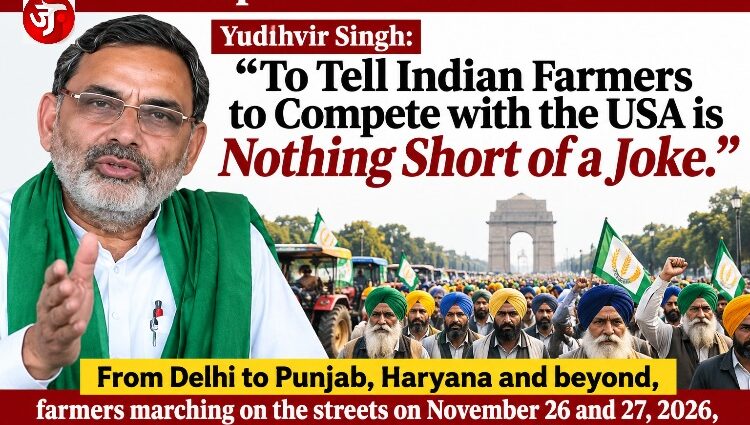
From Delhi to Punjab, Haryana and beyond, farmers marching on the streets on November 26 and 27, 2026, because promises made are unfulfilled
Friday, November 27, 2026
India’s farmers have returned to the streets, six years after one of the largest and longest rural protest movements in the country’s history brought thousands of tractors to the borders of the national capital.
On November 26, the Samyukt Kisan Morcha (SKM), the umbrella organisation of several farmers’ unions, organised demonstrations at more than 100 locations across the country. In Delhi, farmers marched from Mandir Marg towards Jantar Mantar, while demonstrations were held in Punjab, Haryana and other states.
Their central message was unmistakable: the assurances given by the Union government in December 2021, following the withdrawal of the historic agitation, remain substantially unfulfilled.
And the movement is acquiring new political and economic dimensions.
The six-year promise that remains unfulfilled
The farmers’ principal demand is a legally guaranteed Minimum Support Price (MSP) for all crops, calculated according to the Swaminathan Commission’s C2+50 per cent formula, with assured procurement.
The distinction matters. An announced MSP does not automatically mean that every farmer can sell every crop at that price. Farmers want a statutory guarantee that makes the commitment enforceable.
In a statement to The Tribune, All India Kisan Sabha general secretary Vijoo Krishnan described the central demand as:
“The law guaranteeing MSP for all crops at 50 per cent above the comprehensive cost of cultivation.”
The unions also want:
- A comprehensive waiver of agricultural loans.
- Compensation of Rs 25 lakh for families of farmers and agricultural workers who die by suicide.
- Withdrawal of the four labour codes.
- An end to electricity privatisation and opposition to proposed changes in electricity and seed legislation.
- Restoration of MGNREGA with 200 days of employment annually at Rs 700 per day.
- Clearance of pending sugarcane payments and an increase in the sugarcane price to Rs 500 per quintal.
These are not minor administrative requests. Together, they constitute a wider challenge to the economic conditions under which millions of rural households survive.
Delhi: A march stopped, a memorandum delivered
In the national capital, the planned march towards Jantar Mantar ran into resistance from the authorities. Delhi Police said it had received no formal application seeking permission for the proposed procession. Restrictions under Section 163 of the Bharatiya Nagarik Suraksha Sanhita were in force in the New Delhi district, prohibiting unauthorised gatherings and demonstrations.
The march was stopped at Mandir Marg. However, the farmers did manage to submit a memorandum addressed to President Droupadi Murmu through Additional DCP Jagdev Singh. Senior farmer leaders Yudhvir Singh and Revula Venkaiah handed over the document.
The confrontation was significant because the protest was intended to mark six years of a movement that had once brought the national capital’s borders to a standstill.
The farmers also demanded that Jantar Mantar be formally notified as a designated protest site.
In Haryana, tensions were particularly visible around Hisar and the Tikri border. Several farmer leaders and activists attempting to reach Tikri for the anniversary mobilisation were detained on November 26.
Among them were farmer leader Shamsher Singh Ladwa, intercepted between Ladwa and Bhagana villages, and Kapoor Singh Bagla, detained by Adampur police.
Ladwa alleged that police personnel had been deployed outside the homes of farmer leaders in several villages from late Wednesday night. These allegations were reported by The Times of India. The detentions provoked anger among farmer organisations, which accused the administration of preventing peaceful mobilisation.
At Tikri, meanwhile, farmers who managed to assemble held a demonstration and observed a two-minute silence in memory of those who died during the earlier agitation.
Their demands included land for memorials at Tikri and Singhu, a legally guaranteed MSP and a comprehensive farm loan waiver.
The Haryana farmers also announced a proposed gherao of the Chief Minister’s office on December 2 over the failure to increase sugarcane prices.
Punjab, the epicentre of the 2020–21 agitation, witnessed demonstrations in Patiala, Bathinda, Jalandhar and Amritsar. In Patiala, farmers from seven districts of the Malwa region assembled at PUDA Ground, with representatives of 15 affiliated organisations participating.
Sugarcane farmers are also demanding an increase in the state price to Rs 500 per quintal and clearance of outstanding payments.
For Punjab’s farmers, the issue is no longer simply about the legislation that was withdrawn but more about the viability of agriculture itself.
The India-US trade agreement becomes a new flashpoint
One of the most politically significant developments in this round of mobilisation is the farmers’ opposition to the proposed India-US trade agreement. Farmer organisations fear that easier access for American agricultural products could expose Indian farmers, particularly small landholders, to competition from heavily mechanised and subsidised agricultural producers.
The concern is that cheaper imports could depress domestic prices, weaken local procurement systems and place additional pressure on farmers already struggling with rising input costs.
Bharatiya Kisan Union (Tikait) leader Yudhvir Singh had questioned how small Indian farmers could compete with large American agricultural producers.
In remarks reported ahead of the protests, he said:
“To tell Indian farmers to compete with the United States and prepare themselves for international competition is nothing short of a joke.”
The unions have consequently expanded their demands beyond domestic agricultural policy, calling for the withdrawal of the proposed trade agreement and, in some cases, cancellation of free trade agreements altogether.
This gives the renewed agitation a larger economic dimension. It is no longer only a confrontation over MSP or government procurement. It is also about who bears the cost of opening India’s agricultural market to international competition. ReporterWorld+1
West Bengal: An attack adds to tensions
The mobilisation was not without controversy. The Samyukt Kisan Morcha condemned an alleged attack on All India Kisan Sabha national vice-president Amal Haldar during a protest in Bardhaman, West Bengal.
The organisation described the incident as a “cowardly and deplorable” attack and accused BJP supporters of being responsible. The allegation has added another political dimension to the anniversary protests. The circumstances and responsibility for the incident should be independently established, but the episode underlines the tensions surrounding farmer mobilisation in parts of the country. The Tribune
Assam: Farmers fight another battle, over their land
The protests also carried a distinct regional significance in Assam where on November 26, the Samyukta Kisan Morcha, Assam, organised a demonstration at Khena Alibari village in south Kamrup against proposed infrastructure projects, including an Aerotropolis around Guwahati airport.
The protesters alleged that more than 1,100 bighas of agricultural land could be acquired for the project and associated developments. They also raised concerns about a proposed satellite city at Barduar Tea Estate, a dam project on the Kulsi river and a logistics park near Dorabeel wetland.
Dinesh Das, secretary of the Sangrami Krishak Shramik Sangha, warned:
“Hundreds of villagers in south Kamrup fear that their ancestral villages and homes will be displaced in the name of urbanisation.”
The Assam mobilisation demonstrates why the farmers’ movement cannot be understood only through the traditional Punjab-Haryana-Delhi axis.
Across different regions, the immediate disputes may differ, but the underlying concern is increasingly familiar: the loss of agricultural land, insecure livelihoods and the absence of meaningful guarantees for rural communities.
The Assam protesters also demanded statutory MSP protection, ownership rights for long-term tenant farmers and withdrawal of the Assam land acquisition amendment legislation. The Times of India
Friday’s reports suggest that the anniversary mobilisation is continuing to generate local confrontations and political responses. In Jind, Haryana, a separate dispute over compensation for land affected by electricity transmission lines has intensified. Farmers have alleged that landowners in Hisar were offered Rs 1.26 crore per acre, while farmers in Jind were being offered Rs 50 lakh per acre.
After talks with the district administration failed to produce an agreement, the farmers warned that they would fill the pits dug for transmission towers if construction work continued without adequate compensation.
More than three dozen farmers had reportedly been detained during an earlier protest.
This is an important reminder that the agricultural crisis is not confined to MSP. Land acquisition, infrastructure projects, compensation and the rights of landowners are also becoming flashpoints. The Times of India
There is, however, an important distinction in the reporting: November 26 was the principal nationwide mobilisation date. November 27 has brought further reports of detentions, local disputes and the continuing demands of farmers, rather than confirmation of an entirely new nationwide march.
The memory of 2020–21 remains powerful
The anniversary carries considerable historical weight. On November 26, 2020, farmers began the march towards Delhi against three agricultural laws introduced by the Narendra Modi government. What followed was a year-long confrontation, with protest camps at Singhu, Tikri and Ghazipur.
Thousands of farmers endured freezing winters, extreme heat, barricades, water cannons and tear gas. The movement attracted support from agricultural workers, trade unions, students and civil society groups.
After months of confrontation, the government announced the repeal of the three farm laws in November 2021. Parliament subsequently passed the repeal legislation. The farmers withdrew their agitation after receiving written assurances from the government on December 9, 2021.
But the question that has returned six years later is whether those assurances have been honoured. The unions continue to demand a memorial for the farmers who died during the agitation. They also want recognition of their sacrifice and the fulfilment of outstanding commitments. The Tribune+2
A government facing an uncomfortable question
The renewed mobilisation presents the Centre with a familiar but increasingly complicated challenge.
The repeal of the farm laws ended one major confrontation, but it did not resolve the structural problems facing Indian agriculture. Small landholdings, mounting debts, uncertain market prices, rising cultivation costs, climate-related crop losses and inadequate rural employment continue to shape the lives of farming households.
The farmers are now connecting these problems to a wider set of policy decisions, including electricity reforms, labour legislation, land acquisition and international trade agreements.
Their opposition to the proposed India-US trade agreement is particularly significant because it brings agricultural policy into the larger debate over India’s economic and trade strategy.
The government must contend with a movement that has retained its organisational networks and its memory of having forced a major legislative retreat.
There is no evidence yet that the anniversary protests have reached the scale of the 2020–21 agitation. But dismissing them as routine demonstrations would also be a mistake.
The mobilisation across more than 100 locations, the detentions in Haryana, the land protests in Assam and the renewed demands for an MSP law suggest that the underlying discontent remains substantial.
The November 26–27 mobilisation may not yet represent another Delhi-scale uprising. But it has delivered a political reminder that the farmers’ movement was never just about three pieces of legislation.
And six years later, the argument is still unfinished.
JANPATH NEWS NETWORK (JNN)
Independent. Fearless. On the People’s Path.