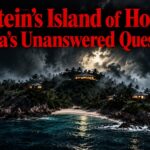







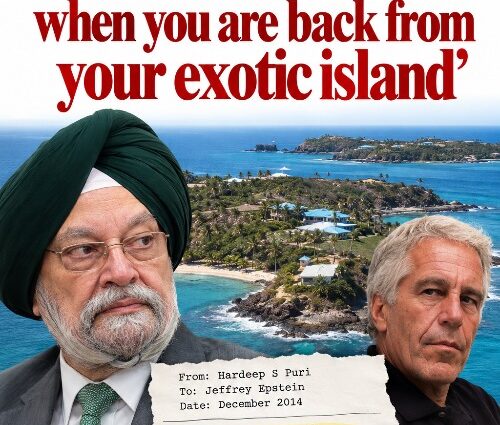
In an email in December 2014, Puri wrote to Epstein, “Please let me know when you are back from your exotic island,”
Hardeep Singh Puri, who serves as the Union Minister of Petroleum and Natural Gas in India says his meetings with Epstein were professional, linked to India’s investment opportunities and Digital India. But emails, scheduled appointments at Epstein’s Manhattan townhouse and a newly circulated photograph have raised fresh questions about the nature of their relationship.
The photograph of Union Petroleum Minister Hardeep Singh Puri seated across a table from Jeffrey Epstein has reignited a controversy that goes well beyond who was in the room. The more important question is why a senior Indian diplomat, later appointed to the Union Cabinet, was meeting a man who had pleaded guilty in 2008 to soliciting prostitution from a minor. What did Puri want from these encounters, what did Epstein offer, and what exactly was discussed?
Puri has publicly explained that he met Epstein three or four times after joining the International Peace Institute (IPI), a New York-based think tank led by Norwegian diplomat Terje Rød-Larsen. According to Puri, his meetings with Epstein took place in the context of IPI or its Independent Commission on Multilateralism. He has described the interactions as professional and denied any connection to Epstein’s criminal activities.
Puri has also pointed to discussions concerning investment opportunities in India, the government’s Digital India initiative and connections with influential figures in the technology sector. The email record includes an introduction to LinkedIn co-founder Reid Hoffman in September 2014. Puri subsequently exchanged messages with Hoffman about India’s internet economy and the potential for technology companies to expand in the country. This correspondence provides a plausible professional explanation for at least part of the contact.
Puri says he did not know about Epstein’s criminal background when he first met him. However, his own account becomes more complicated when he describes what happened after that first encounter.
In a February 12, 2026 interview with NDTV, Union Minister Hardeep Singh Puri was directly asked whether he knew about Epstein’s history when they first met. He replied, “No, I did not.” He said that after the initial meeting, the group Googled Epstein and discussed whether they should meet him again.
There are three important points to distinguish:
- Epstein was already a convicted sex offender. In 2008, he pleaded guilty in Florida to offences involving the solicitation of prostitution, including from a minor. This was years before the documented Puri–Epstein correspondence of 2014–201
- Puri says he subsequently knew of allegations, but not the full extent of Epstein’s conduct. In the same interview, he indicated that by 2014–15 he was aware of allegations surrounding Epstein, while denying knowledge of the full extent of the crimes that later came to light. NDTV Special Projects
- The correspondence continued. The released records document further meetings and emails, including Puri’s December 2014 message asking Epstein to contact him when he returned from his “exotic island”. Puri explained that the message was casual and denied ever visiting the island according to The Wire.
Puri says he did not know Epstein’s criminal background at their first meeting, but has acknowledged becoming aware of allegations during the period in which their contacts continued. What he knew, when he knew it, and why the meetings continued are questions that deserve clear answers.
The newly circulated photograph has intensified the debate because it shows the two men seated opposite one another without other people visible in the frame. Trinamool Congress MP Mahua Moitra responded with the pointed question, “Recognise the room?”, challenging Puri’s account of meetings connected with delegations. Yet a photograph cannot establish whether other participants were present before or after it was taken, or whether the meeting was part of a larger programme.
Epstein’s 2008 conviction makes the context particularly troubling. It also makes it important to establish what Puri knew about Epstein at the time of their meetings, rather than assume knowledge simply because the two men were in contact. The existence of a professional explanation does not automatically settle every question, but neither does association establish complicity in Epstein’s crimes.
For a Union minister, transparency is essential. Puri should be asked to explain the purpose of each documented meeting, the role played by Epstein in facilitating introductions, the circumstances surrounding the visa request, and the meaning of the correspondence about visiting after Epstein’s return from an island. A detailed account supported by records would help distinguish legitimate professional engagement from any conduct that might warrant further scrutiny.
The photograph has brought the story back into public view. The emails provide a more substantial trail. The real test now is whether that trail can be explained in full.
JANPATH NEWS NETWORK (JNN)
Independent. Fearless. On the People’s Path.