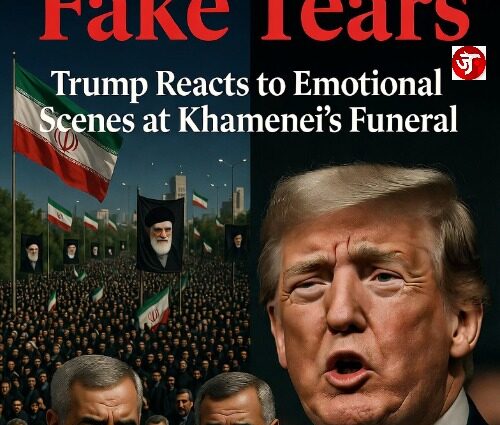
Maybe It’s Fake Tears”: Trump Reacts to Emotional Scenes at Khamenei’s Funeral
Tears, Power and a Sea of Mourners: What Ali Khamenei’s Funeral Really Reveals About Iran
By all accounts, the funeral of Iran’s Supreme Leader, Ali Khamenei, was colossal. Iranian authorities claim that between 15 and 20 million people filled the streets of Tehran alone, with the combined turnout across several cities possibly reaching 20 to 35 million people over multiple days. If even a portion of these estimates are accurate, the funeral would rank among the largest public gatherings in modern history, eclipsing even the approximately 10 million mourners who attended Ayatollah Ruhollah Khomeini’s funeral in 1989.
For comparison, the funeral of beloved Assamese singer and cultural icon, Zubeen Garg, drew crowds estimated between one and three-and-a-half million people, making it one of the largest funeral processions ever witnessed for an artist. But numbers alone do not explain anything. Nothing much has changed except Zubeen’s songs played gustily from every nook and corner.
Yet outside Iran, the funeral triggered another question: Were these purely tears of grief, or also tears of power? And who would these comments come from? None other than the President of the United States of America, Donald Trump, who said, a little astonished, “”I thought they hated him,” watching footage from the funeral. “Maybe it’s fake tears.”
For years, Iran has endured crippling sanctions, economic hardship, youth-led protests, and waves of dissent against the very system Khamenei embodied. Demonstrators had repeatedly challenged the state’s authority, and many analysts described the Islamic Republic as a regime facing deep legitimacy questions.
Videos circulating widely show vast crowds filling major avenues, with state television broadcasting continuous coverage of mourning processions. Authorities reportedly granted a week off to facilitate participation, amplifying the visual of national unity.
Yet the images of public sorrow stand in stark contrast to years of protests, economic hardship, and documented discontent under Khamenei’s rule. Trump could not believe these were real tears, and remarked, “We beat Venezuela in one day, and we knocked the hell out of Iran; they’re dying to settle,” he said. “We gave him a week off for a funeral because we’re nice.”
Adding to the intrigue: Khamenei’s son, Mojtaba Khamenei, is reportedly staying away from the public ceremonies entirely. According to Ayatollah Hakim Elahi, the Supreme Leader’s representative in India, Mojtaba will skip the events over serious security threats, particularly from Israeli surveillance and potential strikes. The absence of the man widely seen as a leading candidate to succeed his father raises immediate questions about regime stability and internal power dynamics.
Why would the presumed heir apparent avoid his own father’s funeral in a country where public rituals are political theater? The cited risks suggest Tehran believes Israeli intelligence retains eyes, and reach, deep inside Iran even after recent conflicts. It also hints at deep anxiety within the inner circle that the funeral could become a target or flashpoint for unrest rather than pure reverence.Iranian state media has worked overtime to project seamless continuity and mass devotion. But the combination of forced national holiday, visible emotional displays by top officials, and the heir’s conspicuous absence paints a more complex picture: a regime still projecting strength while privately bracing for vulnerability.Whether the tears on the streets, and in the eyes of Ghalibaf and Araghchi, reflect authentic grief or carefully managed optics remains an open question.
Iran may not be the same after Ali Khamenei’s death, but the core structures of the Islamic Republic are being preserved with deliberate emphasis on continuity amid crisis. The transition to his son, Mojtaba Khamenei (elected Supreme Leader in March 2026), reflects elite prioritization of stability over reform or rupture, shaped by the shock of assassination, ongoing war with the US and Israel, and deep internal pressures.
As of mid-2026, with the massive state funeral underway,Mojtaba was the “safest” choice for institutional cohesion. Deeply embedded in security networks, with longstanding IRGC ties, he embodied ideological and bureaucratic continuity during wartime. The regime avoided prolonged elite bargaining or structural experiments that could risk fragmentation.
Ali Khamenei reportedly opposed hereditary succession on principle (it contradicted revolutionary anti-monarchical ideals), yet the crisis overrode this. The result is the first father-to-son transfer of supreme power since 1979—a move critics label dynastic and others frame as pragmatic stabilization.
This signals the regime’s core logic: preserve the system (velayat-e faqih and Supreme Leader institution) at all costs rather than risk change: Mojtaba is expected to maintain (or intensify) his father’s resistance axis strategy, nuclear/missile programs, and opposition to US/Israeli influence. Personal trauma reports indicate family members (including possibly his mother, wife, and child) were killed in the same strikes that hit his father makes concessions unlikely in the near term.
The Revolutionary Guards’ political and economic power has grown significantly. Mojtaba’s rule will likely depend heavily on their backing, potentially tilting governance toward a more securitized, militarized model.
There is a continued reliance on Russia and China for support, with a weakened but persistent “Axis of Resistance” (proxies in the region)
What Is (or Likely Will Be) different is Mojtaba (born 1969, age ~56) is a very different figure from his father:is Mojtaba is a behind-the-scenes operator with strong security ties but limited public religious stature or speaking record. He has stayed largely out of sight (reports of injuries from the strikes; low public profile) with a potential for harsher rule as many inside Iran fear he will be “even more oppressive” or “vengeful,” taking frustrations out domestically if external revenge is limited. His background in past election manipulations and protest crackdowns reinforces this view.
With post-war realities, Iran faces reconstruction needs, economic strain, damaged infrastructure, and a battered proxy network enforcing pragmatism with possible tactical easing of social restrictions (e.g., dress codes) to buy public acquiescence, even while maintaining political control.
IRGC-heavy governance could accelerate a shift toward a more Putin- or MBS-style model with repression plus selective pragmatism, rather than pure clerical rule.
Younger than his father at ascension, Mojtaba could rule for decades, if he consolidates power. However, health questions, dynastic perception (undermining revolutionary legitimacy), and war fatigue create vulnerabilities.
Public reaction is sharply split:with regime supporters counting on continuity as divine protection and strength (“Khamenei is still our leader”).
Many ordinary Iranians and opposition voices view it as “the same path, perhaps even worse”, no real hope for reform, only intensified control. Some express despair or even hope external forces target the new leader.
But, the current massive funeral (with estimates of 15–20+ million participants across sites) serves as a state-orchestrated display of unity and power. However, underlying discontent from years of protests, economic hardship, and the war persists. The regime’s resilience so far stems from repression and elite cohesion, not broad popularity.
He is not the same as his father in outlook, Iran under Mojtaba will feel more securitized, potentially more vengeful externally, and focused on survival and reconstruction. It will not be Ali Khamenei’s Iran: different leader, different context (active war aftermath versus relative stability), stronger IRGC role and a longer term.
None of the main scenarios, full continuity, military dominance, or collapse, point to rapid democratization. True transformation would likely require major internal fracture, sustained mass uprising, or catastrophic external defeat, none of which have materialized yet.
The “Khamenei era” in its personal, long-ruling form has ended. What replaces it is a stressed but intact Islamic Republic, rebranded around Mojtaba and the security establishment, readapting to a more Putin-style governance.
Change is happening at the margins and in tone, but the fundamental power structured clerical-military authoritarianism, remains. The funeral’s scale underscores the regime’s determination to project unbroken strength even as it navigates its biggest crisis since 1979. The coming months (post-ceasefire dynamics, reconstruction, and Mojtaba’s public emergence or lack thereof) will reveal how much adaptation versus rigidity defines the new reality.
Emerging from one of the world’s oldest and most influential civilizations, marked by centuries of cultural, scientific, and territorial growth and expansion, Iran has evolved into a modern autocratic, authoritarian state. This transformation carries global weight. Its vast oil reserves, control over critical trade routes (including the Strait of Hormuz, through which a significant portion of the world’s seaborne oil passes), and role in international trade create ripple effects that reshape economic “mathematics”: energy prices, supply chain stability, geopolitical balances, sanctions regimes, and regional security calculations.
In short, what Iran is, and what it becomes, affects global markets, alliances, and stability far beyond its borders. Its history provides context; its current realities drive the equations of power in the 21st century.
Trump’s blunt skepticism has amplified global scrutiny, turning a state funeral into a real-time test of the Iran’s legitimacy in the eyes of its own people and the world.