










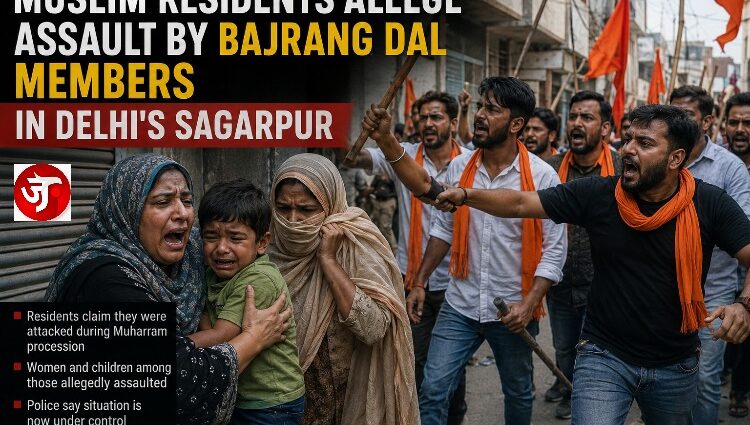
New Delhi’s Sagarpur has once again become a reminder of how fragile communal peace can be in India.
Muslim residents of the area have alleged that they were assaulted by members associated with the Bajrang Dal following tensions that arose during Muharram observances. According to residents and videos circulating on social media, women and children were allegedly threatened, houses were pelted with stones, and inflammatory slogans were raised. Some footage appears to show individuals carrying weapons and issuing provocative remarks. Right-wing groups, however, have offered a different version of events, claiming that stones were first thrown from rooftops during their gathering. Delhi Police have stated that the situation is under control and that peace has been restored.
The truth of what precisely happened must be established through a fair and transparent investigation. In a democracy governed by the Constitution, allegations cannot become convictions, and rumours cannot become justice.
Yet, even before the investigation concludes, one reality is impossible to ignore: ordinary citizens, especially minorities, increasingly live with the fear that a small dispute can rapidly transform into a communal confrontation.
India’s Constitution guarantees every citizen the right to practise their faith, celebrate their festivals, and live without fear. No group, whether acting in the name of religion, nationalism, or community sentiment, has the authority to intimidate, threaten, or punish fellow citizens. The monopoly on force belongs only to the State and its institutions.
The Sagarpur incident also raises uncomfortable questions that India has repeatedly confronted over the years. Why do local disputes increasingly acquire a communal colour? Why are provocative slogans and social media rumours able to inflame neighbourhoods so quickly? Why do ordinary families, who have lived side by side for decades, suddenly begin viewing each other with suspicion?
The answers lie in the dangerous normalization of hate and vigilantism. Across the country, there have been several incidents in recent years where individuals associated with various vigilante groups have been accused of targeting minorities, interfaith couples, traders, or religious gatherings, leading to police investigations and legal action.
History teaches a painful lesson: communal violence rarely ends where it begins. A slogan becomes a scuffle, a scuffle becomes a riot, and a riot leaves wounds that last generations.
Delhi itself carries the scars of past communal disturbances. The capital cannot afford another cycle of fear and mistrust.
This is why the response to Sagarpur must be guided not by emotion, social media campaigns, or political calculations, but by the rule of law. Every allegation must be investigated. Every act of violence, if proven, must be prosecuted irrespective of the perpetrator’s religion or political affiliation. Those spreading inflammatory speeches or inciting violence must also be held accountable.
India’s strength has never been its uniformity. Its strength lies in millions of people of different faiths living together despite their differences.
When citizens begin to fear their neighbours because of their religion, democracy itself is diminished.
Sagarpur should serve as a warning, not merely about one neighbourhood in Delhi, but about the growing ease with which communal tensions can be ignited. The country must choose whether it wishes to become a society governed by laws and institutions or one governed by fear and street power.
The answer will determine not only the future of Sagarpur, but the future of India’s plural and constitutional promise.