








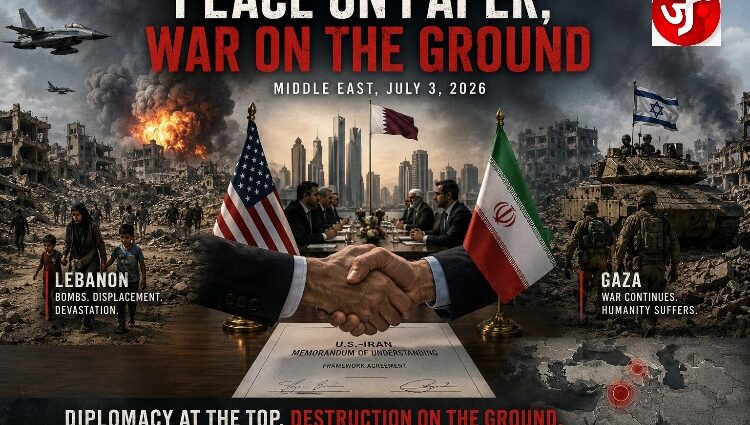
July 3, 2026: If anything defines the Middle East in July 2026, it is this paradox: the negotiators are shaking hands while the guns are still firing.
In the gilded halls of diplomacy, negotiators speak of peace. In the skies above Lebanon and Gaza, warplanes still roar.
The Middle East today is a region trapped in a stunning contradiction. On one hand, President Donald Trump is proclaiming that Iran has agreed to “just about everything we need” in negotiations that could end the 2026 U.S.-Iran conflict and prevent Tehran from acquiring nuclear weapons. On the other, bombs continue to fall, militias remain armed, and entire cities lie in ruins.
Right now, Iran is entering one of the most emotionally charged and politically consequential moments in its modern history as it prepares for a massive, six-day state funeral for former Supreme Leader Ayatollah Ali Khamenei, who was killed in the opening phase of the U.S.-Israeli strikes in February.
The ceremonies, delayed for months because of the war, are expected to draw millions of mourners across Tehran, Qom, Mashhad, and even the Iraqi holy cities of Najaf and Karbala, making them among the largest public gatherings since the 1979 Islamic Revolution.
Iranian authorities are presenting the funeral not merely as a farewell to a leader who ruled for more than three decades, but as a national act of defiance and a declaration that the Islamic Republic has survived its gravest challenge in decades. Streets are draped with banners proclaiming resistance, government offices are closing, security has been tightened, and state media is framing Khamenei’s death through the powerful Shia tradition of martyrdom and sacrifice. Yet beneath the carefully choreographed displays of unity lies profound uncertainty. The death of the man who dominated Iran’s political and religious life for 36 years has opened difficult questions about the future direction of the Islamic Republic, the legitimacy and authority of the new leadership, and the growing influence of the powerful Islamic Revolutionary Guard Corps.
India’s role in this moment is quiet but deeply strategic. New Delhi has sent Minister of State for External Affairs Pabitra Margherita and Bihar Governor Syed Ata Hasnain to represent India at Khamenei’s funeral, a gesture meant to honour India’s long civilizational, political and energy ties with Iran without openly taking sides in the U.S.-Israel-Iran confrontation.
For India, Iran is not just another Middle Eastern country: it is linked to Chabahar, Central Asian access, Gulf security, oil routes, Shia religious networks, and the safety of thousands of Indians living across the region. By attending the funeral, India signals that it will not abandon Tehran under Western or Israeli pressure; by not sending the Prime Minister or External Affairs Minister, it also signals caution.
New Delhi is walking its familiar but difficult tightrope maintaining strong ties with Israel and the United States, protecting its Gulf partnerships, keeping channels open with Iran, and calling for de-escalation while preparing for possible evacuations of Indian citizens if the conflict widens. In effect, India is trying to be present without being provocative, sympathetic without being aligned, and strategic without being dragged into another country’s war.
Diplomatic channels in Doha, mediated by Qatar and Pakistan, have reportedly made significant progress.
A preliminary understanding has already paused direct hostilities between Washington and Tehran and reopened the Strait of Hormuz, through which a large portion of the world’s energy supplies flow. For Trump, it would be a defining foreign policy victory – proof that coercion and negotiation can coexist.
But the investigation reveals a far murkier reality: Iran has publicly disputed several American claims, particularly regarding the extent of nuclear inspections and the final contours of any agreement. Tehran’s leaders appear willing to negotiate, but not to surrender. Their message has been clear: diplomacy cannot become capitulation.
Then there is Israel: While Washington pushes for a broader regional settlement, Israel continues its military campaign in Lebanon with remarkable intensity. Prime Minister Benjamin Netanyahu has vowed that Israeli troops will remain in southern Lebanon until Hezbollah is disarmed, a goal many analysts believe could take years, if it is achievable at all.
This is where the contradictions become glaring: American diplomats are trying to build a peace architecture that depends on regional de-escalation. Yet one of America’s closest allies is pursuing a military campaign that Iran and Hezbollah say makes such de-escalation impossible.
Reports that senior U.S. officials feared potential Israeli actions against Iranian negotiators expose just how fragile the diplomacy has become. It suggests that even within allied circles, there are fears that military objectives and diplomatic goals are moving in opposite directions.
The human cost is staggering: In Lebanon, more than a million people have been displaced. Entire neighbourhoods in southern Lebanon and the suburbs of Beirut bear the scars of relentless bombardment. Thousands have been killed, and infrastructure has been shattered.
Gaza, meanwhile, has slipped from the centre of international headlines but not from tragedy. Israeli operations against Hamas continue, civilians remain trapped in a humanitarian catastrophe, and reconstruction remains little more than a diplomatic aspiration.
And this is the deeper question haunting the region: Can there be peace with Iran while Lebanon burns and Gaza bleeds? History offers a sobering answer.
The Middle East has witnessed many agreements signed with great ceremony, only to be consumed by realities on the ground. Every ceasefire in recent months has been temporary. Every breakthrough has carried within it the seeds of another breakdown.
Trump may indeed be closer than ever to a historic understanding with Tehran. But the region’s conflicts are deeply intertwined. Iran’s influence in Lebanon, Hezbollah’s calculations, Israel’s security doctrine, Hamas’ survival, and the devastation of Gaza are all pieces of the same puzzle. Can this be solved within 2026? If so, it’s a walking miracle!