









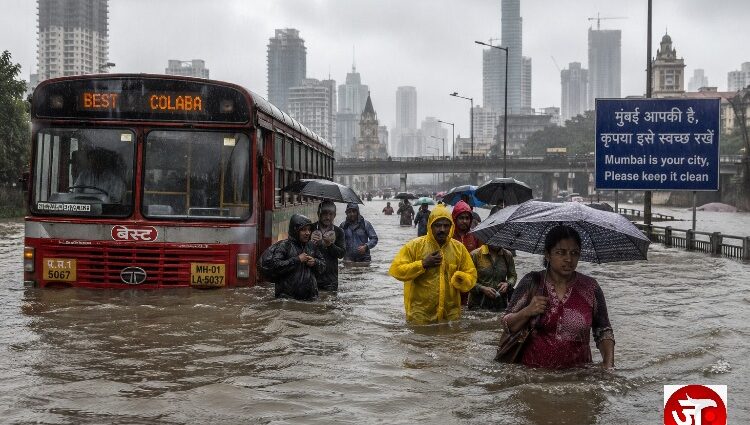
Mumbai’s floods are a national embarrassment precisely because it is the economic capital. While cities like Chennai (2015), Bengaluru, Hyderabad, Ahmedabad, and parts of Delhi also choke every monsoon, Mumbai’s repeated paralysis stands out for a simple reason: it shouldn’t. It has the money, the talent pool, the global visibility, and a centuries-old trading legacy. Instead of leading, it keeps setting the wrong example.
Mumbai’s problems are a toxic mix of geography, history, explosive unplanned growth, and governance failure:Built on water, not land: The city is a collection of seven islands joined by colonial-era reclamation. Large parts sit at or below high-tide level. The original natural drainage (creeks, mangroves, wetlands) has been systematically destroyed or built over.
Much of the underground drainage was designed over 100 years ago for far lower rainfall intensity (around 25 mm/hour). Today’s short, intense cloudbursts (often 100+ mm in an hour) overwhelm it. Add high tide + clogged drains + garbage, and you get the annual spectacle.
Once a natural waterway, it’s now heavily encroached, narrowed, and polluted. Same story with other nullahs.
Mangroves destroyed for “development”: These act as natural sponges and buffers against both rain and sea. Thousands have been cut for real estate, infrastructure, and slums. The ongoing Coastal Road projects (Versova–Dahisar etc.) have sparked fresh controversy because they involve felling or affecting tens of thousands more mangroves.
Population exploded without matching infrastructure. Concrete everywhere = zero absorption. Slums often occupy the most vulnerable low-lying areas.
Monsoons are becoming more erratic with heavier bursts in shorter periods. Studies link excess rainfall in Mumbai to significant economic losses (estimated ~$1.2 billion annually in one analysis) and hundreds to thousands of excess deaths per year, disproportionately affecting the poor.
This is not just “heavy rain.” Other cities face the same rain. Mumbai’s vulnerability is largely self-inflicted.
Billions have been spent since the catastrophic 2005 floods (which killed hundreds and caused massive economic damage). Yet the system remains fragile. Critics point to poor maintenance culture, corruption in contracts, encroachment regularisation for votes, and lack of long-term integrated planning.
While politicians love cutting ribbons on flyovers and coastal roads because they are photogenic and benefit certain sections, fixing the underground drainage network, restoring wetlands, enforcing no-encroachment zones, and proper waste management is harder, less glamorous, and politically riskier.
So while the city celebrates the arrival of the monsoon in June with children splashing in puddles, social media fills with photographs of Marine Drive under dark clouds, and the first showers are greeted like old friends, slowly, the city begins to drown.
By July, Mumbai is once again a landscape of flooded roads, paralysed trains, submerged neighbourhoods and grieving families. Every year, the same scenes unfold with such predictability that they no longer shock the nation. Yet every year, people die in circumstances that should never occur in a modern metropolis.
This monsoon has already claimed lives in ways that reveal a city at war with its own infrastructure. An eleven-year-old boy in Chembur was killed when a tree collapsed during heavy rains. A 55-year-old man, Aslam Shaikh, disappeared into an open, waterlogged manhole in Sakinaka and died. Two teenage girls in Navi Mumbai suffered electric shocks while wading through floodwaters beneath the Nerul bridge, once again exposing the deadly combination of waterlogging and exposed electrical systems.
Supriya Shrinate
@SupriyaShrinate
Translated from Hindi
The rain hasn’t even properly started yet
And videos are coming in from all sides of roads collapsing on the new expressways and highways
This is the state of the Delhi-Mumbai Expressway
Such a huge budget, such a huge government… and one rain turns the whole city into a ‘swimming pool’. Maybe this is the new model of governance!
mumbaiRains
https://x.com/warispathan/status/2072766122701824142?s=20
Why Mumbai’s roads are full of water, but taps at homes are dry
By:
@SushimMukul
Irony hits hard!
https://x.com/IndiaToday/status/2072293258085220528?s=20
Remember, these deaths are not freak accidents, but the annual body count of administrative failure with the tragedy of Mumbai is that none of this is new.
In July 2005, the city witnessed one of India’s worst urban disasters. Nearly 950 millimetres of rain fell in a single day, killing more than 500 people in Mumbai and exposing the catastrophic consequences of poor drainage, rampant encroachment and environmental destruction. The lessons were supposed to be permanent. They were not.
In 2019, heavy monsoon rains caused wall collapses and flooding that killed dozens in Mumbai and neighbouring Pune. Again, authorities promised reforms. Again, committees were formed. Again, citizens were assured that such a tragedy would not be repeated.
In 2021, torrential rains triggered landslides and building collapses in Mumbai, killing more than two dozen people. Entire families were buried under mud and debris while rescue workers dug through the wreckage.
In 2024, even before the full monsoon had arrived, heavy rains and strong winds brought down an illegal billboard in Ghatkopar, killing seventeen people and injuring scores more. The disaster raised disturbing questions about corruption, unauthorised structures and regulatory negligence.
And now, in 2026, the city is counting its dead once again. The pattern is unmistakable: A child crushed by a falling tree, a man swallowed by an uncovered drain, teenagers electrocuted by floodwaters and note, the causes change, but the negligence does not.
Mumbai’s annual flooding is often described as a natural disaster. It is not. Nature brings the rain. Human decisions turn it into a catastrophe.
In 2026 an eleven-year-old lost his life after a tree collapsed during heavy rains due to poor maintenance and inadequate assessment of dangerous trees.
A 55-year-old man disappeared into an open, waterlogged manhole in Sakinaka and died because of open drains and manholes still arecurring hazard in India’s richest city.
Two teenage girls suffered electric shocks while walking through waterlogged streets in Navi Mumbai this seadon where exposed electrical systems continue to become death traps every monsoon?
The Grim Arithmetic: People die, investigations are announced, committees are formed, compensation is paid, promises are made, then the rains return, and Mumbai counts its dead again.
How many more lives must be lost before monsoon deaths are treated not as unavoidable natural disasters, but as preventable failures of governance, planning, and accountability?
Because every death in the rain leaves behind the same haunting verdict: Mumbai did not fail because it rained. Mumbai failed because it never truly prepared for the rain.