


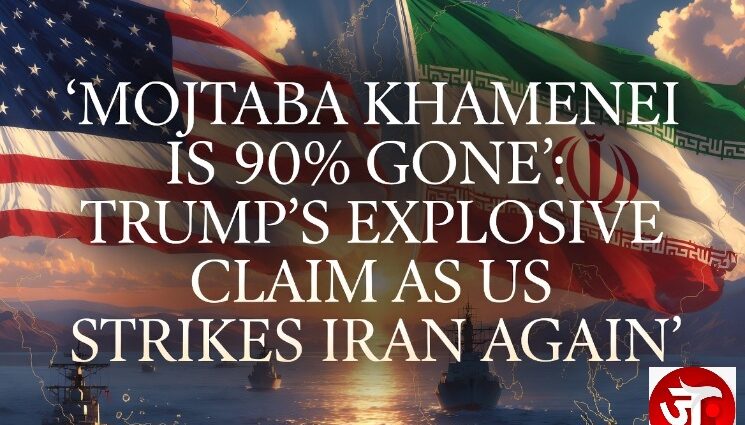
Iran’s Supreme Leader remains unseen as Donald Trump claims Tehran’s military leadership has been devastated and a new wave of US strikes deepens the crisis
WASHINGTON/TEHRAN, July 14, 2026: In one of his most explosive statements yet on the escalating war with Iran, US President Donald Trump has claimed that Iran’s Supreme Leader, Mojtaba Khamenei, is “90% gone”, fuelling fresh speculation over the fate of one of the most powerful and secretive figures in the Islamic Republic.
The extraordinary remark came as the United States launched another wave of strikes against Iran, pushing an already dangerous confrontation into an even more uncertain phase.
“Mojtaba Khamenei is 90% gone.”
With those words, Trump appeared to suggest that Iran’s Supreme Leader may be dead, critically incapacitated or effectively unable to exercise power. But the world still does not know exactly what “90% gone” means.
Trump offered no publicly disclosed evidence establishing Mojtaba Khamenei’s death or condition, and there has been no independent confirmation of his fate. Yet the claim has acquired enormous significance because Mojtaba has reportedly remained out of public view for months, allowing rumours about his health and ability to govern to intensify.
Trump also claimed that Iran’s military leadership and capabilities had been devastated by US and Israeli military operations, asserting that the country had effectively lost major elements of its navy, air force and air defences, along with senior commanders. These remain sweeping claims made by the US president and should not be treated as independently established battlefield assessments without further evidence.
There is mystery shrouded around Mojtaba Khamenei, who rose to Iran’s highest office after the death of his father, Ayatollah Ali Khamenei, during the earlier phase of the 2026 conflict. His succession placed the Islamic Republic in the hands of a figure long associated with the inner machinery of clerical power and the security establishment.
But his leadership has been overshadowed by a fundamental question: Where is he? Mojtaba has reportedly not been seen publicly since February 28, when he was said to have been injured during the same period of strikes that killed his father. Earlier reports also suggested that he was seriously injured and in a diminished condition.
Statements have continued to emerge in his name. The Iranian state has continued to project authority. But the absence of clear, independently verifiable public appearances has created a vacuum in which speculation has flourished.
Now Trump has driven directly into that vacuum: His phrase, “90% gone,” is deliberately dramatic but also deeply ambiguous. Does it mean dead? Critically injured? Politically powerless? Incapable of governing? Until Tehran produces convincing evidence of Mojtaba Khamenei’s condition, or independent intelligence emerges, the answer remains unknown.
If Mojtaba Khamenei is indeed dead or permanently incapacitated, the consequences could extend far beyond the fate of one man. Iran would face another leadership crisis in the middle of a war.
The Islamic Republic’s power structure depends on a complex network of clerical authority, military institutions, the Islamic Revolutionary Guard Corps and competing political factions. The sudden removal of another Supreme Leader could trigger an intense internal struggle over succession, command and the future direction of the state.
It could also raise an even more dangerous question: Who controls Iran’s military forces at a moment when the country is under attack and retaliating against its enemies? In wartime, uncertainty at the top can be as dangerous as defeat on the battlefield.
US STRIKES IRAN AGAIN
Trump’s statement came as the US military announced the completion of another wave of strikes against Iran on July 14, continuing the military confrontation between Washington and Tehran.
The renewed attacks underline the collapse of hopes that the confrontation could be contained through a lasting ceasefire. Instead, the conflict has again widened. At the centre of the crisis is the Strait of Hormuz, one of the most strategically important waterways on Earth and a vital artery for global energy supplies. Military confrontation around the strait threatens not merely Iran and the United States but international shipping, oil markets and economies far beyond the Middle East.
What began as a confrontation over Iran’s military and nuclear capabilities has evolved into something far larger: a struggle over regional power, maritime control, political survival and the future balance of power in West Asia.
Trump is attempting to present the military campaign as a decisive success. His message is blunt: Iran’s senior military command has been shattered, its conventional capabilities have been severely degraded, and even the country’s Supreme Leader may no longer be fully alive or capable of governing. If independently verified, such developments would represent a profound transformation of the Iranian state.
But the fog of war is thick. Governments exaggerate battlefield victories, militaries conceal losses, political leaders use language as a weapon and information itself becomes part of the conflict.
That is why Trump’s claim must be reported for what it is: A dramatic statement by the President of the United States, not yet an independently confirmed fact about Mojtaba Khamenei’s fate.
Whether Trump possesses intelligence unavailable to the public, is referring to severe injuries, or is using psychological warfare against Tehran remains unclear. But one thing is certain: The question of Mojtaba Khamenei’s fate is no longer merely a rumour about one man. It has become a question about who is actually governing Iran in the middle of a rapidly escalating war.
And if Trump’s extraordinary claim is eventually confirmed, the world may discover that the latest American strikes have not merely damaged Iran’s military machinery. They may have struck at the very centre of power in the Islamic Republic. Until that proof emerges, the headline is explosive, the implications are enormous, but the verdict remains open.
Iran has yet to provide the world with a convincing answer.