










JANPATH NIGHTLY NEWS ROLL – WORLD NEWS AND INDIA – JULY 17, 2026
The world ended another day balancing uneasily between conflict, catastrophe, and progress, with events unfolding at a pace that could reshape global politics, economies, and security for years to come.
The gravest flashpoint remains the Middle East, where the United States and Iran have plunged deeper into a dangerous military confrontation. Fresh American strikes targeted Iranian missile batteries, naval installations, coastal defence systems, and strategic infrastructure around Bandar Abbas after repeated attacks on commercial shipping in the Strait of Hormuz.
Iran responded with strikes on US-linked facilities in Bahrain, Kuwait, and elsewhere, while warning that any further escalation could trigger the closure of additional maritime routes. The fragile ceasefire framework that briefly offered hope has effectively collapsed, despite frantic diplomatic efforts by regional mediators. With nearly one-fifth of the world’s oil passing through the Strait of Hormuz, energy markets reacted instantly, sending crude prices higher and raising fresh fears of inflation, supply chain disruptions, and another global economic shock.
As war clouds gathered over the Gulf, nature unleashed its own fury elsewhere. Venezuela continues to grapple with aftermath of one of the worst disasters in its modern history after twin earthquakes measuring 7.2 and 7.5 devastated large parts of the country. Entire towns have been reduced to rubble, thousands are feared dead, tens of thousands injured, and countless families remain homeless as rescue workers race against time to pull survivors from collapsed buildings. International aid continues to pour in, but the scale of destruction has overwhelmed emergency services and left infrastructure shattered.
Europe, too, finds itself battling a different enemy. Southern Spain remains engulfed by massive wildfires that have already claimed more than a dozen lives, including foreign tourists, while forcing thousands from their homes. Scorching temperatures, prolonged drought, and relentless winds continue to feed the infernos, reinforcing warnings from climate scientists that extreme weather events are becoming more frequent and more destructive.
In Britain, political history took a dramatic turn as Andy Burnham emerged as Labour’s new leader and prepared to take over as Prime Minister, signalling a major shift in the country’s political landscape. His government is expected to inherit daunting challenges, from economic recovery and public services to immigration and Britain’s evolving role on the global stage.
Meanwhile, East Asia braces for another natural disaster as Typhoon Bavi barrels towards Taiwan and southeastern China after triggering deadly landslides and widespread destruction in the Philippines. Millions remain on alert as authorities prepare for torrential rain, powerful winds, flooding, and large-scale evacuations.
The war in Ukraine showed no sign of ending, with Russia and Ukraine exchanging another barrage of missiles and drones overnight. Diplomatic efforts remain stalled while civilians continue paying the heaviest price in a conflict that has already transformed Europe’s security landscape.
Against this backdrop of global uncertainty, India projected a markedly different story – one driven by innovation, infrastructure, and ambition.
Prime Minister Narendra Modi flagged off India’s first hydrogen-powered train, a milestone in the country’s transition towards cleaner and more sustainable transportation. The launch represents a significant step in modernising one of the world’s largest railway networks while reducing dependence on fossil fuels.India’s growing space ambitions also moved closer to another historic moment as Skyroot Aerospace prepared for the launch of Vikram-1, a mission expected to further establish India’s private space sector as a serious global player. If successful, the launch will strengthen India’s position in the rapidly expanding commercial satellite market and highlight the country’s emergence as a hub for space innovation.
The government also accelerated development on the ground, with projects worth ₹5,470 crore inaugurated in Punjab to strengthen infrastructure, connectivity, and economic growth. Adding to the momentum, the Union Cabinet approved initiatives exceeding ₹50,000 crore for agriculture, renewable energy, and rural development, reflecting a continued push towards long-term economic resilience and sustainable growth.
Yet India was not untouched by tragedy. Heavy monsoon rains disrupted life across several states, while a stampede-like situation during the Jagannath Rath Yatra in Puri left one person feared dead and hundreds requiring medical attention. Security agencies were also placed on high alert after the Golden Temple received multiple threat emails, prompting extensive searches and heightened vigilance.
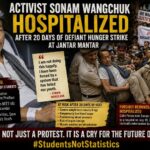
Public attention also remained fixed on environmental activist Sonam Wangchuk, whose hunger strike has now entered a desperate and critical phase on its 20th day. As his health visibly deteriorates and doctors warn of grave risks, the government’s continued silence and apparent indifference have only amplified nationwide outrage. Supporters across the country are demanding urgent, meaningful dialogue on his core demands for Ladakh’s constitutional safeguards and ecological protection, even as Wangchuk himself vows to fight on until July 20 warning that if ignored, he will return “as a ghost” to carry the struggle forward.
In Rampur, Uttar Pradesh, the Rampur Development Authority (RDA) has ordered the demolition of 38 buildings constructed on public land at Samajwadi Party (SP) leader Azam Khan’s Mohammad Ali Jauhar University complex and adjacent properties. Officials cited long-standing violations of land-use norms and encroachment on government land. The move has sparked sharp political reactions, with the SP calling it “vendetta politics” and promising legal recourse, while the ruling dispensation described it as a long-overdue assertion of the rule of law. Bulldozers are expected to move in shortly, adding another layer of tension to an already charged political atmosphere in Uttar Pradesh.
Financial markets, however, reflected confidence rather than anxiety. Despite rising geopolitical tensions overseas, Indian equities closed firmly in positive territory as investors responded to strong domestic fundamentals and expectations of continued economic growth.
Assam, meanwhile, moved closer to becoming the first Indian state to commercially produce and directly benefit from crude oil under a new policy framework, while work on the Mumbai-Ahmedabad Bullet Train continued to advance, underscoring India’s determination to pursue long-term infrastructure transformation despite global uncertainty.
Tonight’s headlines tell the story of a world increasingly defined by sharp contrasts. War threatens one of the planet’s most critical energy corridors. Earthquakes and wildfires continue to expose the devastating force of nature. Political transitions promise change but also uncertainty. At the same time, scientific progress, infrastructure development, and technological innovation offer reasons for cautious optimism.History rarely announces itself before it changes course. More often, it arrives disguised as a day’s headlines. And today, those headlines suggest the world may be standing at another defining moment.
JANPATH NEWS NETWORK (JNN)
Independent. Fearless. On the People’s Path.