









DELHI UNDER SIEGE: STUDENT UPRISING COLLIDES WITH FARMERS’ MARCH AS THE CAPITAL BRACES FOR A NEW WAVE OF DISSENT
New Delhi – July 21, 2026 : India’s capital has entered one of its most volatile political moments in recent years as two powerful movements, one led by students demanding justice and another by farmers opposing a proposed India-US trade framework, converge on Delhi, transforming the city into the epicentre of a nationwide confrontation over governance, accountability, and the future of millions.
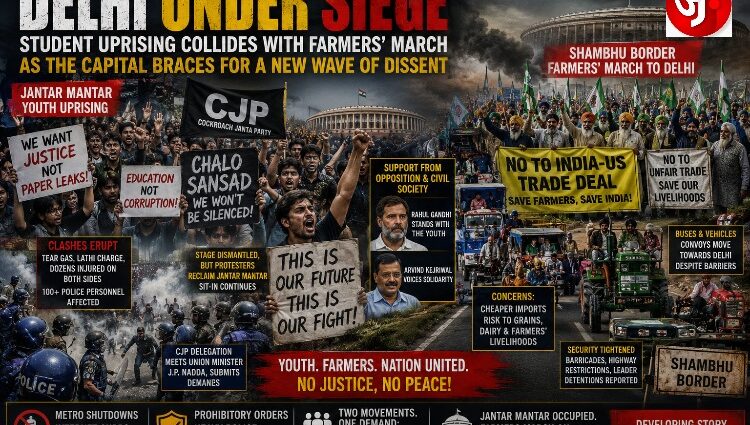
The day witnessed dramatic scenes as thousands of protesters attempted the “Chalo Sansad” (March to Parliament) from Jantar Mantar, where the Cockroach Janta Party (CJP) has spearheaded an escalating youth movement against repeated examination paper leaks and what it describes as systemic failures in India’s education system. Anticipating the march, authorities converted central Delhi into a virtual fortress. Heavy police deployment, barricades, prohibitory orders, metro station closures, internet restrictions in parts of the capital, and extensive security checks sought to prevent demonstrators from reaching Parliament.
Despite the unprecedented security measures, determined protesters pressed forward, leading to intense confrontations with police. Tear gas shells filled the air, lathi charges were carried out, and running battles unfolded on the streets surrounding the protest zone. Reports indicate that dozens of protesters sustained injuries, while more than one hundred police personnel were also affected during the day’s clashes. In one of the most symbolic moments of the confrontation, police dismantled the main protest stage at Jantar Mantar.
Yet within hours, demonstrators regrouped, reclaimed the site, and resumed their sit-in, turning what authorities intended as a dispersal into a powerful display of resilience. Even amid the turmoil, channels of negotiation remained open. A delegation representing the CJP met Union Health Minister J.P. Nadda, submitting a formal charter of demands and urging the government to address growing public anger over education reforms, examination integrity, and accountability.
However, no breakthrough emerged, and protesters vowed to continue their occupation of Jantar Mantar. The movement has steadily expanded beyond student circles, attracting support from opposition leaders including Rahul Gandhi and Arvind Kejriwal, alongside academics, activists, and civil society groups. Increasingly, the protests are being described as a defining Gen Z movement, channelling frustration over employment, education, transparency, and institutional trust.
A Second Front Opens:
Farmers Return to the National Stage Even as Delhi grappled with student unrest, another powerful mobilisation gathered momentum hundreds of kilometres away. At the Shambhu border, thousands of farmers from Punjab, Haryana, and several other states assembled in preparation for a massive Kisan Mahapanchayat scheduled at Kisan Ghat in Delhi.
Their primary grievance is the proposed India-US trade agreement, which they argue could expose Indian agriculture to cheaper imports through tariff reductions on agricultural commodities such as grains and dairy products. Farmer organisations warn that such measures could devastate small and marginal farmers, agricultural labourers, and rural livelihoods. Leaders including Sarwan Singh Pandher and Gurnam Singh Charuni have accused the government of pursuing negotiations without adequate consultation or transparency.
Unlike previous Delhi Chalo movements dominated by tractor convoys, this mobilisation has relied largely on buses and private vehicles, reflecting an attempt to adapt to heightened security restrictions while maintaining momentum. Authorities responded by sealing sections of the Shambhu border, erecting multiple barricades, restricting highway movement, and reportedly detaining several farmer leaders in parts of Haryana, including Kurukshetra. Yet convoys continued moving toward Delhi despite the obstacles. Significantly, several farmer groups have expressed solidarity with the ongoing student movement at Jantar Mantar.
Some delegations are expected to join demonstrations in the capital, reinforcing an emerging alliance between youth and agricultural communities.
Two Movements, One Message
What began as separate struggles is rapidly evolving into a broader national expression of public dissatisfaction. Students demanding educational accountability now find themselves standing alongside farmers fighting for economic security. One movement speaks for classrooms; the other for farmlands. Together, they represent growing concerns about governance, transparency, and policy-making that many believe affects the country’s future. The symbolism is striking. Jantar Mantar, India’s traditional arena for democratic protest, remains occupied despite repeated attempts to disperse demonstrators.
Meanwhile, the Shambhu border has once again become the launching point for another march toward the nation’s capital, echoing memories of earlier farmer agitations. As dawn breaks over July 21, Delhi remains on edge. Protest camps continue to operate, farmers keep advancing toward the capital, negotiations remain inconclusive, and security forces stay on maximum alert.
Whether these parallel movements culminate in meaningful dialogue or descend into a prolonged national confrontation may shape India’s political landscape for months, and perhaps years, to come.
#Delhi #Farmers #GenZ #CockroachJantaParty #Students #StudentsMarch #FarmersMarch #CJP #RahulGandhi #ArvindKejriwal #CongressYouth