









DEADLY EBOLA SURGE: Congo’s Fastest-Growing Outbreak Claims Over 930 Lives, World on High Alert
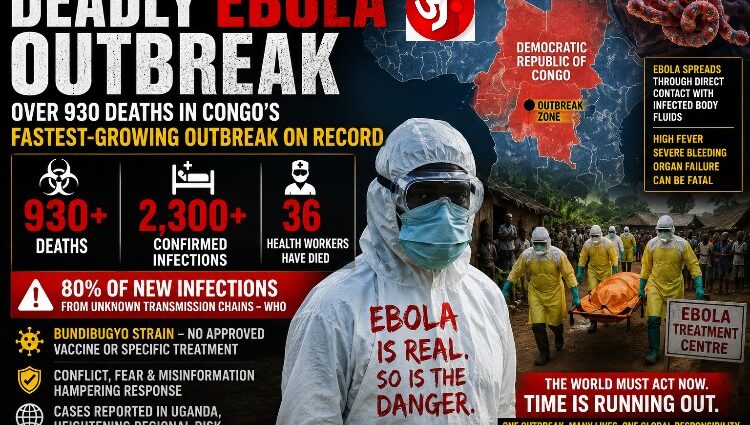
The Democratic Republic of the Congo is confronting one of the darkest public health emergencies in its history as a rapidly escalating Ebola outbreak has claimed more than 930 lives, making it the fastest-growing Ebola outbreak ever recorded in the country. Health authorities have confirmed more than 2,300 infections, while hospitals struggle to keep pace with an epidemic that is spreading faster than containment teams can respond.
Unlike previous outbreaks, this one is being driven by the Bundibugyo strain of the Ebola virus, for which there is currently no approved vaccine or specific treatment. Scientists are racing to test experimental vaccines, but for thousands already exposed, time is running out.
The crisis has been compounded by conflict, fear, and misinformation. Health workers have come under attack, treatment centers have been targeted, and medical teams are battling not only a deadly virus but also insecurity and distrust. At least 36 healthcare workers have died, while strikes over unpaid wages have further strained the response.
Perhaps the most alarming statistic is that the World Health Organization estimates around 80% of new infections originate from unidentified transmission chains, meaning the virus is spreading beyond the reach of traditional contact tracing. That dramatically increases the risk of silent community transmission and makes containment far more difficult.
The outbreak, first confirmed in May 2026, has already crossed borders with cases reported in Uganda, while imported cases have heightened international vigilance. Governments and global health agencies are intensifying surveillance at borders and accelerating research into vaccines and treatments in an effort to prevent a wider regional crisis.
Ebola remains one of the world’s deadliest infectious diseases, spreading through direct contact with infected bodily fluids and causing severe fever, hemorrhaging, and organ failure. Without rapid isolation, treatment, and community cooperation, outbreaks can grow explosively.
The tragedy unfolding in Congo is more than a national emergency. It is a stark reminder that infectious diseases recognize no borders. In an interconnected world, an outbreak in one region can rapidly become a challenge for all humanity. As the death toll continues to climb, the race is no longer just against Ebola, but against time itself.