










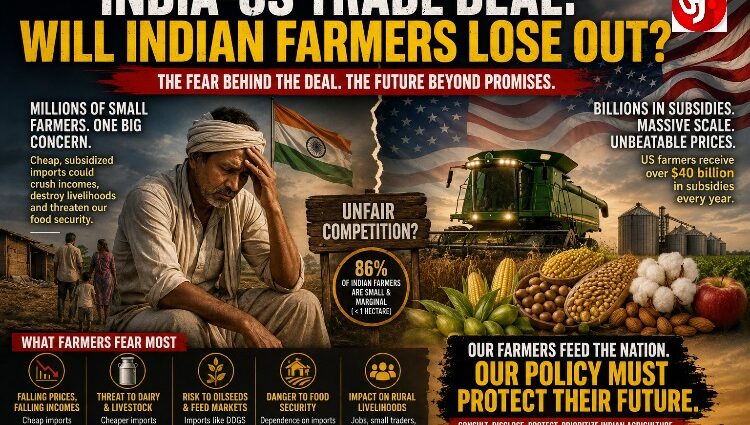
THE $40 BILLION CHALLENGE: Why Millions of Indian Farmers Fear They Could Be the Biggest Casualties of an India-US Trade Deal
As India edges closer to a landmark trade agreement with the United States, a storm is gathering far from the negotiating tables of diplomats and trade experts. Across villages, mandis, and dairy cooperatives, millions of Indian farmers are asking a simple but unsettling question:
Can the world’s largest democracy compete against the world’s most heavily subsidized agricultural superpower?
For India’s farmers, the debate is not merely about tariffs or exports. It is about survival.
A Battle Between Two Very Different Farming Worlds
At the heart of the controversy lies a stark imbalance.
American agriculture is dominated by large, mechanized farms supported by extensive government programs. In recent years, US farm support has reached tens of billions of dollars annually, allowing producers to sell commodities at prices that critics say do not fully reflect production costs.
India presents the opposite picture.
Nearly 86% of Indian farmers are small and marginal cultivators, many farming around one hectare or less. Their operations depend heavily on family labour, seasonal monsoons, and often operate on razor-thin profit margins. Farmer organizations argue that even modest increases in low-priced imports could sharply reduce their incomes.
The Fear of Cheap Imports
Farmer unions warn that lower tariffs could make it easier for subsidized US products such as soybeans, corn, cotton, almonds, apples, processed foods, and other agricultural commodities to enter the Indian market at competitive prices.
Their concern is straightforward.
If imported products become significantly cheaper than domestically grown produce, Indian farmers may struggle to find buyers at sustainable prices. Falling market prices could reduce incomes, increase indebtedness, and make farming economically unviable for many households already under financial pressure.
For millions of rural families, the consequences could extend well beyond a single harvest.
Dairy: The Sector Farmers Say Cannot Be Compromised
Perhaps no issue has generated greater concern than dairy.
India’s dairy economy supports millions of households, many of them women and landless families who depend on one or two cattle for regular income. Farmer groups fear that expanded access for US dairy products could place enormous pressure on domestic cooperatives and small producers.
They also point to possible changes in livestock feed markets if imports of products such as Distillers Dried Grains with Solubles (DDGS) increase, arguing that this could reduce demand for domestically produced oilseed meals and affect soybean and groundnut growers.
Beyond Crops: Rural Economies at Stake
Agriculture in India is not an isolated industry.
Every farm supports a network of transporters, labourers, traders, commission agents, food processors, equipment suppliers, dairy cooperatives, and small rural businesses.
Farmer organizations argue that prolonged pressure on farm incomes could ripple through entire rural economies, increasing unemployment and encouraging migration from villages to already crowded cities.
For critics of the agreement, the concern extends beyond economics to food security and national self-reliance. They argue that greater dependence on imports for sensitive agricultural sectors could weaken domestic production over time.
The Government’s Position
The Union Government has emphasized that negotiations are being conducted with India’s national interest in mind.
Officials have stated that sensitive sectors, including staple crops such as rice and wheat and core areas of dairy production, remain protected through existing safeguards and negotiating positions. The government argues that a comprehensive trade agreement could unlock wider economic benefits by expanding opportunities for Indian exports in services, pharmaceuticals, manufacturing, and technology.
Supporters of the negotiations also contend that carefully managed market access could lower input costs for some sectors and strengthen India’s position in global trade.
Why Farmers Remain Skeptical
Despite these assurances, farmer organizations continue to demand greater transparency.
They are calling for public consultation before any final agreement, disclosure of the proposed terms affecting agriculture, and legally enforceable safeguards for vulnerable sectors.
Many unions cite previous trade experiences, including concerns over edible oil imports, as reasons for caution. They argue that once import barriers are reduced, reversing market disruption becomes far more difficult.
The Stakes Could Not Be Higher
The debate over the India-US trade agreement is no longer just about diplomacy or commerce.
It has become a question about the future of Indian agriculture itself.
Supporters see the agreement as an opportunity to integrate India more deeply into the global economy and expand long-term growth.
Critics fear that without robust protections, India’s smallholder farmers could be forced to compete against an agricultural system backed by vastly greater financial resources, economies of scale, and government support.
As negotiations continue and protests gather momentum at places such as the Shambhu Border, one reality is becoming increasingly clear:
The final provisions of the agreement may shape not only India’s trade future, but also the livelihoods of millions of farming families whose fields remain the foundation of the country’s food security.
JANPATH NEWS NETWORK (JNN)
Independent. Fearless. On the People’s Path.
#ShambhuBorder #FarmersProtest #CongressINC #INCCongress #RahulGandhi #ArvindKejriwal #NarendraModi