









Standing before the media, Congress leader Rahul Gandhi delivered one of his strongest attacks yet on the Modi government.
New Delhi – July 21, 2026
As the Monsoon Session of Parliament commenced, the streets surrounding India’s seat of democracy became the stage for a confrontation that has ignited outrage across the nation.
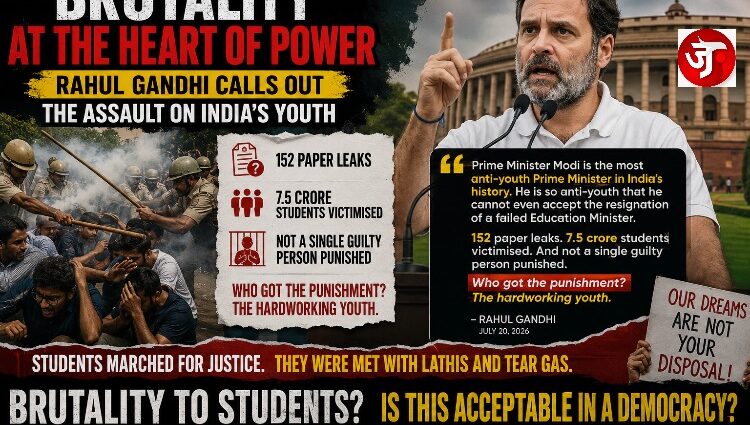
Hundreds of students and young protesters marched peacefully from Jantar Mantar toward Parliament, carrying a single demand: the resignation of Union Education Minister Dharmendra Pradhan over what protesters describe as 152 documented examination paper leaks that have affected an estimated 7.5 crore students.
For millions of young Indians, the issue goes far beyond examinations. It is about shattered aspirations, broken faith in public institutions, and the belief that merit has been sacrificed while those responsible remain untouched.
Instead of receiving answers, the protesters were met with tear gas, barricades, and police batons.
Standing before the media, Congress leader Rahul Gandhi delivered one of his strongest attacks yet on the Modi government.
Rahul Gandhi: “Dharmendra Pradhan? He is an intermediary. Absolutely, he should resign. But Dharmendra Pradhan hasn’t beaten up the students; the Home Minister has; he should resign, and the Home Minister reports to the Prime Minister. He should resign.” He also said the Prime Minister, Modi, is the most anti-youth Prime Minister in India’s history, with 152 paper leaks. 7.5 crore students were victimized. And not a single guilty person was punished. Who got the punishment? The hardworking youth. Tear-gassing students, lathi-charging students is not democratic. It’s not India’s way, and it is not the way they should be done.”
Rahul Gandhi emphasised that the government is “pouncing on” the youth instead of addressing their legitimate demands for exam reforms and accountability (especially the resignation of Education Minister Dharmendra Pradhan).
For millions of young Indians, the issue goes far beyond examinations. It is about shattered aspirations, broken faith in public institutions, and the belief that merit has been sacrificed while those responsible remain untouched. Instead of receiving answers, the protesters were met with tear gas, barricades, and police batons. The scenes that unfolded outside Parliament have raised uncomfortable questions for India’s democracy. The protesters were not armed. They were not demanding privilege. They were demanding fairness. They were students carrying placards, not weapons. Yet videos from the protest show young men and women being pushed back, struck with lathis, and dispersed with tear gas while attempting to march toward Parliament.
In every functioning democracy, peaceful protest is recognized as a constitutional right, not a criminal act. When students alleging systemic failures are met with force instead of dialogue, the focus inevitably shifts from the protest itself to the government’s response. At the heart of this controversy lies the examination paper leak crisis, which many students believe has undermined the credibility of India’s competitive examination system.
For countless families, years of preparation, financial sacrifice, and emotional investment have been overshadowed by repeated allegations of leaked question papers and compromised examinations. Rahul Gandhi argues that this is not merely an administrative failure but a national crisis of trust. His central accusation is that while students bear the consequences of a broken system, those responsible for overseeing it continue without accountability.
The events of July 20 have therefore become larger than a single protest. They have become a test of how the Indian state responds when its youngest citizens demand answers. Images circulating across social media show students coughing through tear gas, running from police charges, and shielding one another amid the chaos. For supporters of the protest, these images symbolize a government protecting itself rather than confronting the failures that sparked public anger.
For critics of the protesters, authorities maintain that maintaining public order around Parliament is essential. Yet the broader question refuses to disappear. Can the use of force against peaceful students ever be justified when their grievance concerns the integrity of the very education system meant to shape the nation’s future?
Rahul Gandhi’s remarks have amplified a sentiment already shared by many students and parents across the country: that India’s examination system requires accountability, transparency, and urgent reform.
Can the use of force against peaceful students ever be justified when their grievance concerns the integrity of the very education system meant to shape the nation’s future? Rahul Gandhi’s remarks have amplified a sentiment already shared by many students and parents across the country: that India’s examination system requires accountability, transparency, and urgent reform.
Whether one agrees with his politics or not, the images from outside Parliament have intensified a debate that extends far beyond party lines.
JANPATH NEWS NETWORK (JNN)
Independent. Fearless. On the People’s Path.
#LathiCharge, #JantarMantar #CJPProtest #CJPMarch #RahulGandhi #AAPHelplineForStudents #DharmendraPradhanResign #NEET #PaperLeak #JointVenture