










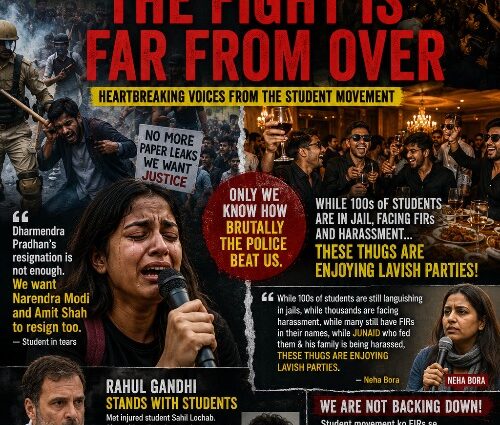
The resignation of Union Education Minister Dharmendra Pradhan marked a significant political moment. For many students who spent weeks on the streets demanding accountability over the examination crisis, it was proof that sustained public pressure can shake even the highest offices of power.
Yet for many others, the celebrations have come too soon.
Across social media and student circles, voices continue to insist that a minister’s resignation cannot erase the suffering of those who were allegedly beaten, detained, arrested, or left facing criminal cases. Students and activists have continued demanding the withdrawal of FIRs, the release of those still in custody, and an end to what they describe as police harassment following the protests.
Reports and videos circulating online have raised fresh questions about alleged arrests from hostels after assurances that no further action would be taken. These claims remain disputed, but they have deepened anxiety among students who fear that the movement’s human cost is being forgotten.
National President of the All India Students’ Association, Neha Bora and others have continued highlighting these concerns, urging the public not to lose sight of students who remain entangled in legal battles. Others, including journalists and commentators, have amplified accounts from families and protesters who say the struggle did not end with one political resignation.
Activist groups and student movements claim that 21 students died by suicide following the 2026 NEET controversy;and 12 to 14 suicides during the period of uncertainty leading up to the retest. Those families need strong compensation. In one case, Sana’s family, as well as the families of two other students who took their own lives, attributed their deaths to the voiding of the first exam and the uncertainty that followed.
“The fear killed her. The fear of re-NEET,” Sana’s father, Sheikh Jaffar Hussain, told Reuters at New Delhi’s Jantar Mantar protest site, where students have been demanding accountability over the government’s handling of the affair. The government has not commented on the deaths of the exam candidate
Leader of the Opposition Rahul Gandhi has refused to let the issue fade. After meeting injured student protester Sahil Lochab, Gandhi publicly questioned the use of pellet guns, tear gas, and lathi charges against demonstrators. He demanded to know who authorised the force used against students peacefully demanding a fair examination system, placing direct questions before the Union Home Ministry and calling for accountability rather than silence. He also showed a picture of a student, pelted with rubber bullets.
The controversy grew after sources told The Indian Express that an internal CRPF review found a Rapid Action Force (RAF) personnel fired seven rounds from a pellet gun in the Connaught Place area. According to the report, five rounds struck protesters while two hit the ground.
Delhi Police repeatedly denied that their personnel used pellet guns, stating they do not possess them, calling the reports “completely false and misleading,” and urging the public not to circulate unverified claims.
The RAF/CRPF, which was deployed alongside Delhi Police near Jantar Mantar, Connaught Place/Palika Bazar and other points, has not issued a clear public admission. Pellet guns form part of the RAF’s standard riot-control inventory. Under existing SOPs they are meant to be used only in extreme situations posing a serious threat to life, preferably with a deflector and aimed below the waist to limit injury.
Multiple independent reports, however, documented injuries consistent with metal pellets:Hospital medico-legal certificates and doctors’ notes at Safdarjung Hospital, Lady Hardinge Medical College, and AIIMS Trauma Centre described “pellet wounds,” metal fragments or shards stuck in or under the skin, multiple puncture marks, and the surgical removal of metallic pellets.
Meanwhile, student organisations including AISA have pledged continued legal assistance to protesters facing FIRs and criminal proceedings, arguing that justice requires more than symbolic victories.
The contrast has become increasingly striking.
While some sections of the protest movement, particularly the satirical Cockroach movement, have been criticised by commentators and fellow activists for celebrating the minister’s resignation with parties and victory gatherings, others argue that the movement cannot claim success while students remain behind bars, families continue fighting legal cases, and allegations of police excesses remain unresolved. These criticisms reflect the opinions of those activists and commentators and are part of an ongoing public debate.
The demand heard from many students today is therefore not simply for one resignation, but for accountability throughout the chain of command, transparent investigations into the use of force, protection of civil liberties, and the restoration of trust between young citizens and the institutions meant to serve them.
If even one student remains imprisoned for exercising the democratic right to protest, if families continue living under the shadow of unresolved criminal cases, and if unanswered questions about the policing of demonstrations remain, then many believe the story is not over. The hardest work usually starts after the headlines disappear.
JANPATH NEWS NETWORK (JNN)
Independent. Fearless. On the People’s Path.