







The planet rarely pauses. Even as one conflict cools, another crisis erupts. From the battlefields of Eastern Europe to the forests of southern Europe, from Africa’s humanitarian emergencies to Asia’s geopolitical tensions, July 2026 reminds us that the world remains deeply interconnected. Decisions made in one capital ripple across oceans, affecting millions far beyond national borders. Humanity, it seems, insists on conducting simultaneous fire drills on every continent.
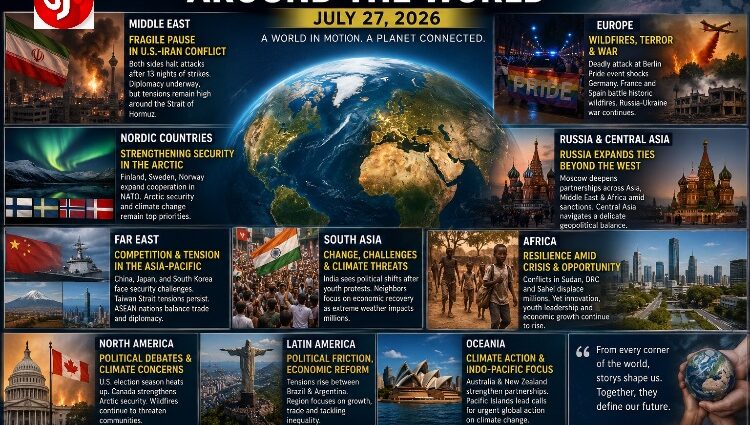
Middle East: A Fragile Pause in the Iran-U.S. Conflict After thirteen consecutive nights of American airstrikes on Iranian military targets, the Middle East has entered an uneasy silence. Both Washington and Tehran have refrained from direct attacks for a second consecutive day, allowing diplomats from Qatar, Oman, and other regional powers to intensify mediation efforts. Yet beneath the calm lies uncertainty. The Strait of Hormuz remains under immense pressure, disrupting one of the world’s most important energy corridors. Oil markets continue to fluctuate as shipping companies weigh security risks against global demand. The ceasefire remains one missile away from collapse.
Europe: Fire, Terror and War Europe faces multiple emergencies simultaneously. Germany remains shaken after the deadly terrorist attack at Berlin’s Christopher Street Day Pride celebrations, where a vehicle and knife assault claimed lives and injured dozens. Security agencies across Europe have heightened alert levels as investigations continue. Meanwhile, France and Spain continue battling one of the worst wildfire seasons in recent history. Hundreds of thousands have been evacuated as record-breaking temperatures, drought, and fierce winds fuel infernos that have consumed forests, villages, and farmland. Further east, the Russia-Ukraine war continues without respite. Missile strikes and drone attacks persist across both countries, reminding the world that Europe’s largest armed conflict since World War II remains far from resolution.
Nordic Countries: Watching the Arctic Closely The Nordic nations remain among the strongest voices on climate security and regional defence. Finland and Sweden continue strengthening cooperation within NATO following their recent membership, while Norway closely monitors growing military activity across the Arctic and Barents Sea. Melting polar ice is opening new shipping lanes and strategic competition, making the High North an increasingly important geopolitical frontier. Denmark, through Greenland, also finds itself at the centre of Arctic security discussions as major powers expand their interests in the region.
Russia and Central Asia Russia continues balancing its military operations in Ukraine with growing diplomatic engagement across Asia, the Middle East, and Africa. Western sanctions remain in place, but Moscow continues expanding trade partnerships outside Europe, particularly through BRICS and Eurasian economic networks. Across Central Asia, governments remain cautious, seeking economic opportunities while avoiding becoming entangled in broader geopolitical rivalries between Russia, China, and the West.
Meanwhile, Ukraine remains in a grinding war of attrition with Russia, now in its fifth year. Neither side has achieved a decisive breakthrough, but fighting remains intense along several fronts, with daily missile, drone, and artillery attacks.
The Far East: Economic Competition and Strategic Tension East Asia remains one of the world’s most consequential regions. China continues navigating economic headwinds while maintaining an assertive diplomatic and military posture in the South China Sea and around Taiwan. Military patrols and naval exercises remain frequent, ensuring the region stays under close international scrutiny. Japan continues strengthening its defense capabilities amid regional security concerns while investing heavily in advanced technology, semiconductor manufacturing, and renewable energy. South Korea remains focused on both technological leadership and security challenges posed by North Korea, whose missile development continues to concern neighbouring countries. Across Southeast Asia, ASEAN nations continue walking a delicate diplomatic line, expanding trade while carefully balancing relations with both China and the United States.
South Asia South Asia remains one of the world’s fastest-changing regions. India continues experiencing significant political developments following nationwide youth-led protests over education reforms, while also expanding its role in global diplomacy, manufacturing, digital innovation, and space technology. Bangladesh, Nepal, Sri Lanka, Bhutan, and the Maldives continue addressing economic recovery, climate resilience, and infrastructure development, even as extreme weather increasingly threatens livelihoods across the region.
Africa: Growth Amid Humanitarian Challenges Africa continues to demonstrate remarkable resilience despite significant challenges. Sudan remains trapped in one of the world’s worst humanitarian crises, with millions displaced by ongoing conflict. International aid agencies warn that food insecurity continues to worsen across parts of the county. In the Democratic Republic of Congo, violence involving armed groups continues to destabilise eastern provinces, forcing further displacement of civilians. Across the Sahel, countries including Mali, Burkina Faso, and Niger continue confronting insurgencies, political instability, and humanitarian emergencies. Yet another Africa is also emerging. Nations such as Kenya, Rwanda, Ghana, Botswana, and Morocco continue attracting investment in technology, renewable energy, infrastructure, and digital finance. The African Continental Free Trade Area is steadily strengthening economic integration, while young entrepreneurs are driving innovation across the continent.
North America The United States remains deeply engaged internationally while navigating domestic political debates ahead of upcoming elections. Canada continues focusing on Arctic security, clean energy, and support for international humanitarian efforts. Wildfire risks across parts of North America remain a continuing concern as climate extremes reshape emergency planning.
Latin America Latin America continues balancing political change with economic reform. Brazil remains a leading voice on climate policy and Amazon conservation, while diplomatic disagreements with neighbouring Argentina have recently added fresh political tension. Mexico continues strengthening its role as a manufacturing hub linked closely to North American supply chains, while several Central American nations continue confronting migration and security challenges.
Oceania
Australia and New Zealand continue expanding defense cooperation with Indo-Pacific partners while investing heavily in renewable energy and climate adaptation. Pacific Island nations remain among the world’s strongest advocates for urgent climate action, warning that rising sea levels pose an existential threat to their future.
A World in Motion From Arctic ice to African deserts, from the Pacific Ocean to the Atlantic coast, the defining themes of July 2026 are unmistakable: conflict, climate, technology, migration, and diplomacy. Some nations fight wars. Others fight wildfires. Some struggle against economic uncertainty, while others race toward scientific breakthroughs. Together they form a picture of a world under extraordinary pressure, yet one that continues to adapt, rebuild, and search for stability. History rarely unfolds in one place alone. It happens everywhere, all at once. That inconvenient habit of reality keeps journalists employed and everyone else permanently refreshing the news feed.