










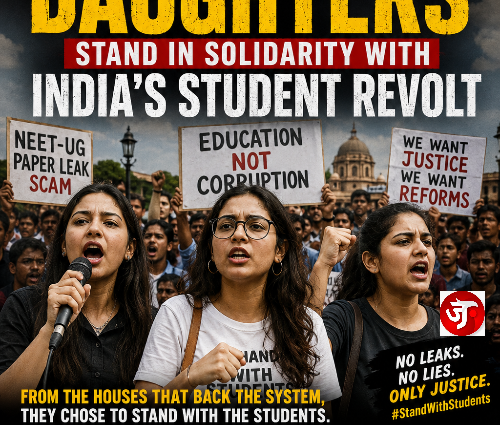
DAUGHTERS OF THE NDA BREAK RANKS: ELITE GEN-Z VOICES STAND WITH INDIA’S STUDENT REVOLT
NEW DELHI: July 30, 2026: In one of the most politically symbolic developments of the nationwide NEET-UG 2026 movement, three young women from families closely associated with the BJP and its NDA allies publicly sided with student protesters, transforming what began as an examination scandal into a deeply personal challenge to the ruling establishment.
The nationwide agitation, spearheaded by students under the Cockroach Janta Party (CJP), erupted after allegations surrounding the NEET-UG 2026 paper leak. Protesters demanded accountability, sweeping education reforms, and the resignation of Union Education Minister Dharmendra Pradhan, while also condemning police action that included lathi charges and tear gas against demonstrators. Following weeks of mounting pressure, Pradhan resigned on July 25, describing his decision as necessary to protect students and prevent political exploitation.
Among the most striking supporters of the movement was Dibisa Mahanta, daughter of Assam Cabinet Minister Keshab Mahanta. She joined demonstrations in Guwahati, praised protesting students, and sharply criticised the handling of peaceful demonstrations. Her participation sparked intense political debate before her social media accounts reportedly disappeared from public view.
In Odisha, Archita Sachin Rahar, daughter of BJP MP Aparajita Sarangi, reportedly celebrated Pradhan’s resignation through social media posts declaring, “My family is with DP, but I am with the students. This is democracy.” Her reported refusal to remove the posts fuelled nationwide discussion over independent political voices within influential families.
Meanwhile, Yashaswini Raj Singh, daughter of former BJP MLA Vikram Singh and an LSE graduate, openly backed the student movement, attended protests at Jantar Mantar, criticised the government’s response to the examination crisis, and argued that the minister’s resignation lacked genuine accountability.
Their interventions have ignited fierce debate across India. Supporters describe them as courageous young voices placing conscience above political inheritance. Critics accuse them of undermining their own ideological families.
Whatever history ultimately concludes, one reality is increasingly difficult to ignore: the NEET movement has not merely challenged a government. It has crossed political bloodlines, exposing a new generation unwilling to let family affiliations define its convictions. In India’s evolving political landscape, perhaps the loudest rebellion is no longer coming from the opposition, but from within the establishment’s own homes.
JANPATH NEWS NETWORK (JNN)
Independent. Fearless. On the People’s Path.