










Sanjay Singh Tears Into Government Over Court Backlog and Crumbling Schools
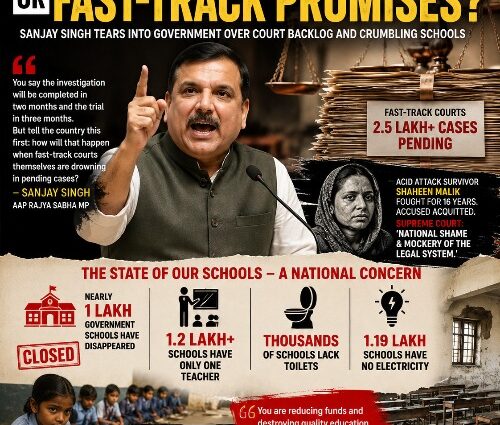
New Delhi, July 31: “You say the investigation will be completed in two months and the trial in three months. But tell the country this first: how will that happen when fast-track courts themselves are drowning in pending cases?”
With those words, Aam Aadmi Party Rajya Sabha MP Sanjay Singh launched one of Parliament’s fiercest attacks during the debate on the Public Examinations (Prevention of Unfair Means) Amendment Bill, 2026, questioning whether the government’s promise of speedy justice was anything more than a slogan.
“You are talking about three-month justice while nearly 2.5 lakh cases are already pending in fast-track courts,” Singh declared. “What magic will suddenly make these cases disappear?”
To drive home his point, Singh cited the harrowing story of acid attack survivor and activist Shaheen Malik, whose case stretched across 16 years before the main accused was acquitted. The Supreme Court itself described the prolonged proceedings as “a national shame” and “a mockery of the legal system.”
“If this is the condition of fast-track justice today, how can you promise every investigation in two months and every trial in three?” Singh asked, accusing the government of offering timelines without first strengthening the judicial system.
But Singh reserved some of his strongest criticism for the state of public education.
“Nearly one lakh government schools have disappeared under the BJP. More than one lakh schools have only a single teacher. Around 1.19 lakh schools still do not have electricity. Thousands lack proper toilets. Is this your idea of education?” he thundered.
He further alleged that the government was unwilling to adequately invest in schoolchildren. “There are schools where children are served only salt and roti under the midday meal. Even food has become too expensive for this government.”
Quoting official education statistics, Singh argued that declining investment in government schools would ultimately weaken India’s future. “If you destroy quality public education, you destroy opportunity itself,” he said.
In his sharpest political attack, Singh accused Prime Minister Narendra Modi’s government of intentionally weakening public education. “You are reducing funds and destroying quality education because you want people to remain uneducated and become andhbhakts who never question the government,” he alleged.
That accusation remains a political allegation, not an established fact. However, many of the statistics Singh cited are broadly consistent with official datasets. Government data indicate that the number of government schools has declined by nearly one lakh over the past decade, largely due to mergers and consolidation by state governments. Official education surveys also continue to report over one lakh single-teacher schools and significant gaps in functional electricity and sanitation, despite improvements in overall infrastructure.
Similarly, while Fast Track Special Courts have disposed of hundreds of thousands of cases since 2019, official figures still show around 2.5 lakh cases pending, raising legitimate questions about whether newly proposed statutory timelines can be achieved without substantially expanding judicial capacity.
For Singh, the issue was larger than examination reforms. “You cannot promise speedy justice while justice itself waits for years. You cannot promise a brighter future while government schools are left to decay.”
His speech transformed what began as a debate on an examination bill into a broader indictment of India’s judicial backlog and the condition of its public education system, arguing that legislation alone cannot substitute for sustained investment in courts, teachers and schools.