








By Sanchita Bhattacharya, Research Fellow, Institute for Conflict Management

New Delhi, July 31, 2026: Afghanistan’s mineral-rich northeastern province of Badakhshan is rapidly descending into one of the gravest security crises since the Taliban seized power in 2021. What was once considered a distant mountain stronghold has become the epicentre of a deadly convergence of armed resistance, internal Taliban mutiny, ethnic tensions, and an escalating battle for control of vast mineral wealth.
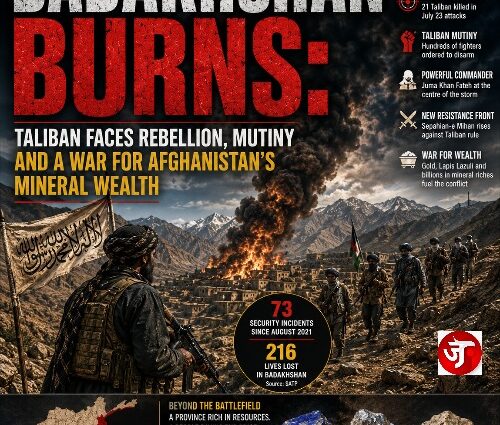
One of the Taliban’s most serious military setbacks this year came on July 23, when the Afghanistan Freedom Front (AFF) claimed it killed 21 Taliban fighters and wounded another 37 during coordinated attacks on Taliban positions in Zebak District. The resistance group also said it captured large quantities of weapons, ammunition and military equipment after overrunning Taliban bases, though one AFF fighter was killed during the operation.
The violence has exposed deep fractures within the Taliban itself. Over recent weeks, Taliban commanders have moved to disarm hundreds of their own fighters in Nusay, Shekay and Shahr-e Buzurg, threatening military action against anyone refusing to surrender weapons. The unprecedented crackdown reflects growing fears that disgruntled local commanders could ignite an internal rebellion.
At the centre of the turmoil is influential Tajik commander Juma Khan Fateh, whose loyalists have been linked to control of lucrative gold mines, land seizures and extortion. Despite repeated negotiations involving Defence Minister Mullah Yaqoob Mujahid and Army Chief Fasihuddin Fitrat, tensions remain dangerously unresolved.
The crisis has been further complicated by the emergence of Sepahian-e Mihan (Patriotic Soldiers Front), a newly formed anti-Taliban organisation claiming attacks on government positions while pledging to continue its campaign for Afghanistan’s freedom.
Yet beneath the gunfire lies an equally fierce struggle for Badakhshan’s extraordinary mineral riches. Home to significant deposits of gold, lapis lazuli, silver and limestone, the province has become the focus of intense competition between Taliban authorities, local commanders, miners and resistance groups. Mine closures, violent clashes and protests by workers have added another explosive dimension to the conflict, forcing the Taliban to deploy additional security forces to protect strategic mining projects.
According to the South Asia Terrorism Portal (SATP), 73 security incidents have claimed 216 lives in Badakhshan since August 2021, including attacks by the Afghanistan Freedom Front, the National Resistance Front (NRF) and the Islamic State-Khorasan Province (IS-KP), alongside bloody internal Taliban confrontations.
For the Taliban leadership, Badakhshan has become a defining test of its authority. In a predominantly non-Pashtun province, where ethnic grievances, armed resistance and the scramble for immense natural resources continue to deepen instability, the battle is no longer simply about security. It is a struggle for political control, economic survival and legitimacy. As violence spreads and competing factions tighten their grip, Badakhshan increasingly stands as the clearest symbol of the widening cracks within Taliban rule.