










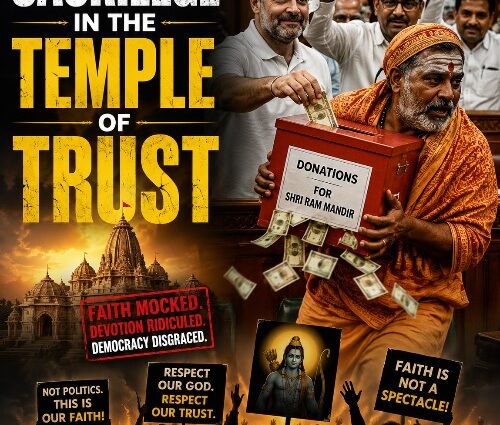
Congress’s Ram Temple Play Rekindles Debate Over Faith, Corruption and Public Trust
New Delhi, July 31: A dramatic protest staged on the Parliament premises on Friday reignited the political and religious controversy surrounding the alleged embezzlement of donations at the Ram Mandir in Ayodhya, sparking intense reactions across the country.
During the demonstration, Independent MP Pappu Yadav appeared dressed as a Hindu priest while seated beside a donation box. Leader of the Opposition Rahul Gandhi enacted the role of a devotee, placing money in the box before touching the “priest’s” feet. Moments later, Pappu Yadav picked up the donation box and ran away, symbolically portraying what Opposition leaders describe as the alleged theft of devotees’ offerings at the Ram Temple.
The protest comes as investigations into alleged irregularities in temple donations continue. A Special Investigation Team (SIT) has reported lapses in the counting of offerings, leading to the arrest of eight staff members and the recovery of nearly ₹80 lakh. Opposition parties have described the alleged wrongdoing as a betrayal of millions of devotees and have demanded a Supreme Court-monitored investigation along with sweeping reforms in the temple’s financial administration.
Beyond the political spectacle, the controversy has ignited a deeper national conversation about trust.
For many observers, the allegations raise three troubling questions. First, if those entrusted with safeguarding donations made in the name of Lord Ram could allegedly misuse them, what does that say about accountability within even the nation’s holiest institutions? Critics argue that corruption in a sacred space represents not merely financial misconduct but a profound moral failure.
Second, devotees who contributed with faith and devotion now find that trust shaken. Donations made as acts of worship carry immense emotional and spiritual significance. Allegations that such offerings may have been misused have left many believers feeling deeply betrayed and have raised broader concerns about transparency in religious institutions.
Third, commentators warn that such controversies may further erode the confidence of younger generations in institutions. Many fear that when sacred spaces, public bodies and national institutions appear vulnerable to allegations of misconduct, Gen Z and Gen Alpha may become increasingly sceptical of authority, tradition and leadership itself. While no single event can explain wider social movements or generational attitudes, critics argue that repeated controversies risk weakening public confidence across society.
Adding to the controversy, actor Anupam Kher reportedly described the alleged embezzlement as an instance of ordinary greed rather than a stain on the temple itself. His remarks have drawn criticism from those who believe the alleged misuse of offerings dedicated to Lord Ram cannot be dismissed as an isolated financial offence.
Supporters of the parliamentary protest maintain that exposing alleged corruption, even within religious institutions, is a democratic duty. Critics, however, contend that employing sacred symbolism in political theatre crossed a line, turning matters of faith into partisan spectacle.
As the debate continues to reverberate across India, the scenes from Parliament have become emblematic of a larger national question: how can a society preserve integrity, transparency and accountability while also protecting the sanctity of its places of worship and the trust reposed by millions of devotees? For many, the issue extends beyond a temple. It is about safeguarding faith, preserving public confidence, and ensuring that every institution, from the temple to the Constitution itself, remains worthy of the trust placed in it.