









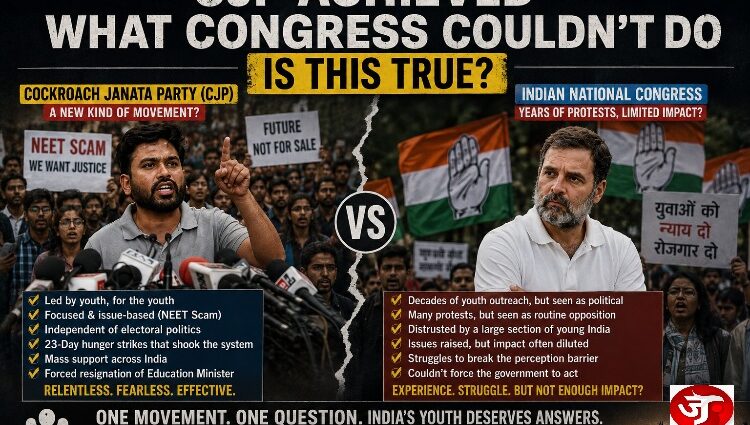
Perhaps the most important lesson from the Jantar Mantar movement on July 20, 2026, is that the success of a protest is rarely determined by numbers alone, but determined by its ability to capture a particular moment in time. In that sense, CJP appears to have found itself at exactly such a historical intersection.
India was already witnessing widespread youth discontent. Across different states, students were protesting recruitment delays, examination irregularities, paper leaks, unemployment and the rising cost of education. Competitive examination aspirants were staging hunger strikes, university students were organising demonstrations, and frustration had been steadily building long before the Jantar Mantar movement reached national prominence.
CJP did not create all of these grievances. It became the movement that managed, at that particular moment, to gather many of them under one emotional roof. Its success lay not merely in raising issues, but in giving dispersed frustrations a common language and a common stage.
Yet history also demands honesty. No movement of this scale is ever the work of one organisation or one individual.
The remarkable mobilisation witnessed during the July 20 phase of the agitation was the product of multiple streams converging into one powerful current.
Student leaders such as Neha Bora brought with them extraordinary credibility earned through weeks of personal sacrifice and relentless campus mobilisation. The presence of students transformed the movement from a protest about policy into a visible expression of a generation’s anxieties and aspirations.
Congress’s NSUI, one of India’s largest and most active student organisations, also played a significant role. Backed by years of organisational experience, its volunteers helped sustain mobilisation and gave the movement reach that few independent groups could have achieved on their own. The participation of Congress workers and youth leaders demonstrated that established political organisations were prepared to stand alongside the students on an issue that had already resonated deeply across the country.
The arrival of Rahul Gandhi further altered the political landscape. Whether one agrees with his politics or not, his presence ensured that the concerns being raised at Jantar Mantar could no longer be dismissed as a fringe student agitation. National media attention intensified, and the movement acquired a political weight that compelled broader public attention.
Other opposition leaders, civil society activists, academics, lawyers and public intellectuals also lent legitimacy to the growing campaign. Their participation reflected a widening coalition rather than a single organisational effort.
This broader context should never be forgotten.
To attribute the movement solely to CJP would oversimplify history.
To attribute it solely to Congress or any one political party would do the same.
The movement became powerful precisely because it transcended organisational boundaries. Independent youth activists, student organisations, opposition parties, civil society groups and ordinary citizens all contributed, each bringing different strengths. Some brought moral authority through sacrifice. Others brought organisational discipline. Others brought visibility, legal support, media attention or political influence.
It was this convergence that created momentum.
It is the rare alignment of timing, leadership, public mood, organisation and sacrifice.
Whether CJP can sustain that resonance beyond this defining moment remains to be seen.
Reflecting on the campaign that brought national attention to CJP, Dipke described Dharmendra Pradhan’s resignation as a defining victory for India’s youth. According to him, the resignation broke a long-standing culture of political fear by demonstrating that sustained, peaceful public mobilisation can compel accountability. The success, he suggested, may encourage citizens to challenge authority more readily whenever democratic institutions fail to respond.
At a core committee meeting in Chhatrapati Sambhajinagar, Dipke outlined what he described as the next phase of CJP’s evolution. CJP intends to remain a national pressure movement, seeking influence without seeking office.
Beginning in September 2026, the movement will launch its most ambitious initiative yet: “Kya Bolti Public?” Rather than addressing rallies from elevated stages, CJP volunteers will travel across the country to listen. The campaign will take its workers into towns, villages, campuses, factories, and neighbourhoods to document what ordinary Indians actually want from governance.
The symbolism is powerful.
For decades, Indian politics has largely functioned by telling citizens what they need. CJP proposes reversing the equation by first asking the public what they need. In a nation where more than 65 percent of the population is under the age of 35, Dipke argues that young Indians remain dramatically underrepresented in both Parliament and policymaking, despite carrying the weight of unemployment, rising educational costs, shrinking opportunities, and economic uncertainty.
Organisationally, the movement is also preparing for expansion. He encourages youth to jon the movement. Membership across India will remain completely free, with registration through online platforms and QR codes. A new leadership structure has been announced, with Abhijeet Dipke serving as Convener alongside co-conveners including Saurav Das and Ashutosh Ranka, among others. The organisation says its framework draws inspiration from the constitutional ideals associated with B. R. Ambedkar, Mahatma Gandhi, and Jawaharlal Nehru, emphasising constitutional methods over electoral ambition.
A movement that refuses to broaden can become irrelevant once its original issue is resolved, and finding the balance will determine CJP’s future.
While Dipke provides organisational direction, another figure illustrates why the movement resonated emotionally: Neha Bora, National President of AISA and a doctoral researcher at JNU, became one of the most recognisable faces of the Jantar Mantar protests.
Her nearly 23-day hunger strike. along with Sonam Wangchuk’s 26-day hunger strike, represented something politics often struggles to manufacture, personal sacrifice. It must be noted that Neha Bora is not a CJP leader, she belongs to a different political tradition, but recent months have seen Bora continue supporting student movements beyond the NEET issue, including protests over recruitment examination irregularities in Jharkhand, where demonstrations were marked by confrontation and even an ink-throwing incident during a march towards the state Assembly.
Neither alone would have generated the same public attention.
So Where Does Congress Fit Into This Story?
No serious analysis can ignore Congress. For years, Congress leaders, the Indian Youth Congress, NSUI and allied organisations have organised protests on unemployment, inflation, paper leaks, farmers’ distress and democratic institutions. The Indian Youth Congress, NSUI and countless local workers have marched, courted arrest, faced police action and kept issues alive long after television cameras had moved on.
Their contribution cannot simply be erased because another movement captured recent headlines. Indeed, many of the issues CJP now raises have been discussed by Congress for years.
Yet there remains an uncomfortable question. Why did those campaigns often fail to produce the same level of public momentum? Congress operates under a constraint unique to every political party. Being an electoral organisation, it must constantly guard against accusations that it is exploiting students for political gain. That sensitivity often produces a cautious approach. In many Congress-led demonstrations, the overwhelming presence is that of party workers, Youth Congress volunteers and NSUI activists. While students certainly participate, the party has generally been careful not to appear as though it is recruiting or drawing unaffiliated students into partisan street politics. Such restraint is understandable in a political climate where any student mobilisation can quickly be dismissed by opponents as “party-sponsored.”
An independent civic movement begins with fewer such assumptions attached to it, and it benefits from appearing to represent citizens before representing political ideology. That perception may explain part of CJP’s appeal. It does not automatically prove that CJP is more sincere than Congress, nor does it prove Congress is less sincere.
Yet, not everyone is convinced about the sincerity of CJP
A protest’s visibly identified with a political party is often interpreted through the prism of electoral competition, regardless of how genuine its concerns may be. Citizens who agree with the issue sometimes hesitate to participate because they do not wish to be seen as joining a political campaign. The cause becomes inseparable from the party carrying it.
CJP entered the same national conversation from an entirely different position.
CJP already created curiosity. For a social media handle to gather over 23 million followers in a few days is historic. Naturally, crowds would come to their rallies. It did not arrive carrying decades of electoral history, ideological rivalries or the baggage that inevitably accompanies established political parties. It presented itself as a youth-led civic movement rather than an electoral challenger. That distinction, whether temporary or enduring, mattered enormously in shaping public perception.
When CJP called upon students to mobilise, the response unfolded differently. Student leaders such as Neha Bora, who had already earned credibility through prolonged sacrifice, including a hunger strike lasting nearly twenty-three days, gave the movement moral force among campuses. Students did not merely attend rallies; many began to see themselves as participants in a broader national conversation about accountability, education and opportunity.
Once students entered in large numbers, another transformation occurred: Parents joined, teachers joined, professionals joined, and citizens who may never have attended a political rally came to observe, support or simply understand what was happening. Some undoubtedly participated out of conviction, others out of curiosity, and many because they sensed that something unusual was unfolding. Public movements often grow this way. Curiosity becomes conversation. Conversation becomes participation.
Across India during the same period, there were numerous independent student agitations and youth protests: These were not from CJP
In Jharkhand, competitive examination aspirants were on prolonged hunger strikes over recruitment irregularities. Elsewhere, Bihar, Bengal, Assam, Karnataka, Maharashtra, Gujarat, Telangana, and Arunachal Pradesh, students were protesting examination leaks, employment delays, education costs and recruitment processes. These movements arose from local grievances and were not necessarily organised or directed by CJP.
Whether CJP’s role proves historically significant will depend not simply on how effectively it captured that moment, but on whether it can continue representing those voices after the immediate passion of protest has faded.
History shows that this distinction can be immensely powerful, and it also shows that it is extraordinarily difficult to preserve.
History is still being written and the most revealing aspect of this moment is that it is forcing every political actor to confront the same challenge.
The BJP must convince young Indians that institutions respond before frustration becomes crisis.
Congress must persuade citizens that its protests are driven not only by opposition but by long-term public purpose.
CJP must demonstrate that refusing electoral politics is a principled commitment rather than a temporary strategy.
Student leaders such as Neha Bora must show that movements can remain inclusive while retaining their moral clarity.
These are not competing tests, they are parallel ones: A Democracy Listening to Itself
This should be the beginning of a larger national conversation about who speaks for India’s youth, who truly listens to them, and whether trust, once broken, can be rebuilt before another generation concludes that no institution is listening at all.
The real question, therefore, is not whether CJP has replaced Congress. It has not. Nor is the question whether Congress has become irrelevant. It certainly has not. Congress remains India’s single largest opposition party, with a nationwide organisation, parliamentary voice and decades of experience in confronting governments. What CJP appears to have brought is a new language of youth mobilisation and public participation. India’s democratic future may depend less on choosing between the two than on whether established political opposition and emerging civic movements can complement one another instead of competing for ownership of the same public anger. A democracy is strongest when Parliament amplifies what the streets are saying, and when the streets know their voice can still reach Parliament.
JANPATH NEWS NETWORK (JNN)
Independent. Fearless. On the People’s Path.