



Some days announce themselves with a single headline, while others refuse to fit inside one.
Today was one of those days where the sound of rain competed with the sound of political arguments, where students demanded justice while lawmakers demanded debates, and where the world lurched from one crisis to another before anyone had finished absorbing the last.
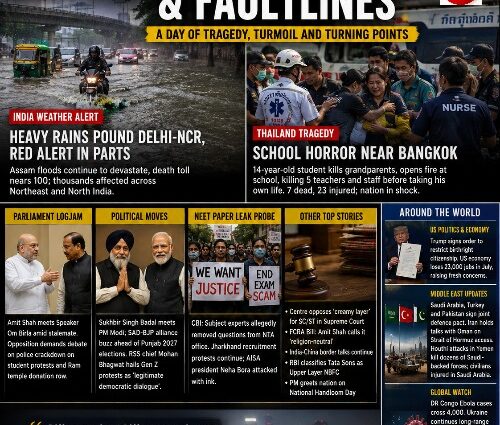
India woke to dark skies. The monsoon tightened its grip across large parts of the country, turning roads into rivers and neighbourhoods into islands. Delhi-NCR spent another day battling relentless rain, submerged under waterlogged streets that brought traffic to a crawl and prompted fresh weather warnings across the capital region. Yet, while Delhi struggled with inconvenience, Assam continued to fight for survival.
Floodwaters have now claimed nearly a hundred lives in Assam alone. Families have watched homes disappear beneath muddy currents, livestock have been swept away, schools have become relief shelters, and entire villages remain cut off from the outside world. Across the Northeast and northern India, swollen rivers, landslides, and relentless rain have become reminders that climate disasters are no longer rare events. They are becoming part of everyday life.
And while the skies poured endlessly, Parliament remained unable to move.
The Monsoon Session continued under the shadow of another stalemate as Union Home Minister Amit Shah met Lok Sabha Speaker Om Birla in an effort to break the deadlock between the government and the Opposition. The Opposition insists that the House debate the police action against student protesters and allegations surrounding Ram Temple donation irregularities. The government has sought to push ahead with legislative business, but day after day, Parliament has become less a chamber of legislation and more a battlefield of competing accusations.
Outside Parliament, another generation continued asking questions that refuse to disappear.
Fresh findings by the CBI into the NEET paper leak have painted an even more troubling picture. Investigators allege that subject experts were able to remove examination questions directly from the National Testing Agency’s office, reinforcing fears that India’s most competitive examinations may have been compromised from within the very institutions entrusted to protect them.
The frustration has spread far beyond NEET.
In Jharkhand, students protesting alleged recruitment examination irregularities refused to leave the streets. Their movement has now become a symbol of growing anger among young Indians who believe that years of preparation can be destroyed by corruption long before merit gets a chance to compete. The atmosphere grew even more tense after an ink attack targeted AISA leader Neha Bora, reflecting how quickly public anger is spilling into confrontation.
Yet politics, as always, found time to write its own separate script.
Punjab’s political circles buzzed after Shiromani Akali Dal president Sukhbir Singh Badal met Prime Minister Narendra Modi, reviving speculation that old allies could once again become partners ahead of the 2027 Punjab Assembly elections. Whether the meeting signals genuine reconciliation or simple political courtesy remains unclear, but in Indian politics, even a handshake is rarely just a handshake.
Adding another unexpected voice to the national conversation, RSS chief Mohan Bhagwat remarked that Gen Z protests represent a legitimate form of democratic dialogue. Coming from one of the country’s most influential ideological figures, the comments immediately sparked debate about whether India’s political establishment is beginning to recognise that today’s youth intend to participate rather than simply observe.
Elsewhere, the machinery of government continued turning.
The Centre defended its stand before the Supreme Court against introducing the “creamy layer” principle for Scheduled Castes and Scheduled Tribes. Parliament discussed amendments to the Foreign Contribution Regulation Act, with Amit Shah describing the proposed changes as entirely religion-neutral. India and China continued diplomatic engagement over border issues, the Reserve Bank of India classified Tata Sons as an Upper Layer NBFC, and National Handloom Day became an occasion for Prime Minister Narendra Modi to celebrate India’s traditional artisans while urging citizens to support indigenous craftsmanship.
The world’s headlines, however, carried an even heavier weight.
Thailand is reeling after one of its deadliest school shootings in years. Police say a 14-year-old Grade 9 student first shot and killed his grandparents at home before taking his grandfather’s legally owned 9mm handgun to Debsirin Nonthaburi School near Bangkok, where he opened fire, killing five teachers and staff before taking his own life. The attack left seven people dead in total and 23 others injured, with several remaining in critical condition. Terrified students barricaded themselves inside classrooms as gunfire echoed through the campus, while frantic parents gathered outside searching for their children. Investigators say the teenager fired at least 26 rounds, with more ammunition recovered, and are examining reports that he had been struggling with academic pressure and mental health issues. Prime Minister Anutin Charnvirakul called it “a tragedy for the entire nation,” pledging stronger gun control measures and expanded mental health support in schools. The massacre has reignited debate over Thailand’s high rate of civilian gun ownership and renewed calls for tighter firearm regulations and better protection for students.
Across the Pacific, President Donald Trump signed executive orders aimed at restricting birthright citizenship, reopening one of America’s longest-running constitutional battles. At the same time, an unexpected loss of roughly 23,000 jobs in July raised fresh concerns that the world’s largest economy may be entering a more uncertain period than many had anticipated.
Meanwhile, the geopolitical map continued shifting beneath everyone’s feet.
Saudi Arabia, Turkey, and Pakistan unveiled a new defence agreement declaring that an attack on one would be treated as an attack on all, a move that could significantly alter regional security calculations. Iran pressed ahead with discussions involving Oman over access through the Strait of Hormuz, while reports suggested increasing restrictions affecting American and Israeli-linked vessels navigating one of the world’s most strategically vital waterways.
Yemen’s conflict also intensified as Houthi forces launched fresh attacks that reportedly killed dozens of Saudi-backed troops and injured civilians, reminding the region that wars ignored by the global spotlight continue claiming lives every day.
Africa, too, faced an escalating emergency. The Democratic Republic of Congo’s Ebola outbreak crossed the sobering mark of 4,000 reported infections, stretching health systems already struggling under immense pressure.
In Eastern Europe, Ukraine continued its campaign of long-range drone strikes against Russian logistics facilities, while North Korea maintained missile activity that once again unsettled East Asia. Conversations surrounding Gaza also continued, with international discussions exploring the possibility of African peacekeeping forces participating in future stabilisation efforts should a lasting ceasefire ever emerge.
Perhaps that is what defined this day more than any single event.
Floods were not merely about rain.
Student protests were not merely about examinations.
Parliament’s disruption was not merely about procedure.
School shootings were not merely about guns.
Each story pointed toward something deeper: institutions under pressure, public trust under strain, and societies searching for stability in an increasingly unpredictable world.
As darkness settles over India, rescue teams remain on flooded riverbanks, students continue their protests, legislators prepare for another day of confrontation, diplomats negotiate across continents, and countless ordinary families simply hope that tomorrow brings fewer sirens than today.
Because sometimes the biggest story isn’t one event.
It is the uncomfortable feeling that the world is changing faster than anyone has learned to manage it.
This is Janpath News Network.
Where the headlines meet the people, and the people remain the story.
JANPATH NEWS NETWORK (JNN)
Independent. Fearless. On the People’s Path.