










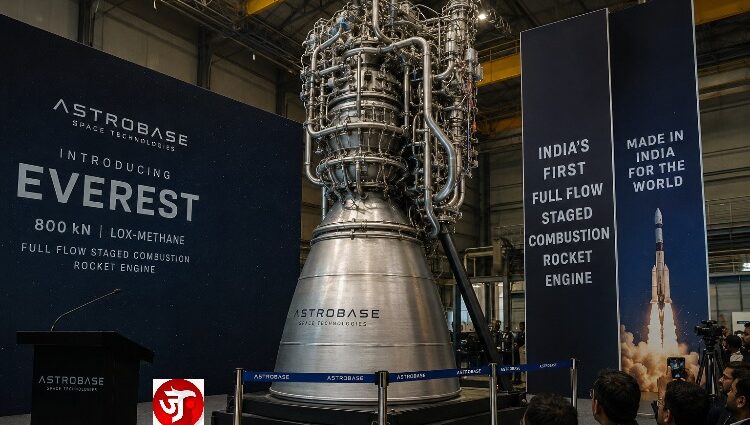
NEW DELHI August 8, 2026: In Bengaluru, India’s private space revolution has just gained another powerful engine, quite literally. Bengaluru-based Astrobase Space Technologies has unveiled EVEREST, an 800-kilonewton, roughly 80-tonne-class rocket engine that could place India among a very small club of nations capable of developing one of the most sophisticated propulsion systems ever designed.
EVEREST uses Full-Flow Staged Combustion (FFSC), an extraordinarily complex rocket-engine architecture prized for its efficiency, power and potential for reusability. Until now, the technology has been associated with only a handful of major space powers, including Russia, the United States and China. SpaceX’s Raptor is the only FFSC engine to have actually flown, making the architecture something of a technological Mount Everest in rocket propulsion. Humanity, apparently, decided even rockets needed their own version of climbing Everest.
Astrobase says its LOX-methane-powered EVEREST is being developed for reusable medium-lift launch vehicles. The company plans to begin hot-fire testing soon, with a target of putting the technology into flight around 2028.
The announcement carries significance far beyond one engine. India’s space programme is increasingly moving from being dominated by government institutions to a rapidly expanding ecosystem of private companies developing launch vehicles, propulsion systems and other advanced technologies.
The timing is particularly striking. The EVEREST announcement comes only weeks after Skyroot Aerospace’s historic Vikram-1 private orbital launch, underscoring how quickly India’s commercial space sector is advancing.
For decades, India’s space story was largely written by ISRO. Now, a new generation of Indian companies is beginning to write its own chapters.
EVEREST is not yet a flight-proven engine, and major engineering challenges remain before it reaches orbit. But its unveiling represents an audacious technological leap: India is no longer merely buying a ticket to the space race. Its private sector is beginning to build the engines that could drive the next generation of Indian rockets.
JANPATH NEWS NETWORK (JNN)
Independent. Fearless. On the People’s Path.