








ECI’s massive voter-roll revision sparks allegations of disenfranchisement, political targeting and documentation barriers as deletions approach 6 crore nationwide
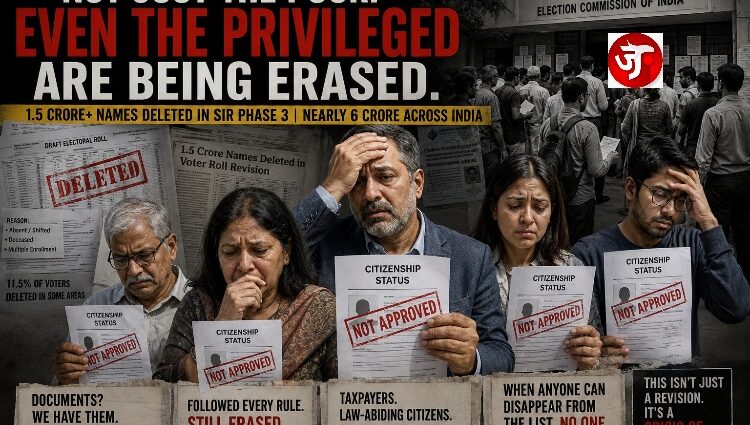
NEW DELHI, Aug 9: India’s electoral rolls have become the centre of a rapidly escalating political and constitutional controversy, with the Election Commission of India’s (ECI) ongoing Special Intensive Revision (SIR) resulting in the deletion of more than 1.5 crore names in its third phase alone.
The exercise, covering Delhi, Maharashtra, Karnataka, Jharkhand, Andhra Pradesh and several other States and Union Territories, has already removed millions of names from existing electoral rolls. In some draft lists, deletions have reportedly amounted to around 11.5 per cent of the previous electorate, with the principal official categories being voters who were found absent or permanently shifted, deceased electors and multiple registrations.
Across the various phases of SIR since mid-2025, the cumulative number of deletions has now approached 6 crore, turning what the ECI describes as an electoral-roll purification exercise into one of the most contentious questions facing Indian democracy.
WHEN GENERATIONS OF INDIANS DISAPPEAR FROM THE VOTER LIST
SIR controversy deepens as critics allege that documentation hurdles, verification failures and administrative exclusions are wiping legitimate long-term residents off electoral rolls
The Election Commission’s Special Intensive Revision (SIR) of electoral rolls has triggered a growing democratic controversy over the fate of millions of people whose families have lived in India for generations.
Critics argue that the exercise risks creating a situation in which Indian citizens are not removed because they are foreigners, dead or duplicate voters, but because they cannot successfully navigate an increasingly demanding verification process.
The allegation is not that the system openly declares an ethnic purge. It is more subtle and, critics say, potentially more dangerous: administrative exclusion can produce the same democratic consequence without ever announcing itself as discrimination.
THE DOCUMENTATION TRAP
One of the biggest concerns involves requirements to establish links with older electoral records, in some cases dating back to 2002–03, or to produce specified documents demonstrating eligibility.
For a family that has lived in the same village or town for generations, the irony is stark.
They may have birth certificates, ration cards, property documents, Aadhaar records, school certificates, tax records and decades of electoral participation.
Yet an old electoral entry may contain a spelling error,
A woman’s surname may have changed after marriage.
A parent’s name may appear differently in another document.
A family may have moved from a village to a city for employment.
An elderly voter may simply have no access to records created decades ago.
Suddenly, a citizen who has lived in India all their life can find themselves being asked to prove a history that their own existence should already demonstrate.
Once a name disappears from a draft roll, restoration can require claims, objections and appeals, processes that critics say can be slow and difficult for ordinary citizens to navigate.
WHEN THE HOUSE IS EMPTY, DOES THE VOTER DISAPPEAR?
Another major controversy concerns house-to-house verification by Booth Level Officers.
The system is intended to establish whether voters continue to reside at their registered addresses.
But India is a country of enormous internal migration.
Workers leave villages for construction sites, factories, farms and cities. Students move for education. Families travel. Elderly people may be hospitalised. A house can remain locked for weeks without its residents having abandoned their permanent home.
Critics fear that a temporary absence can therefore become an administrative record suggesting that a citizen has “shifted” or cannot be traced.
In the third phase of SIR, involving more than 1.5 crore reported deletions, “absent” and “shifted” voters constitute a major category.
That raises a fundamental question:
Can a citizen lose their vote simply because the government finds an empty house on the day it comes looking?
THE SIX-CRORE QUESTION
The controversy becomes even larger when viewed nationally.
Across the different phases of SIR, nearly six crore names have reportedly been removed from electoral rolls.
The official explanations include deceased voters, permanently shifted voters, duplicate entries and other forms of ineligibility.
But critics have repeatedly demanded a clearer public breakdown showing exactly how many deletions belong to each category.
Most importantly, they want to know how many people were actually established to be non-citizens, rather than merely absent, shifted, duplicated or unable to satisfy documentation requirements.
That distinction is critical.
If millions are removed because they are genuinely ineligible, the exercise can be defended as electoral housekeeping.
If large numbers of legitimate voters are removed because they cannot satisfy bureaucratic requirements, the issue becomes one of disenfranchisement.
And if the public cannot independently examine the numbers, suspicion inevitably fills the vacuum.
THE MOST VULNERABLE ARE NOT NECESSARILY THE POOREST ALONE
The controversy is often described as a problem affecting poor or undocumented citizens.
But the implications could extend considerably further.
A multi-generational family may be educated, property-owning, tax-paying and firmly established in India, yet still encounter inconsistencies between historical electoral records and modern documents.
A professional who has moved repeatedly for work may have addresses spread across several cities.
A woman may have changed her name after marriage.
An elderly citizen may have documents that do not perfectly correspond.
None of these circumstances makes a person foreign.
Yet each can create an administrative obstacle.
That is why critics argue that the controversy is not simply about poverty.
It is about whether bureaucratic perfection should become a condition for exercising a constitutional democratic right.
AND THEN COMES THE QUESTION OF CITIZENSHIP
The Supreme Court has made an important distinction that must not be lost in the political battle:
Deletion from an electoral roll does not, by itself, determine or cancel a person’s citizenship.
Citizenship is governed under India’s citizenship laws.
The electoral roll determines who is entitled to vote.
But for the citizen standing outside a polling station, the legal distinction can feel painfully abstract.
If their name is absent, they cannot vote.
And if an appeal takes months, the right exists on paper while remaining inaccessible in practice.
THE REAL CONTROVERSY
The central question surrounding SIR is therefore not whether electoral rolls should be cleaned.
Of course they should.
Dead people should not vote.
Duplicate registrations should be removed.
People who have permanently shifted should have their records corrected.
Ineligible voters should not remain on electoral rolls.
The controversy begins when the process intended to protect the integrity of elections potentially excludes the very citizens whose votes elections are supposed to protect.
India therefore needs far greater transparency:
How many names were deleted?
Why was each category deleted?
How many were subsequently restored?
How many objections were filed?
How many were rejected?
How many alleged non-citizens were actually confirmed as such?
How many legitimate citizens remain trapped in the appeals process?
Until those questions receive clear, verifiable answers, the charge made by critics will continue to resonate:
They may not be formally declaring generations of Indians to be foreigners.
They may simply be making it increasingly difficult for some of them to remain visible on the electoral roll.
And in a democracy, being invisible on the voter list can be almost as consequential as being told you do not belong.
The ballot does not ask how rich you are, where you work, what your surname is, or whether your family has preserved every document since 2002.
It asks only one thing: are you entitled to vote?
The SIR controversy is ultimately about whether India’s electoral machinery can answer that question accurately, fairly and transparently for every citizen.