









Opposition prepares all-out war as Centre moves to seize foreign-funded schools, hospitals and charities.
New Delhi, 9 August 2026: A legislative storm is gathering over Parliament this week. The Foreign Contribution (Regulation) Amendment Bill, 2026 is set to give the Central Government unprecedented power to take control of foreign contributions and the very assets built with them, schools, hospitals, orphanages, community centres and charitable institutionsm the moment an organisation loses its FCRA registration.
The Opposition has drawn battle lines. Congress has issued a strict whip to every MP in both Houses, demanding full attendance on 10, 11 and 12 August. Congress President Mallikarjun Kharge has called an all-party meeting of floor leaders on Monday with a clear mission: block the Bill or force major changes. NCP (SP) leader Supriya Sule has demanded either complete withdrawal or referral to a Joint Parliamentary Committee, warning that foreign funding cannot always be viewed with suspicion.
At the heart of the danger lie three lethal sections:
Section 14B declares that an FCRA certificate will be treated as “ceased” if an organisation fails to apply for renewal, is refused renewal, or simply lets it expire.
Section 16A immediately vests all foreign funds and every asset created from those funds, including assets built only partly with foreign money, in a powerful new “Designated Authority” controlled by the Centre.
Section 16B goes even further, allowing this new framework to be applied retrospectively to assets that had already vested under the old law. Organisations that lost registration years ago but continue working with domestic funds now face the nightmare of sudden government takeover.
Once the Designated Authority steps in, it can manage, monitor, transfer or permanently seize the assets if the organisation fails to regain registration within a specified time. Schools educating the poor, hospitals treating the sick, and charities serving the most vulnerable could be taken over and even sold, with the money flowing into the Consolidated Fund of India.Congress general secretary K.C. Venugopal has called the Bill “completely unconstitutional” and a deliberate attempt to intimidate and control voluntary organisations, particularly Christian groups in Kerala.
He warned that it will “tighten the noose” over social service institutions. Trinamool Congress MP Derek O’Brien has branded it “draconian” and written directly to the Prime Minister, cautioning against “excessive executive control” over education and healthcare organisations.The numbers reveal the scale of the threat.
As of 15 July 2026 there were only 14,449 active FCRA registrations left, while 22,498 had already been cancelled and 15,212 had expired. Tens of thousands of organisations now stand on the edge of a legal cliff. This is not mere regulation. Critics say the Bill hands the executive a loaded weapon to silence independent civil society, shrink democratic space, and place decades of charitable work under the shadow of state control. With the Monsoon Session racing toward its end, the next few days in Parliament will decide whether India’s voluntary sector remains free, or is placed under permanent government custody.
One devastating truth already proven:
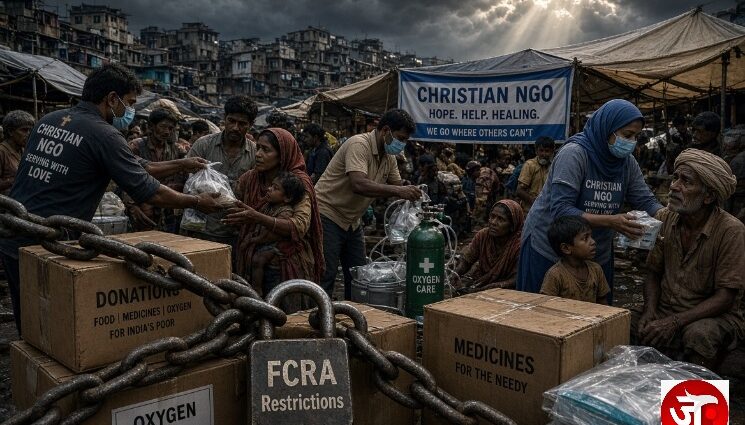
Previous FCRA amendments had already crippled foreign funding for Christian NGOs long before this new Bill. The full impact exploded into the open during the COVID-19 pandemic. When the nation was locked down, hospitals overflowed, and families starved, it was Christian NGOs that stepped into the vacuum. They opened care centres for the sick, distributed food packets in the poorest colonies, ran oxygen helplines, and provided medical aid in places the government machinery could not reach fast enough or deep enough. Yet they were forced to operate with severely restricted funds.
Because of the earlier FCRA changes, the flow of foreign donations that once sustained their large-scale relief work had been choked. As a result, the scale of help they could offer was drastically reduced, fewer centres, less food, limited medicines, and many areas left uncovered. The same organisations that had the network, the volunteers, and the will to serve were deliberately starved of resources at the exact moment the public needed them most.
This is not a theoretical danger. It has already happened. And now the 2026 Bill seeks to tighten the noose even further. When the next crisis comes, another pandemic, a natural disaster, or a humanitarian emergency, the very hands that reach the last mile will be even more constrained. The government simply cannot cover every street, every village, every starving family alone. Civil society, especially faith-based groups with deep grassroots presence, fills that gap. Further strangling them does not protect the nation.
It leaves the most vulnerable even more abandoned.
The fight has begun. The stakes could not be higher.
JANPATH NEWS NETWORK (JNN)
Independent. Fearless. On the People’s Path.