









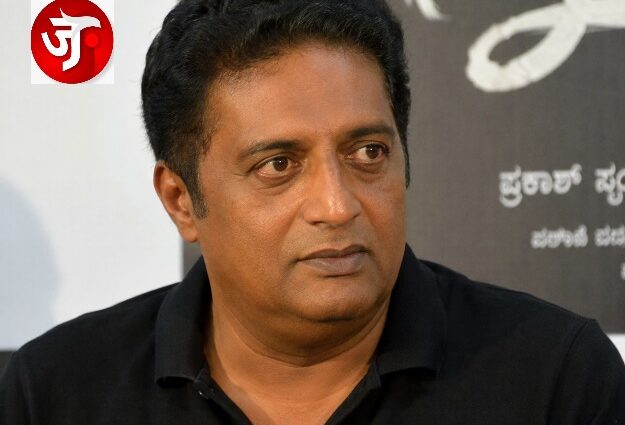
Prakash Raj has alleged that his name was removed despite his longstanding connection with Bengaluru, where he was born and educated and where he contested the 2019 Lok Sabha election as an independent candidate.
AUGUST 11: “Karnataka-born actor and public figure Prakash Raj, who was born and educated in Bengaluru, former independent Lok Sabha candidate Prakash Raj’s alleged deletion from Bengaluru’s electoral rolls has added fresh political heat to Karnataka’s ongoing Special Intensive Revision (SIR), an exercise that has placed an extraordinary 1.09 crore electors under the ASDDO category: Absent, Shifted, Dead, Duplicate and Others.
Raj has alleged that his name was removed despite his longstanding connection with Bengaluru, where he was born and educated and where he contested the 2019 Lok Sabha election as an independent candidate.
His allegation carries an unusual twist. Raj is also facing a legal case over allegations that his name appeared on multiple electoral rolls across Karnataka, Tamil Nadu and Telangana. A Bengaluru court has issued warrants in connection with that matter. The allegations remain subject to judicial proceedings and should not be confused with a finding of guilt.
Prakash Raj is a celebrated and versatile actor whose powerful performances have earned him admiration across Indian cinema. Beyond the screen, he is known for his outspoken voice, independent spirit and willingness to speak up on issues he believes matter. A respected artist and public figure, he has consistently brought conviction, intelligence and authenticity to both his craft and public life. But the larger issue extends far beyond one celebrity.
It is about what happens when an electoral “clean-up” becomes so enormous that genuine voters risk becoming collateral damage.
Karnataka has approximately 5.54 crore electors, and the Election Commission has said digitisation of the SIR enumeration process has been completed. Yet around 1.09 crore voters have been categorised as ASDDO, representing nearly one-fifth of the electorate.
Being placed in the ASDDO category does not automatically mean that a voter has been deleted. Election officials have stressed that verification and the claims-and-objections process remain part of the exercise.
That distinction is crucial. But it does not eliminate the underlying concern.
If millions of voters have to establish that they are still alive, still resident, still eligible and still entitled to vote, the burden of an administrative error begins to shift from the state to the citizen. And that is where democracy can become dangerously bureaucratic.
There is nothing inherently wrong with maintaining accurate electoral rolls. Dead voters should be removed. Genuine duplicates should be eliminated. People who have permanently shifted should not remain registered at their old address.
But the central democratic principle is equally simple: a genuine voter must not disappear merely because the system failed to find them.
That danger becomes particularly serious when the scale of verification is enormous.
Reports indicate that 33.61 lakh Karnataka voters remain unmapped even after digitisation, while the 1.09 crore ASDDO figure has triggered considerable political and public concern. In Bengaluru, the scale is even more striking, with reports indicating that nearly half of the city’s registered voters were placed in the ASDDO category during the exercise.
That raises a basic administrative question: can every questionable entry realistically receive meaningful human verification before an election?
The consequences of an erroneous deletion are not evenly distributed.
A digitally connected, affluent citizen who discovers the problem early may have the time, documents and resources to file an objection. But consider elderly citizens living alone, migrant workers, tenants who have moved within a city, students living away from home, people working in another state, poor families without easy access to documentation and citizens whose names, addresses or spellings differ across government records.
Consider, too, someone who is simply away from home when verification takes place.
For such people, a bureaucratic classification of “Absent” or “Untraceable” can become much more than a database entry. It can become political exclusion.
The political debate has increasingly portrayed SIR as a BJP-driven exercise, with opposition parties accusing the BJP of attempting to manipulate electoral demographics. But technically, SIR is being conducted by the Election Commission of India, not by the BJP as a political party.
That distinction matters.
The legitimate question, therefore, is not simply whether the BJP supports SIR. The real question is whether the Election Commission’s procedures are sufficiently transparent and robust to guarantee that eligible voters will not be disenfranchised.
The ECI has said safeguards exist. These include door-to-door verification, multiple attempts to contact voters, recording reasons for deletion, publication of draft rolls, a claims-and-objections period and avenues for appeal.
Those safeguards are important. But safeguards on paper must work in practice.
Because once an election arrives, telling a citizen that they could have objected several weeks earlier is not much consolation when they are standing outside a polling station unable to vote. Democracy has the unfortunate habit of operating according to deadlines.
The real danger is silent disenfranchisement.
The state has enormous institutional power. The citizen has one vote. That imbalance demands extraordinary caution.
Raj’s case is politically complicated because of the separate allegations concerning multiple voter registrations. His personal complaint therefore cannot, by itself, be treated as proof that SIR is targeting genuine voters.
But the larger question remains valid. The danger does not necessarily require a conspiracy, and sometimes bureaucracy does not need a conspiracy.
That means every disputed deletion must be transparent, independently verifiable and easily appealable. Citizens should be able to check their status without navigating a bureaucratic maze. Political parties and civil-society observers should have meaningful opportunities to scrutinise the process.
Most importantly, the system must place the protection of an eligible citizen’s franchise at the centre of every deletion decision rather than treating removal as the easiest administrative solution.
Because an electoral roll is not merely a government database. It is the list of people whose voices count.
And if 1.09 crore names can be flagged in a state containing around 5.54 crore electors, Karnataka is facing a test far larger than the controversy surrounding one actor.
It is testing whether India’s promise of “one citizen, one vote” survives the machinery designed to protect it.
The irony is difficult to miss. A process intended to make democracy cleaner could, if poorly implemented, leave democracy with fewer people able to participate in it.
The objective should therefore be neither political victory nor bureaucratic efficiency. It should be something considerably more fundamental: an electoral roll that is clean without becoming exclusionary, accurate without becoming inaccessible, and efficient without making genuine citizens prove their existence simply to retain the right to vote.
JANPATH NEWS NETWORK (JNN)
Independent. Fearless. On the People’s Path.