










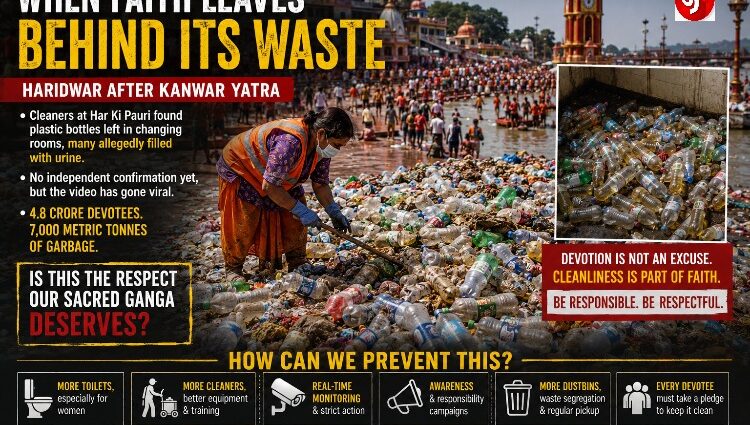
A sacred pilgrimage should not end with mountains of garbage, filthy changing rooms and bottles allegedly filled with urine. The real question is not merely what pilgrims left behind. It is why a system built for tens of millions still appears so unprepared for them.
There is something deeply unsettling about the images emerging from Haridwar after this year’s Kanwar Yatra. Cleaning workers at Har Ki Pauri reportedly discovered large numbers of plastic bottles abandoned inside changing rooms, including facilities used by women. Workers appearing in viral footage have claimed that some of the bottles contained urine rather than water or Ganga water, and the footage has since spread widely across social media.
That claim, however, deserves verification. There has not, so far, been independent laboratory confirmation of the contents of every bottle, nor a detailed official account establishing exactly what happened. A viral video can show that something was found, but it cannot automatically establish every allegation attached to it. Yet even after stripping away everything that cannot currently be independently established, the larger question remains impossible to ignore: How does a pilgrimage involving nearly 4.8 crore people leave a sacred city struggling to cope with basic sanitation?
The 2026 Kanwar Yatra drew an estimated 4.8 crore Kanwariyas to Haridwar, according to police, surpassing the previous year’s reported record of 4.5 crore. Those numbers are not a surprise. The Kanwar Yatra happens every year. Its dates are known. Its routes are known. The extraordinary scale of the crowds is known. The sanitation burden is known. And yet the familiar crisis returns: garbage, overflowing facilities, inadequate privacy, congestion and exhausted sanitation workers trying to clean up after a human tide has passed through the city.
This is where the conversation needs to become more serious. It is easy, and politically convenient, to reduce the entire episode to individual misconduct: someone urinated in a bottle, someone left it behind, someone behaved without civic responsibility, case closed. But that explanation is too comfortable. If people are repeatedly forced to improvise because toilets are inaccessible, overcrowded, poorly maintained, too distant or unavailable when needed, then sanitation stops being merely a question of individual morality. It becomes an infrastructure question. And infrastructure is the responsibility of the administration.
None of this excuses people who deliberately litter or misuse public facilities. Devotion does not suspend basic civic responsibility. Carrying a Kanwar does not grant anyone a temporary exemption from the laws of hygiene. But neither should the state be allowed to pretend that telling millions of people to “keep the city clean” is a sanitation strategy. It isn’t. It is a slogan. A pilgrimage of this scale requires infrastructure designed around the basic realities of human beings: people need toilets, water, privacy and somewhere to dispose of their waste. Those needs do not disappear simply because the occasion is religious.
The most disturbing element of the reports is the alleged use of women’s changing facilities for purposes for which they were never intended. Women already face a fundamentally different sanitation problem in crowded public spaces. Privacy matters. Safety matters. Access matters. The ability to change clothes without fear of intrusion matters. Haridwar does have designated women’s bathing and changing facilities around Har Ki Pauri, but during an event involving millions upon millions of people, simply having changing rooms is not enough. How many are there? Where are they located? How frequently are they cleaned? Who monitors them? Are they adequately staffed at two in the morning as well as two in the afternoon? Can a woman enter one without worrying about privacy, cleanliness or safety? These are the questions a serious administration should answer.
Authorities did not enter this year’s pilgrimage blind. Preparations included additional sanitation personnel, with around 1,000 extra sanitation workers deployed as the Yatra began, according to reports. The administration also planned mobile toilets, drinking-water arrangements and waste-management measures along the pilgrimage routes. Yet the scale of the event was extraordinary: nearly 48 million people. That is a population comparable to that of an entire large country passing through one pilgrimage system. You cannot manage that population with a few temporary facilities, a heroic sanitation workforce and a massive cleanup operation after the crowds disappear. At some point, the mathematics wins.
Human beings require toilets. Human beings generate waste. Human beings need water. Women require privacy. Children require sanitation. Millions of people concentrated around a river and a few major ghats require a waste-management system designed for millions, not a temporary arrangement designed to look impressive on an administrative spreadsheet.
There is also an uncomfortable contradiction at the heart of the spectacle. The Kanwar Yatra is fundamentally associated with devotion to Shiva and the collection of sacred Ganga water. Haridwar is one of the major pilgrimage destinations where Kanwariyas come to collect holy water from the Ganges. So what does it say about our understanding of holiness if people arrive carrying sacred water and leave behind mountains of plastic? What does it say about religious devotion if sanitation workers have to enter changing rooms after the crowds have gone and deal with waste that should never have been abandoned there? And what does it say about governance when the cleanup becomes the spectacle rather than prevention? Cleanliness cannot begin after the devotees leave. It has to begin before they arrive.
Faith may move millions. But it still has to pass through a toilet. And if a civilisation capable of organising a pilgrimage for nearly 50 million people cannot organise enough clean, safe and dignified sanitation facilities for them, then perhaps the real cleanliness campaign we need is not another slogan on a wall. It is a change in how we plan. A sacred place should not need a sanitation miracle after every festival.