






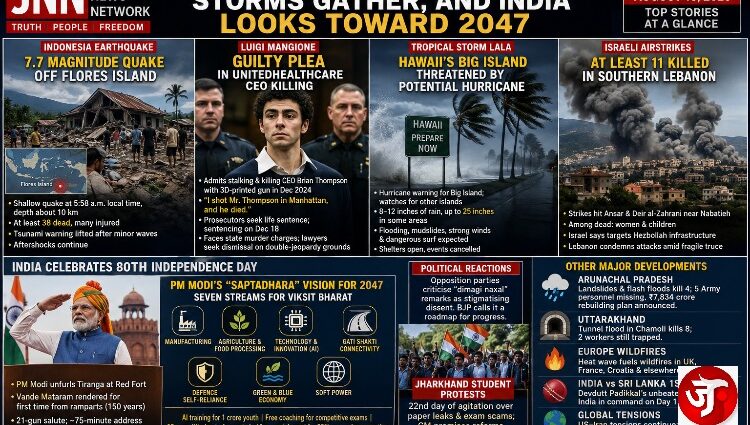
Saturday, August 15, 2026, brought a dramatic mix of disaster, conflict, crime and political spectacle across the world. A powerful earthquake struck Indonesia, Hawaii prepared for a potentially historic hurricane, Israeli airstrikes killed civilians in southern Lebanon, and Luigi Mangione pleaded guilty in the killing of UnitedHealthcare CEO Brian Thompson. In India, Independence Day celebrations took centre stage as Prime Minister Narendra Modi delivered his address from the Red Fort, laying out an ambitious roadmap for a “Viksit Bharat” by 2047.
Indonesia reels after powerful 7.7 earthquake
Eastern Indonesia was hit by a devastating magnitude 7.7 earthquake early Saturday off the northern coast of Flores Island, near Ende. The shallow quake struck at roughly 5:58 a.m. local time at a depth of about 10 kilometres, triggering landslides, building collapses and widespread panic across a region accustomed to seismic activity.
The death toll rose rapidly as rescuers reached affected communities. Early reports put the toll in the single digits and then the 20s, before Indonesian authorities reported at least 38 deaths. Later reports indicated the number had risen further, underscoring how quickly casualty figures were changing as search-and-rescue operations continued.
A tsunami warning sent thousands of residents scrambling toward higher ground. The warning was later lifted after tsunami waves remained relatively limited, although waves exceeding one metre were recorded in some locations. More than 200 aftershocks were reported, including a powerful magnitude 6.1 tremor, while damaged roads, landslides and communications failures complicated rescue operations.
The earthquake struck in Indonesia’s seismically active “Ring of Fire”, where earthquakes and volcanic activity are a recurring threat. For residents already familiar with the ground moving beneath their feet, Saturday brought another brutal reminder that nature remains spectacularly unimpressed by human infrastructure.
Mangione pleads guilty in UnitedHealthcare CEO killing
In New York, Luigi Mangione, 28, pleaded guilty Friday in Manhattan federal court to federal stalking charges connected to the December 2024 killing of UnitedHealthcare CEO Brian Thompson.
Mangione admitted that he tracked Thompson’s movements, including by posing as an investor to obtain information about an investor conference, before travelling to New York. He acknowledged using a 3D-printed firearm and shooting Thompson on a Manhattan street.
During the hearing, Mangione explicitly admitted responsibility, saying: “I shot Mr. Thompson in Manhattan, and he died.”
The federal charges carry the possibility of a life sentence, with sentencing scheduled for December 18. The guilty plea, however, does not end the case. Mangione continues to face separate state murder charges, and his lawyers are seeking dismissal of that prosecution on double-jeopardy grounds.
The killing has generated extraordinary public attention, including intense debate surrounding the American healthcare system, corporate power and attitudes toward Mangione. But the courtroom proceedings now move into a more consequential phase, with both federal sentencing and the unresolved state prosecution ahead.
Hawaii braces for Lala
Across the Pacific, Hawaii was preparing for Tropical Storm Lala, which was approaching the Big Island with the potential to strengthen into a hurricane.
A hurricane warning was in effect for Hawaii Island, while tropical-storm warnings covered other parts of the state. Forecasters expected Lala to bring powerful winds, torrential rainfall, dangerous surf and potentially life-threatening flooding and mudslides.
The storm was expected to approach the southern part of the Big Island, with authorities urging residents to complete preparations before conditions deteriorated. Shelters were opened and events were cancelled as officials prepared for the possibility of hurricane-force conditions.
Lala’s threat was particularly significant because a direct hurricane impact on the Big Island is an uncommon event. The immediate concern was not simply the wind but the combination of extreme rainfall, steep terrain, flooding and landslides.
Israeli strikes kill civilians in southern Lebanon
Southern Lebanon witnessed one of the deadliest escalations since the fragile June truce framework involving Israel and Hezbollah.
Israeli airstrikes struck areas including Ansar and Deir al-Zahrani near Nabatieh. Lebanon’s Health Ministry reported at least 11 people killed, including seven people in Ansar and four in Deir al-Zahrani. The casualties reportedly included women and children.
The Israeli military said it had targeted Hezbollah infrastructure and described the strikes as a response to activity directed against Israeli forces. Lebanese officials condemned the attacks, arguing that civilians had been killed and warning that the escalation threatened diplomatic efforts to stabilise the situation.
The violence is particularly significant because it comes amid efforts to maintain the June truce framework. The latest strikes threaten to widen an already fragile confrontation at a time when Lebanon and Israel remain engaged in difficult negotiations.
India celebrates its 80th Independence Day
Back home, India marked its 80th Independence Day with flag-hoisting ceremonies, patriotic programmes and celebrations across the country.
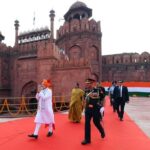
At the Red Fort in New Delhi, Prime Minister Narendra Modi unfurled the Tiranga and addressed the nation in a speech lasting roughly 75 minutes. A notable moment came with the rendering of Vande Mataram from the Red Fort during the ceremony, commemorating 150 years of the national song.
The central theme of the address was India’s journey toward becoming a developed nation by 2047. Modi presented a seven-part framework, described as “Saptadhara”, covering manufacturing, agriculture and food processing, technology and innovation, connectivity, defence self-reliance, the green and blue economies, and India’s cultural and diplomatic influence.
The Prime Minister placed particular emphasis on India’s young population, announcing plans to provide AI-related training to one crore young people within a year and proposing free online coaching for competitive examinations. He also spoke about developing sporting talent ahead of the 2036 Olympics and expanding India’s capabilities in semiconductors, nuclear energy and domestic energy production.
Modi also claimed that 25 crore people had been lifted out of poverty over the previous 12 years and appealed for greater political support for the implementation of 33% reservation for women in legislatures.
But the speech was not without controversy. His remarks about “dimagi naxals”, referring to what he described as ideological or intellectual supporters of Naxalism, drew sharp criticism from opposition parties, which accused the government of stigmatising dissent. The BJP defended the remarks as part of its warning against extremist ideology.
Protests continue in Jharkhand
Independence Day also became a day of protest in Jharkhand, where students demanding action over alleged irregularities and paper leaks in state recruitment examinations held a Tiranga Yatra in Ranchi.
The demonstration came on the 22nd day of their agitation. Chief Minister Hemant Soren promised systemic reforms and said the hard work of students should not be destroyed by what he described as a “paper leak mafia”. The protests reflect a wider national anxiety over examination integrity, recruitment and the increasingly high stakes attached to government jobs.
Rain and disaster continue to test India
Independence Day celebrations unfolded against a backdrop of severe weather in several parts of the country.
In Arunachal Pradesh, landslides and flash floods caused multiple deaths, while five Army personnel remained missing after a flash flood swept away two shelters at an Army camp. Four labourers were also killed in a landslide at a road construction site in Upper Subansiri. Rescue and search operations were continuing.
In Uttarakhand’s Chamoli district, the death toll from a flooded under-construction tunnel rose to eight after rescuers recovered another worker’s body. Two workers remained trapped as rescue teams continued pumping out water and debris from the tunnel.
Heavy rain and landslides were also affecting Odisha, Himachal Pradesh and other parts of the country, disrupting roads and transport.
And elsewhere…
Europe continued to battle destructive wildfires amid a punishing heat wave, with fires affecting areas including the United Kingdom, France and Croatia.
Meanwhile, tensions surrounding the United States and Iran remained a major international concern, with continuing disputes over the Strait of Hormuz and the strain placed on American naval forces operating in the region.
In sport, India began its first Test against Sri Lanka in Galle with Devdutt Padikkal producing a major performance, scoring an unbeaten 131 on the opening day.
Saturday therefore offered a strikingly complicated picture of the world: an earthquake tearing through communities in Indonesia, a tropical storm bearing down on Hawaii, renewed bloodshed in Lebanon, a major American criminal case entering a new phase, and India celebrating eight decades of independence while debating what its next two decades should look like.
The flags were flying. The speeches were being made. But beneath the ceremonies, the harder questions remained: how resilient are nations when disaster strikes, how fragile is peace when guns fall silent, and how much of a country’s promised future actually reaches the people waiting for it?
JANPATH NEWS NETWORK (JNN)
Independent. Fearless. On the People’s Path.