










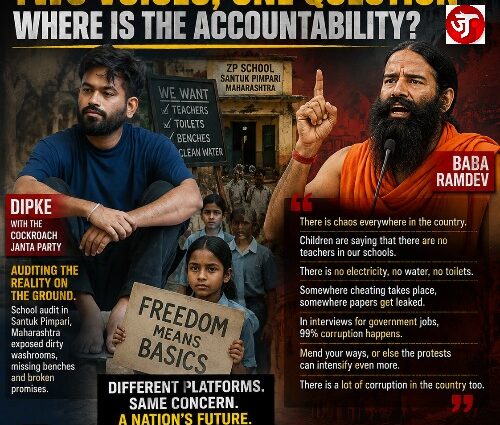
Ramdev: There is no electricity, no water, no toilets.. In interviews for government jobs, 99% corruption happens.
These remarks attributed to Baba Ramdev strike at a question that is larger than any one political party or government: what happens when the institutions meant to serve citizens stop delivering even the basics?
The claims are sweeping and politically charged, and the specific “99%” figure should be treated as an allegation rather than an established statistic. But beneath the rhetoric is a set of problems that can and should be examined independently: teacher shortages, inadequate school infrastructure, examination malpractice and paper leaks, corruption allegations in public recruitment, and the growing frustration of citizens who believe that government systems are failing to perform their most basic responsibilities.
The most revealing part of the argument is perhaps not the allegation of corruption itself, but the reference to children.
When children say that their schools have no teachers, toilets, electricity or water, the issue stops being an abstract debate about governance. It becomes a question of what kind of citizenship a country is building. A child who enters a government school should not have to understand budgets, procurement procedures or administrative responsibility. The state has already accepted that education is a public responsibility. The expectation is therefore simple: provide a functioning school.
That is precisely why grassroots school audits such as the one recently undertaken by Dipke and the Cockroach Janta Party in Santuk Pimpari, Maharashtra, have attracted attention. Instead of discussing education as a statistic, the campaign puts the physical condition of the classroom in front of the public: Are there benches? Are the toilets usable? Is there drinking water? Are teachers present? Is the building fit for children?
Dipke, along with the Cockroach Janta Party, recently audited a government school in Santuk Pimpari, Maharashtra, after local children themselves pointed to dirty washrooms and missing benches. The village sarpanch reportedly promised that the problems would be addressed within a week. The larger significance, however, lies beyond one school. When citizens, parents and even children have to inspect public institutions to establish whether basic facilities exist, it points to a serious failure of routine governance and accountability.
Dipke said: Even after 80 years of Independence, our govt schools still lack basic amenities. I spoke to the Sarpanch of my village, who has assured that the Panchayat will resolve all these issues within a week. Change is possible when we come together and act.
Here is one of the videos where he visits a school:
These questions sound almost embarrassingly basic. That is exactly the problem.
When development exists on paper
Governments routinely announce schemes, allocate budgets and publish development figures. Yet the distance between a budget document and a child sitting in a classroom can be enormous.
Money may be sanctioned, but implementation can falter. Infrastructure may be constructed, but maintenance may be neglected. Teachers may be appointed on paper but remain unavailable where they are needed. Facilities may exist but be unusable. Procurement can become vulnerable to inflated costs, favoritism or other forms of malpractice. This is where accountability becomes more important than political slogans.
If a school is sanctioned funding for toilets, the question is not whether the allocation appears in a government document. The question is whether children actually have a clean, functioning toilet.
If teachers are sanctioned, the question is not simply whether their posts exist. The question is whether children have teachers in their classrooms.
Ramdev’s reference to examination cheating and paper leaks raises another particularly sensitive issue. Competitive examinations are supposed to provide one of the few mechanisms through which students from very different social and economic backgrounds can compete on a common platform. The promise is simple: study hard, prepare well and your performance will determine your opportunity.
Paper leaks, cheating or credible allegations of examination malpractice undermine that principle. The damage goes far beyond one cancelled examination. Students invest years of preparation, families spend money on coaching and accommodation, and young people build their career plans around examination dates. When an examination is compromised, the immediate victims are the students who played by the rules. The larger casualty is trust.
A young person who begins to believe that connections, money or manipulation matter more than merit may eventually stop believing in the fairness of the institution itself.
That is a far more serious consequence than the inconvenience of conducting another examination.
Government recruitment carries an even heavier responsibility
The allegation that “99% corruption” occurs in government-job interviews is an extraordinary claim and should not be accepted as a literal national statistic without evidence. But the underlying concern deserves examination.
For millions of young Indians, a government job represents stability, social mobility and economic security. Recruitment therefore has to be transparent enough to withstand public scrutiny.
Selection procedures need clear eligibility criteria, standardized evaluation, documented decisions, independent oversight and credible grievance mechanisms. Where interviews are necessary, their weight and assessment should be transparent enough to prevent the perception that personal influence can determine outcomes.
Even where corruption does not occur, a system perceived as corrupt can be damaging.
Trust is itself an institutional asset. Once citizens lose it, rebuilding it is considerably harder than issuing another government notification.
The political temptation
There is also a political complication that cannot simply be ignored. Whenever a prominent public figure accuses a government of corruption or institutional failure, supporters may treat the criticism as courageous accountability while opponents may dismiss it as political theatre. Both reactions can become convenient ways of avoiding the underlying questions.
The correct response should be neither automatic acceptance nor automatic dismissal. If a school lacks toilets, inspect the school; If teachers are absent, examine attendance records; if funds were allocated, follow the money; if an examination paper leaked, investigate how it happened; if recruitment is alleged to have been compromised, audit the process. In other words, the answer to a political allegation should be institutional verification.
That is how a democracy protects itself from both propaganda and complacency.
The children are asking the most important questions: There is something deeply significant about young people becoming increasingly vocal about basic public services. Children asking for teachers are not making an ideological demand. And when young citizens begin auditing their own schools, documenting deficiencies and demanding explanations, the traditional relationship between government and citizen begins to change. The citizen is no longer merely the recipient of a welfare scheme, the citizen becomes the auditor. That is a healthy instinct in a democracy.
Post-Independence India was built on a promise that freedom would eventually translate into dignity, opportunity and a better life for every citizen. Yet decades later, the most basic question remains painfully relevant: can a child in rural India expect a functioning school, a teacher, clean toilets, drinking water, electricity and a desk to sit at?
JANPATH NEWS NETWORK (JNN)
Independent. Fearless. On the People’s Path.