










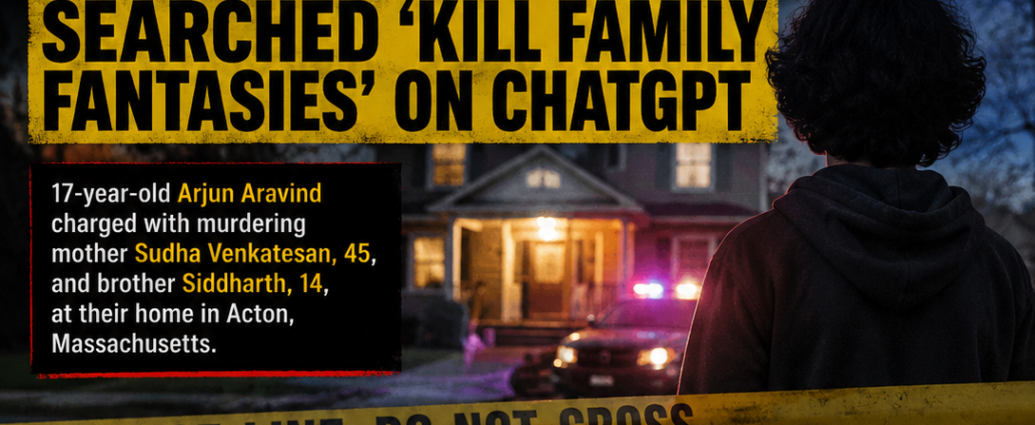
Indian-origin teenager charged after mother and younger brother found dead in Massachusetts home
Aug. 16: A quiet suburban community in Massachusetts is confronting a devastating family tragedy after a 17-year-old Indian-origin teenager was charged in connection with the deaths of his mother and younger brother at their family home in Acton.
Authorities said the teen faces two counts of murder, along with additional charges including assault and battery involving household or family members, assault and battery, unauthorized use of a motor vehicle and motor-vehicle theft. The victims were identified as his mother, Sudha Venkatesan, 45, and his younger brother, Siddharth Aravind, 14.
The deaths occurred on August 11 at the family’s residence on Martha Lane. According to authorities, Arjun Aravind’s father had spoken with his wife earlier that morning before leaving for work. Siddharth was reportedly last seen around midday. Concern grew when family members and a tutor were unable to make contact with those inside the home.
When police arrived to conduct a welfare check, they discovered both victims dead inside the residence. Authorities have not yet established publicly all the circumstances surrounding the deaths, and the exact cause and manner of death remain subject to the ongoing investigation and medical examiner’s findings.
Aravind was subsequently located in nearby Wayland inside a vehicle belonging to his mother and was taken into custody without incident, according to investigators.
But perhaps the most unsettling aspect of the case is what investigators say they discovered about the teenager’s recent online activity.
When disturbing thoughts enter the digital world, lives turn upside-down. Prosecutors have said that Aravind had recently displayed what they described as concerning behaviour, including internet searches and interactions with ChatGPT involving theoretical ideas or fictional fantasies about killing members of his family.
That revelation introduces an uncomfortable dimension to an already heartbreaking case. It would be premature, and deeply irresponsible, to conclude that online material or artificial intelligence caused the alleged violence. The investigation is still unfolding, and human behaviour is rarely reducible to one website, one conversation or one technological tool.
The allegation raises questions that society can no longer easily avoid. What happens when a troubled young person begins exploring violent fantasies online? When should disturbing searches be regarded as a warning sign rather than dismissed as curiosity? How should parents, schools, technology companies and communities respond when potentially dangerous behaviour begins to surface in digital spaces?
These are difficult questions precisely because there are no simple answers. The internet has become an extension of adolescence. Young people now think, experiment, communicate and sometimes reveal their darkest fears and fantasies online. Artificial intelligence has added another layer to that environment, because unlike a conventional search engine, an AI system can engage in an extended conversation.
That makes the question of responsible AI use increasingly important, particularly when vulnerable or troubled young people are involved.
It is easy for a shocking crime to become a headline, a social-media debate and, eventually, another item in the relentless machinery of the news cycle. But before the charges, investigations and courtroom proceedings, there was a family. There was a mother going about an ordinary morning. There was a 14-year-old boy whose life was suddenly and violently ended. There was a father who left home expecting to return to his family.
Now, here, there was a teenager who now stands accused of an act that, if proven, would permanently alter the lives of everyone connected to the family. That human dimension can disappear beneath the most disturbing details of a criminal case.
The tragedy also illustrates how little outsiders may know about what is happening inside a home. A family can appear ordinary from the outside while carrying private struggles that are invisible to neighbours, teachers and even extended relatives.
That does not mean every troubled teenager is a potential danger. Quite the opposite. Most young people experiencing emotional distress, anger, isolation or disturbing thoughts do not become violent. But it does mean that warning signs deserve to be taken seriously.
While the Investigators are continuing to establish what happened inside the Acton home, what preceded the deaths and whether there were earlier signs that could have alerted those around the family, authorities are also determining the precise circumstances and weapon allegedly involved.
The legal process will now have to establish what happened, why it happened and what evidence supports the charges. Aravind is an accused person, not a convicted murderer, and the presumption of innocence remains fundamental to the American justice system.
Society, meanwhile, must ask a broader question: could anything have been recognised earlier, and if so, would anyone have known what to do with that warning. The case is likely to intensify an already growing conversation about teenagers, mental health, violent online content and artificial intelligence.
Technology does not exist in a vacuum. It is used by human beings carrying their own histories, vulnerabilities and impulses. The challenge is therefore not simply to ask what AI can generate, but what safeguards should exist when someone appears to be using technology to explore increasingly dangerous ideas.
Parents cannot monitor every thought their children have and schools cannot diagnose every emotional struggle, while technology companies cannot be expected to replace families, doctors, teachers or law enforcement, but each part of society has a role in recognising serious warning signs and responding appropriately.
Perhaps the most uncomfortable lesson from this tragedy is that prevention rarely begins with the dramatic moment that makes the news. It begins much earlier, in small changes in behaviour, conversations that suddenly stop, isolation that deepens, disturbing material that appears repeatedly, or a young person who is struggling and does not know how to ask for help.
The challenge is knowing when a troubling thought is simply a thought and when it is becoming something more dangerous. Behind every shocking headline are human lives, relationships and losses that cannot be reduced to a crime statistic. The court will determine the charges, But the questions about how we recognise distress, protect children and responsibly navigate an increasingly digital childhood belong to all of us.
JANPATH NEWS NETWORK (JNN)
Independent. Fearless. On the People’s Path.