








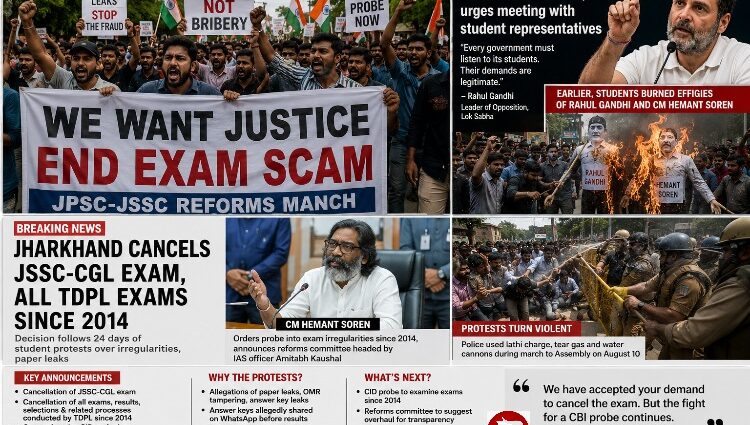
Ranchi, Jharkhand: JPSC-JSSC aspirants sing and dance as they celebrate after the state government accepted their demands by scrapping JSSC-CGL, all TDPL exams since 2014 after 24-day student revolt.
August 18, 2026: In one of the biggest breakthroughs for students, yet, setback for Jharkhand’s recruitment system, the Hemant Soren government has cancelled the JSSC-Combined Graduate Level (JSSC-CGL) examination and ordered the cancellation of examinations, results, selections and related recruitment processes conducted through private testing agency TSR Data Processing Pvt Ltd (TDPL) since 2014.
The sweeping decision came after 24 days of sustained student protests in Ranchi over allegations of paper leaks, manipulation of examination records, irregularities in recruitment and the alleged capture of the state’s competitive examination system by a network of officials, private agencies and middlemen.
The announcement followed a marathon special Cabinet meeting chaired by Chief Minister Hemant Soren. The government has also ordered a wider investigation into irregularities in competitive examinations conducted in the state since 2014 and announced an examination reforms committee headed by senior IAS officer Amitabh Kaushal.
The move represents a major concession to the protesting aspirants, who had made cancellation of allegedly tainted examinations and an independent investigation central demands of their agitation. Student leaders welcomed the cancellation, with hunger strikers ending their fasts after the government accepted the demand. Devendra Nath Mahato, one of the prominent faces of the agitation, ended a 16-day hunger strike in the presence of state ministers.
But the protest movement has not completely ended.
Student leaders say the government has addressed the cancellation demand but has still failed to concede their demand for a CBI investigation. Ravindra Paswan of the JPSC-JSSC Reforms Manch said the agitation would continue until the CBI probe was ordered, reflecting the depth of distrust that has developed between aspirants and the state recruitment authorities.
The dispute has therefore moved beyond one examination. It has become a larger confrontation over whether Jharkhand’s recruitment machinery can be trusted to select candidates fairly.
How the crisis exploded
The immediate controversy gathered force around allegations concerning the 14th JPSC Civil Services Preliminary Examination and other recruitment examinations. Aspirants alleged that examination processes had been compromised through manipulation of OMR sheets, answer keys and results.
A particularly damaging controversy surrounded a purported carbon copy of an OMR answer sheet that circulated publicly and was claimed to show a candidate qualifying despite answering only a limited number of questions. The allegation became a symbol of what protesters described as a deeper systemic failure rather than an isolated examination error.
The government’s own investigative agencies subsequently began looking into alleged irregularities involving officials and private testing companies. The Jharkhand CID registered cases and arrested several people in connection with the investigations, including officials and individuals associated with TDPL. The JPSC chairman also resigned amid the widening controversy, while several examinations were postponed.
The role of TDPL became particularly contentious because the agency had previously faced questions over its functioning. Reports noted that JSSC had blacklisted the agency in 2025 over alleged irregularities and non-compliance connected with an earlier examination, yet TDPL continued to feature in examination-related work.
That raised a question that has become central to the controversy: how did a private agency already facing scrutiny continue to receive sensitive examination-related responsibilities?
That question is now part of the wider investigation.
Allegations point to a deeper examination racket
Investigators and media reports have described allegations involving the circulation of answer keys before official results, manipulation of OMR data and merit lists, and the improper handling of sensitive examination material.
There have also been allegations of money being demanded from candidates in exchange for guaranteed selections. Several arrests have been made in cases involving alleged recruitment fraud, although the allegations remain subject to investigation and judicial proceedings.
The CID probe has consequently expanded beyond individual candidates or isolated leaks. Authorities are examining whether different examination controversies were connected through a broader network involving officials, private agencies and intermediaries.
That is precisely why the government’s decision to examine recruitment processes going back to 2014 is politically and administratively significant. It acknowledges that the credibility problem cannot simply be confined to the latest JSSC-CGL controversy.
Students versus the government
The protests had become increasingly intense in the days before the Cabinet decision.
Aspirants gathered at Ranchi’s Jaipal Singh Munda Stadium and organised marches, sit-ins and hunger strikes. The agitation included attempts to march towards the state Assembly, with clashes reported between protesters and police. BJP leaders also joined the political attack on the JMM-led government, demanding an independent investigation into the alleged examination irregularities.
The political anger became particularly complicated for the ruling alliance because Congress is part of the Jharkhand government.
Congress leader and Leader of Opposition in the Lok Sabha Rahul Gandhi wrote to Hemant Soren urging him to personally meet representatives of the protesting students. Gandhi described the students’ agitation as peaceful and their demands as legitimate, arguing that governments have a responsibility to listen to young people protesting against examination irregularities.
The intervention came at a politically awkward moment. Students had earlier gone so far as to burn effigies of Rahul Gandhi and Chief Minister Hemant Soren, demonstrating that the anger was not neatly divided along party lines. The protesters’ message was blunt: they wanted accountability from the entire political establishment, not merely criticism of whichever party happened to be in opposition.
A victory with a new problem
The government’s decision has solved one problem while creating another.
While protesting aspirants demanded cancellation of the allegedly compromised JSSC-CGL examination, approximately 2,000 candidates who obtained government jobs through the examination have opposed its cancellation, fearing that they could lose appointments they had already secured. They argue that genuine candidates should not be punished for alleged wrongdoing by officials or intermediaries.
The government therefore faces a difficult balancing act: restore credibility to the recruitment system without unfairly destroying the careers of candidates who may have cleared examinations legitimately.
The legal consequences could be equally complicated. Cancelling examinations is administratively straightforward compared with determining what happens to appointments already made, candidates who may have been victims rather than beneficiaries of malpractice, and those allegedly involved in manipulation.
The real test begins now
The cancellation of the JSSC-CGL and TDPL-linked examinations is undoubtedly a major victory for the students. But it is not, by itself, proof of wrongdoing in every examination conducted through TDPL since 2014.
That distinction matters.
The allegations remain under investigation, and responsibility must ultimately be established through evidence and due legal process. The government’s decision to launch a comprehensive probe is therefore only the beginning.
The larger question is whether Jharkhand can rebuild an examination system in which a young person preparing for a government job does not have to wonder whether hard work, merit and months of preparation will be enough.
For thousands of aspirants, that is the issue beneath the politics, the protests and the competing demands for a CID or CBI probe.
An examination is supposed to test a candidate. In Jharkhand, the crisis has now turned the question around: the candidates are testing the examination system itself.
And after 24 days of protest, the government has finally answered, at least partially. The harder examination begins now: whether it can restore trust.
JANPATH NEWS NETWORK (JNN)
Independent. Fearless. On the People’s Path.