










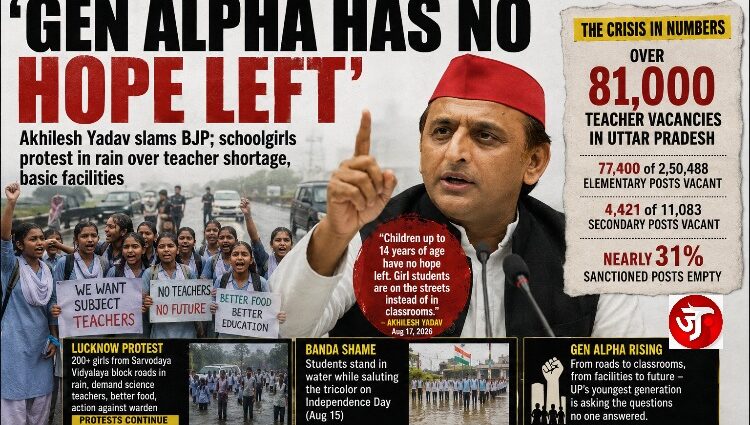
Akhilesh Yadav calls the neglect of schools the “biggest failure” of the BJP government
August 17, 2026: A fresh wave of student protests in Uttar Pradesh has given the state’s education crisis a sharper political edge, with Samajwadi Party chief Akhilesh Yadav accusing the BJP government of failing an entire generation of schoolchildren.
In a post on August 17, Yadav described the situation as the “biggest failure” of the BJP government, alleging that children up to the age of 14 are being left with “no hope” as schools struggle with teacher shortages and inadequate basic facilities. He questioned whether Uttar Pradesh even has an education minister, while sharing visuals linked to the latest student protests in Lucknow.
The timing of the attack was significant. On Monday, more than 200 girls from the Jai Prakash Narayan Sarvodaya Vidyalaya in Lucknow took to the streets amid heavy rain, blocking roads at the Dubagga-Kanpur Bypass and Balaganj intersections. It was the second major protest by students of the government-run residential school in just four days.
The students said their studies were being badly affected by a shortage of subject teachers, particularly in Physics, Chemistry and Biology, crucial subjects for students preparing for board examinations. They also raised complaints about food quality, school administration, excessive assemblies eating into academic hours and the functioning of the hostel.
The protest forced senior officials from the Social Welfare Department and district administration to intervene. Students were eventually taken back to the campus after officials held discussions with them and heard their grievances. The episode followed a similar protest by boys from the same institution days earlier over teacher shortages and other problems.
The protests have increasingly been described in political and media discourse as a “Gen Alpha” revolt, referring broadly to children born from around 2010 onward. The striking feature is that schoolchildren who would normally be expected to remain inside classrooms are instead appearing on highways and public roads to demand the basic conditions needed to study.
For the BJP-led Uttar Pradesh government, the protests come against the backdrop of substantial teacher vacancies. A Union Education Ministry review found that 77,400 of 2,50,488 sanctioned elementary teaching posts in Uttar Pradesh were vacant, while 4,421 of 11,083 sanctioned secondary teaching posts were also unfilled. Together, that amounts to more than 81,000 vacancies, or roughly 31% of the sanctioned posts examined. The Centre advised the state to accelerate recruitment.
The shortage is particularly consequential in schools such as the Sarvodaya Vidyalayas, which serve students from disadvantaged backgrounds. A shortage of teachers in specialised subjects can leave students enrolled in science streams without regular instruction at precisely the stage when they are preparing for board examinations and competitive examinations.
The government, however, has pointed to recruitment efforts already under way. Uttar Pradesh has been preparing a major recruitment drive involving tens of thousands of teaching posts, while the state has also conducted the Teacher Eligibility Test and said recruitment processes are progressing.
The political battle therefore centres on a familiar question: whether the problem is fundamentally one of neglect or one of recruitment procedures, court cases and administrative delays. For students standing in the rain, the distinction may offer little comfort. A vacant post remains a vacant classroom, regardless of how efficiently the file describing it moves through government offices.
Yadav’s post also pointed to another disturbing image from Banda district, where schoolchildren reportedly stood in water while saluting the national flag and singing the national anthem during Independence Day celebrations on August 15. The image has become another symbol in the opposition’s argument that government schools continue to struggle with basic infrastructure even as official programmes promise upgrades.
The Lucknow protests are not an isolated incident. Students in other parts of Uttar Pradesh have recently raised demands ranging from roads and classroom facilities to drinking water, fans, desks and proper midday meals. In Hamirpur, students and villagers recently marched to the Collectorate demanding a proper road to their school, while students in Fatehpur protested over basic classroom infrastructure and food facilities.
For the opposition, the emerging pattern is politically explosive: after years of student-led movements involving older generations, a younger cohort is now discovering the power of collective protest.
Akhilesh Yadav has seized on that moment, portraying the sight of schoolgirls leaving their classrooms and entering rain-soaked streets as evidence of a deeper institutional failure.
The larger question now confronting Uttar Pradesh is not simply why students are protesting. It is why children are having to protest at all for teachers, classrooms, drinking water, roads and functioning schools.
For a state that routinely speaks of India’s demographic dividend and the aspirations of its youth, the optics are uncomfortable. The next generation is not asking for luxury. It is asking for a teacher to walk into the classroom.
JANPATH NEWS NETWORK (JNN)
Independent. Fearless. On the People’s Path.