









Three Tamils were shot dead by Karnataka Forest Department officials in the early hours of August 15.
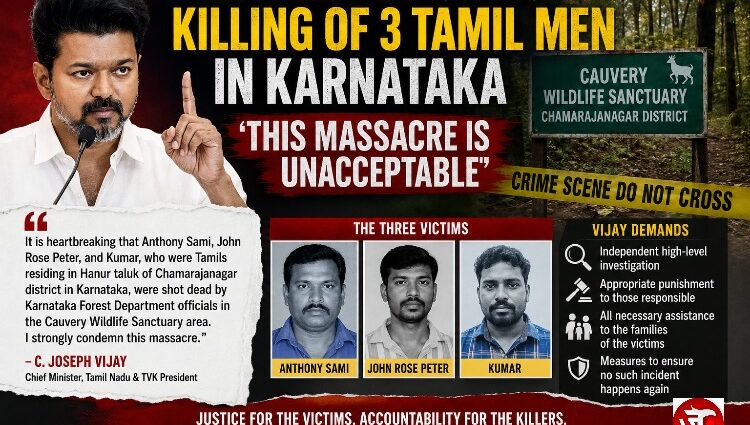
August 17, 2026: Tamil Nadu Chief Minister and Tamilaga Vettri Kazhagam (TVK) president C. Joseph Vijay has strongly condemned the killing of three Tamil men by Karnataka Forest Department personnel in the Cauvery Wildlife Sanctuary in Chamarajanagar district, describing the incident as a “massacre” and demanding a high-level investigation.
The three men, identified as Anthony Sami, John Rose Peter and Kumar, were reportedly residents of villages in Hanur taluk of Chamarajanagar district. They were killed in the early hours of August 15 during an alleged anti-poaching operation in the forest area. Karnataka authorities have described the incident as an exchange of fire involving suspected poachers.
In a statement shared through the official TVK handle, Vijay rejected the Karnataka Forest Department’s explanation as “unacceptable” and called for an impartial investigation into the circumstances surrounding the deaths.
“It is heartbreaking that Anthony Sami, John Rose Peter, and Kumar, who were Tamils residing in villages in the Hanur taluk of Chamarajanagar district in Karnataka, were shot dead by Karnataka Forest Department officials in the early hours of August 15, 2026, in the Cauvery Wildlife Sanctuary area. I strongly condemn this massacre,” Vijay said.
The Chief Minister demanded that a high-level inquiry committee be constituted to establish what happened and determine responsibility. He also called for appropriate punishment for anyone found guilty and urged the Karnataka government to provide assistance to the victims’ families.
“An honest investigation must be conducted regarding this brutal incident,” Vijay said, according to the statement, while also urging Karnataka authorities to take measures to ensure that such an incident is not repeated.
The deaths have triggered political concern in Tamil Nadu, with several parties and leaders calling for a transparent investigation. The DMK, CPI, CPM, PMK and MMK have also condemned the killings and demanded a fair probe.
The Karnataka Forest Department, meanwhile, has maintained that the operation was connected to a wildlife crime investigation. Officials reportedly seized around 20–30 kg of wild animal meat, four tents and other material during a combing operation in the Hanur Wildlife Range on August 15.
The central question now is whether the three men were killed during a genuine exchange of fire, as claimed by the authorities, and whether the use of lethal force was justified. Those questions can only be settled through an independent and credible investigation, rather than competing statements from officials and politicians. Humanity has somehow managed to invent both wildlife protection laws and bullets, so accountability remains the inconvenient part.
The incident has also revived concerns over the treatment of people living around protected forest areas and the need to ensure that anti-poaching operations remain firmly within the law.
Vijay’s demand puts pressure on the Karnataka government to establish the facts quickly and transparently, particularly as the deaths involve residents of a border region where communities and livelihoods frequently intersect with protected forests.
It’s important to remember the laws of poaching: In India, a government official cannot simply “shoot blindly” at people because they are suspected of being poachers or because they have entered a protected forest. The law does not turn a wildlife sanctuary into a place where constitutional protections conveniently disappear.
Under the Bharatiya Nyaya Sanhita (BNS), 2023, the use of lethal force has to fall within a legally recognised justification. The right of private defence can extend to causing death only in specific circumstances, such as an assault that reasonably creates an apprehension of death or grievous hurt. Even then, the law expressly says that the force used cannot exceed what is necessary for defence.
There is an important distinction here: Suspected poaching is not, by itself, a licence to kill. Entering a protected forest or allegedly carrying weapons does not automatically establish that lethal force was necessary. If forest personnel genuinely faced an immediate threat to their lives, lethal force may potentially be legally justified, depending on the facts.
If there was no such immediate threat, the circumstances of the shooting require investigation and whether the three men fired first, what weapons were recovered, the distance and direction of the shots, forensic evidence, injuries, post-mortem findings, and whether alternative means of apprehension were available are all crucial.
The BNS specifically states that the right of private defence “in no case extends to the inflicting of more harm than it is necessary” for defence.
And the criminal-procedure framework does not give officials unlimited powers either. The Bharatiya Nagarik Suraksha Sanhita (BNSS) regulates arrest and the means that can be used to effect an arrest.
The demand from Tamil Nadu is now clear: investigate the deaths, establish accountability and ensure that justice is not lost somewhere between the forest and the official version of events.
JANPATH NEWS NETWORK (JNN)
Independent. Fearless. On the People’s Path.