










J&K Courts Order GPS Monitors for People on Bail, First in India, Despite Supreme Court Privacy Violation Ruling
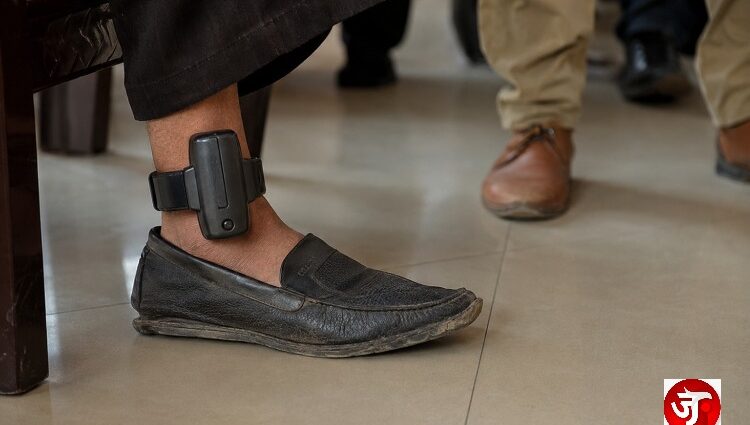
A person walks out of prison after securing bail. Legally, that person is no longer in custody. But in parts of Jammu and Kashmir, freedom can now come with a small black device locked around the ankle, silently transmitting where the wearer goes.
In July 2024, the Supreme Court of India held that a bail condition enabling police or an investigating agency to track every movement of an accused through technology or otherwise violates the right to privacy under Article 21. Yet documented cases show that GPS anklets have continued to be imposed in Jammu and Kashmir, including in 2026.
The experiment began in Jammu
The practice became public in November 2023, when a Special National Investigation Agency court in Jammu directed the Jammu and Kashmir Police to affix a GPS tracker anklet to Ghulam Mohammad Bhat, an accused facing UAPA-related allegations including terror financing.
J&K Police described the move as a first for India. The authorities argued that close technological monitoring was justified because of the nature of the allegations and the stringent requirements surrounding bail in terrorism-related cases.
The logic was straightforward: instead of keeping a person behind bars, the State could release him while retaining the ability to monitor his movements.
That distinction matters.
A conventional bail condition might require an accused to report periodically to a police station, appear before a court, surrender a passport or stay away from a specified area. A GPS anklet is fundamentally different. It places surveillance technology directly on the body and potentially converts movement itself into a stream of information available to law enforcement.
The technology was not introduced in a legal vacuum, however. Police pointed to practices in countries including the United States, United Kingdom, Australia, New Zealand and South Africa, where electronic monitoring has been used in various contexts including bail, parole and house arrest.
But importing a technology does not automatically import the legal safeguards that may accompany it elsewhere. That is where India’s experiment becomes considerably more complicated.
From terrorism cases to narcotics cases
The anklet did not remain confined to the original UAPA case.
By May 2024, J&K Police had expanded the system to narcotics cases. In Kupwara, Abdul Majid Bhat and Aabid Ali Bhat, accused under the NDPS Act, were released on bail with GPS anklets pursuant to a court order. Local reporting described the purpose explicitly as maintaining surveillance over their movements while they remained on bail.
Days later, Baramulla police announced that a GPS tracker had been installed on a bailed-out accused in an NDPS case, again pursuant to a court order. Police said the purpose was to monitor movement and ensure compliance with bail conditions.
The geography of the experiment also expanded. Udhampur police had already installed a GPS anklet on an accused released on interim bail in a UAPA case in December 2023.
By then, the technology was no longer merely an extraordinary response to one terrorism-related case. It was becoming an enforcement tool that could be deployed through ordinary bail orders in different districts and different categories of criminal cases.
That expansion is arguably more important than the original experiment.
A surveillance mechanism introduced as an exceptional response to terrorism can, over time, become normalised. First terrorism. Then narcotics. Then other serious offences. And eventually the question shifts from whether electronic monitoring should exist to which categories of accused should receive it.
That is how exceptional powers become administrative routine. Human institutions have a remarkable talent for turning temporary measures into permanent furniture.
The Supreme Court had already drawn a constitutional line
Then came the Supreme Court’s judgment in Frank Vitus v. Narcotics Control Bureau on July 8, 2024.
The case did not concern a physical ankle monitor. It concerned a bail condition requiring an accused to share a Google Maps PIN so that the investigating agency could access his location.
The Supreme Court held that a bail condition enabling police or an investigating agency to track the accused’s movements constantly, using technology or otherwise, would violate the right to privacy under Article 21. It deleted the Google Maps condition.
The Court’s reasoning went beyond the technical question of Google Maps and stressed that bail conditions cannot become so onerous that they effectively defeat the liberty granted by bail. It also warned against allowing investigative agencies to maintain constant vigilance over a person’s movements and “peep” into private life. Continuous technological surveillance, the Court reasoned, can amount to a form of confinement even after release from prison.
This is the crucial constitutional problem confronting GPS anklets. An anklet is not merely a person voluntarily sharing a location pin. It is a physical device attached to the body and designed specifically for monitoring movement. That makes the constitutional question arguably sharper, not weaker.
The Article 21 problem
The right to privacy is not absolute. The Supreme Court made that clear in its landmark privacy jurisprudence. But the State cannot simply say that security requires surveillance and stop the constitutional analysis there.
In K.S. Puttaswamy v. Union of India, the Supreme Court established that an intrusion into privacy must satisfy requirements including legality, a legitimate State aim and proportionality. There must also be safeguards against abuse.
This creates three uncomfortable questions for electronic ankle monitoring.
First: where is the specific legal authority?
Is there a clearly defined statutory framework authorising continuous, body-attached electronic surveillance as a condition of bail?
A judicial order granting bail can impose conditions appropriate to the circumstances. But when the condition creates an ongoing surveillance regime involving collection of highly sensitive location information, the constitutional question becomes considerably larger than the ordinary discretion to impose bail conditions.
Second: is continuous tracking necessary in every case in which it is imposed?
There is an obvious difference between preventing an accused from leaving a particular jurisdiction and recording his location continuously, including movements within his own home and neighbourhood.
If a less intrusive condition can achieve the same objective, proportionality becomes difficult to establish.
Third: what happens to the data?
This may be the least visible and potentially most important issue.
A location trail can reveal far more than whether somebody has complied with bail. It can reveal where a person sleeps, whom they visit, where their family members live, where they seek medical care, where they worship, where they work and how they spend their private lives.
The Supreme Court’s privacy jurisprudence specifically recognises informational privacy as part of the constitutional protection.
The question therefore cannot simply be whether the police can collect the data.
It must also be: who can access it, how long can it be retained, for what purpose can it be used, can it be shared, when must it be deleted, and what remedy does the accused have if the system is misused?
Without clear answers, surveillance risks becoming a permanent archive of a person’s movements.
The word “bail” starts to look complicated
Bail is not an acquittal. An accused remains subject to the criminal process and can be required to comply with reasonable conditions.
But bail is also not supposed to be a technological substitute for imprisonment.
The Supreme Court has explicitly warned that conditions cannot effectively turn release into continued confinement. This is why critics describe electronic monitoring as “virtual custody” or “e-carceration.”
The strongest argument for the anklets
There is, nevertheless, a powerful argument on the other side.
Jammu and Kashmir presents an unusually difficult security environment. Investigators dealing with terrorism, terror financing, militant networks and narcotics trafficking face risks that cannot simply be treated like ordinary criminal cases.
The State also has an interest in preventing an accused who has been granted bail from disappearing, contacting witnesses, returning to criminal activity or assisting an underground network.
Electronic monitoring can provide a middle ground.
Instead of choosing between incarceration and unrestricted freedom, the State can release an accused while maintaining a technological safeguard.
That can have an important consequence in a criminal justice system where prolonged pre-trial detention itself is a major concern.
In that sense, an ankle monitor can be portrayed not only as a surveillance device but as an instrument that makes release possible in cases where a court might otherwise be reluctant to grant bail.
Police have explicitly argued that the technology helps monitor accused persons and prevent violations of bail conditions. The argument cannot simply be dismissed.
The constitutional challenge is not whether the State has a legitimate interest in security. It plainly does.
The question is whether constant bodily surveillance is the least intrusive and legally authorised method of achieving that interest.
The most significant finding in the J&K experience may therefore not be that GPS anklets exist. It is that the technology has demonstrated institutional momentum.
The first case was a UAPA matter in 2023. By 2024, reporting documented deployment in narcotics cases and multiple districts. By March 2026, Kathua police had again fitted GPS anklets on three accused released on interim bail after a court order. The accused were identified by police as alleged Jaish-e-Mohammad overground workers in a case connected to the 2024 Kathua attack on an Army convoy.
That 2026 case is particularly revealing because it demonstrates that the practice did not disappear after the Supreme Court’s 2024 judgment. It survived, and that survival raises a question more serious than the legality of any single anklet:
The Supreme Court in Frank Vitus was directly deciding the legality of a Google Maps location-sharing condition. It did not issue a judgment specifically declaring every possible form of electronic monitoring unconstitutional.
But its language was broad. The Court said that bail conditions enabling police or investigative agencies to track every movement of an accused through technology or otherwise would violate Article 21. That does not automatically mean every GPS anklet in every circumstance is conclusively unlawful.
It does mean that courts imposing continuous GPS monitoring must confront the constitutional principles articulated by the Supreme Court.
A future case involving physical electronic monitoring could therefore force the judiciary to answer questions that Frank Vitus left open: Can an ankle monitor ever be a valid bail condition? If yes, under what statute? For which offences? For how long? Who controls the data? What safeguards apply? What alternatives must a court consider before imposing it? And most importantly, can continuous tracking ever be reconciled with the Supreme Court’s warning against turning bail into technological confinement?
The danger is not necessarily that GPS anklets will be used in serious cases. The danger is that a tool introduced for exceptional circumstances gradually becomes normal.
The GPS anklet does more than track movement. It can mark the wearer. In a crowded marketplace, on public transport or at a family gathering, the device can become a visible reminder that the person is under State surveillance. Bail may restore physical liberty, but the anklet can impose another kind of punishment: the loss of anonymity, dignity and the ability to move through society without being publicly identified by the criminal-justice system.
That is how surveillance expands. Rarely through one dramatic announcement. More often through a sequence of individually defensible decisions. Each case has its own justification. The system grows quietly. And one day a practice that once seemed extraordinary has become ordinary.
The Constitution may eventually require us to decide whether it can also be called freedom.
JANPATH NEWS NETWORK (JNN)
Independent. Fearless. On the People’s Path.