







On August 7, 2026, Saudi Arabia, Pakistan and Türkiye signed the Makkah Joint Defence Agreement, creating a new security framework with potentially significant consequences for West Asia and South Asia.
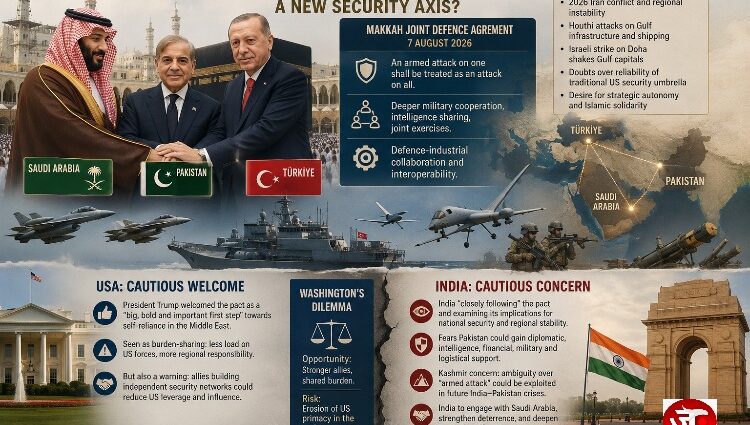
On August 7, 2026, Saudi Arabia, Pakistan and Türkiye signed the Makkah Joint Defence Agreement, creating a new security framework with potentially significant consequences for West Asia and South Asia. Signed in Makkah by Saudi Crown Prince Mohammed bin Salman, Pakistani Prime Minister Shehbaz Sharif and Turkish President Recep Tayyip Erdoğan, the pact states that an armed attack against one member will be treated as an attack against all three. It also envisages deeper military cooperation, intelligence sharing, joint exercises and defence-industrial collaboration.
The symbolism of Makkah is powerful, but the strategic message is even more important. The three countries appear to be preparing for a world in which regional powers cannot depend entirely on external security guarantees. They are not abandoning their relationships with the United States or other partners. They are building additional options.
For Washington, this creates a paradox. Greater regional self-reliance could reduce the burden on American forces, something successive US administrations have encouraged. But the more capable America’s partners become at coordinating independently, the less indispensable Washington becomes. Saudi Arabia, Türkiye and Pakistan could increasingly manage certain regional crises without waiting for the United States to organise the response.
The pact does not replace existing American relationships. Saudi Arabia remains a major US defence partner, Türkiye remains a NATO member and Pakistan retains longstanding military ties with Washington. The agreement is therefore better understood as strategic hedging than as an anti-American alliance.
Iran is an important part of the backdrop. Saudi Arabia has longstanding concerns about Iran and its regional partners, while Türkiye and Pakistan share borders with Iran and maintain complex relationships with Tehran. The Makkah framework is officially defensive and does not identify Iran or any other country as its target. Its effectiveness will ultimately depend on how its collective-defence clause is interpreted and implemented.
For India, however, Pakistan’s membership makes the pact especially significant.
India and Pakistan remain nuclear-armed rivals, with Kashmir at the centre of decades of conflict. Yet it would be premature to describe the Makkah agreement as an automatic Saudi-Turkish military guarantee for Pakistan against India. There is no public indication that Riyadh or Ankara has committed to fighting India in a future conflict.
The greater concern is indirect. Pakistan could potentially gain greater access to Turkish defence technology, Saudi financing, intelligence cooperation, training, logistics and diplomatic support. Such assistance could strengthen Islamabad’s strategic position without requiring Saudi or Turkish troops to enter an India-Pakistan conflict.
Türkiye deserves particular attention because of its expanding defence industry, especially in drones, missiles, naval systems and electronic warfare. Deeper Turkish-Pakistani defence cooperation could therefore have consequences for India’s security calculations.
Saudi Arabia, however, has strong economic and strategic interests in India. India is a major energy market, trading partner and home to a large Indian diaspora in the Gulf. Riyadh is unlikely to casually jeopardise these interests by entering a conflict with India.
New Delhi should therefore avoid both complacency and overreaction. India can strengthen its economic, energy, maritime and defence ties with Saudi Arabia while closely monitoring Turkish-Pakistani military cooperation. Its objective should be to ensure that Pakistan’s expanding strategic network does not evolve into a broader coalition against Indian interests.
For Washington, the pact is another sign of a more multipolar international system. America may remain the dominant external military power in the region, but its partners are increasingly building alternative security relationships.
The Makkah agreement does not yet create a “Muslim NATO”. Its real importance will depend on implementation: permanent military structures, intelligence sharing, joint exercises, defence production and credible mechanisms for collective response.
The pact is therefore less about immediately redrawing the map than revealing where the map may be heading. Regional powers are writing their own security insurance policies.
For the United States, that means potentially sharing both the burden and the influence. For India, it means watching Pakistan’s expanding strategic network without unnecessarily alienating Saudi Arabia or the wider Gulf.
JANPATH NEWS NETWORK (JNN)
Independent. Fearless. On the People’s Path.