










Vande Mataram: A National Song, a Complicated History
Few patriotic songs in India carry the emotional power, historical prestige and political controversy of Vande Mataram. It became one of the great anthems of the freedom struggle. Yet its history is more complicated than the familiar patriotic invocation suggests.
The key distinction is between its first two stanzas and the later portions of the poem.
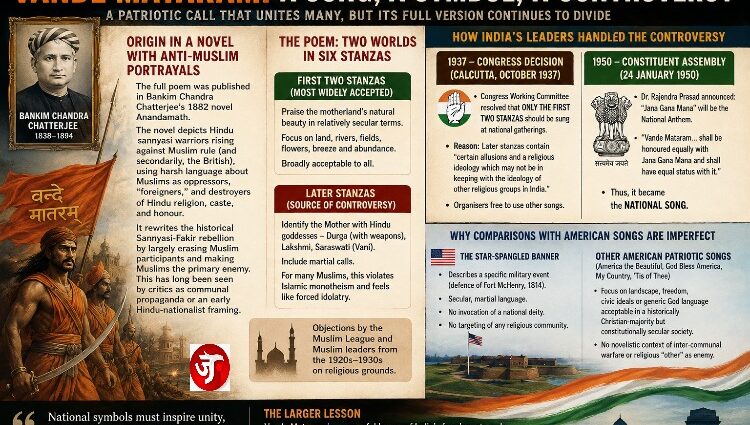
The song appeared in Bankim Chandra Chattopadhyay’s 1882 novel Anandamath, a work centred on Hindu ascetic warriors fighting Muslim rule. The novel portrays Muslim rule in deeply negative terms and places Hindu regeneration at the heart of its vision of national liberation. That literary context has led historians and critics to regard Anandamath as an important source of an early Hindu-nationalist imagination.
But Vande Mataram cannot simply be dismissed as an “anti-Muslim song”. Its opening two stanzas are strikingly different. They celebrate the motherland through images of rivers, crops, greenery, cool winds, moonlight and abundance. There is no explicit invocation of a Hindu deity. These were the stanzas that became the song’s broadly shared nationalist expression.
The later stanzas move into an explicitly Hindu religious and martial vocabulary. The Mother is identified with Hindu goddesses including Durga, Lakshmi and Saraswati, transforming the motherland from a poetic personification into a distinctly Hindu sacred figure.
That creates a deeper question in a religiously plural India: The concern surrounding the later stanzas of Vande Mataram is not merely a Hindu-Muslim question. India is home to several major religious and philosophical traditions whose understanding of the divine differs fundamentally from the poem’s identification of the motherland with Hindu goddesses.
Muslims, Christians, Sikhs and Jews affirm monotheistic traditions; Zoroastrianism centres worship on Ahura Mazda while treating fire as sacred; Buddhism and Jainism do not rest upon belief in a creator God at all. The later stanzas, therefore, articulate one particular religious conception of the nation rather than the full theological and philosophical diversity of India.
That distinction helps explain why the national movement ultimately separated the opening two, more universally accessible stanzas from the explicitly religious imagery of the later verses.
The issue, therefore, was never simply whether Vande Mataram was patriotic. It was whether one particular religious vocabulary could serve as an unquestioned expression of a common Indian nationalism.
The freedom movement itself recognised the problem.
In October 1937, the Congress Working Committee acknowledged objections to the later stanzas, noting that they contained “certain allusions and a religious ideology” that might not accord with the beliefs of other religious groups. It recommended that only the first two stanzas be sung at national gatherings.
That was not a rejection of Vande Mataram. It was an attempt to preserve its historic nationalist power while making its public use more inclusive.
The distinction survived independence. On 24 January 1950, Constituent Assembly President Dr Rajendra Prasad declared Jana Gana Mana the National Anthem and said that Vande Mataram, because of its historic role in the freedom struggle, would be honoured equally and given equal status with it.
This history matters today because two opposite claims can both distort the past.
To portray Vande Mataram simply as an anti-Muslim song erases its extraordinary role in India’s struggle against colonial rule and the independent national meaning acquired by its opening stanzas.
But to treat the entire original poem as though every stanza carries the same inclusive meaning ignores its Anandamath setting, its depiction of Muslim rule and its explicitly Hindu theological imagery.
The 1937 compromise understood this distinction.
It recognised that love of the motherland need not require uniformity of faith. The argument is not really about four additional stanzas of an old poem. It is about what kind of nation India believes itself to be.
JANPATH NEWS NETWORK (JNN)
Independent. Fearless. On the People’s Path.