










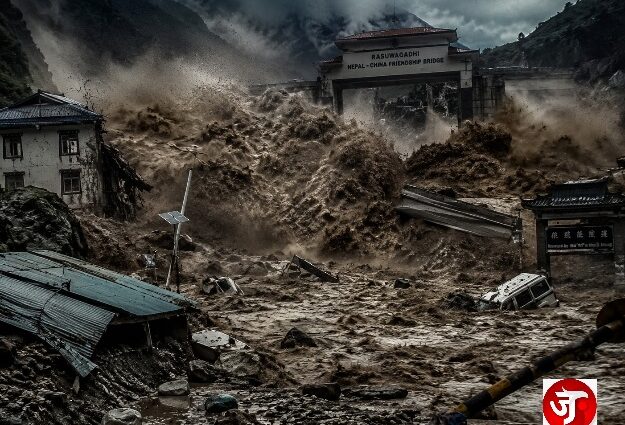
At around 9 a.m. on Wednesday, 26 August 2026, the Himalayas seemed to split open.
A sudden, terrifying surge of mud, rock and water tore through Nepal’s Rasuwa district near the Tibet border, transforming the Bhote Koshi River into a raging wall of destruction. In minutes, the Rasuwagadhi border area was overwhelmed. Roads disappeared. Bridges were swept away. Buildings, vehicles, customs facilities and riverside settlements were ripped apart and carried downstream.
The images are almost impossible to comprehend: where there had been a functioning international border crossing, there was suddenly a landscape of mud, broken concrete and violently moving water.
The disaster struck the Timure and Syafrubesi areas with extraordinary speed. The Friendship Bridge and other infrastructure around the Rasuwagadhi crossing were badly damaged, while communities along the river were inundated. Hydropower infrastructure was also hit, adding another layer of devastation to a region already cut off by destroyed roads and bridges.
And then came the most frightening number. As many as 384 travellers have been reported missing.
According to preliminary information released by the Nepal Tourism Board, the missing include 291 foreign nationals and 93 Nepali citizens. Among the foreign nationals are 105 Indians, along with travellers from several other countries. The list is still being verified, and authorities have cautioned that being reported missing means contact has been lost, not that the individuals have been confirmed dead. Some reports say nearly 400 Kailash-bound pilgrims are out of contact after Rasuwa flash flood including 93 Nepalis, who were preparing to cross into Tibet on Wednesday.
Many of those unaccounted for were travelling towards the Kailash Mansarovar pilgrimage route, making the tragedy especially painful for families across India and Nepal who are now waiting desperately for word from loved ones.
At least eight people were initially confirmed dead, with later reports putting the toll higher as rescue teams recovered more bodies. Nepal’s Army, Armed Police Force and police have been deployed, while helicopters, drones and search teams are working in terrain made treacherous by debris, damaged roads and unstable river conditions.
Here are three terrifying visuals:
A border erased by water
The destruction was not confined to Nepal.
Across the border, China’s Gyirong Port area was also affected. Video footage from the Chinese side showed an immense surge of debris striking the border complex and transforming the area within moments. The disaster has effectively severed an important trade and travel corridor between Nepal and Tibet.
For those caught in the flood, there was little warning. One moment there were roads, buildings, vehicles and people moving through a familiar landscape. The next, the river had become an unstoppable torrent carrying boulders, trees, vehicles and debris.
What caused the catastrophe?
The exact cause is still being investigated, and it is important not to turn preliminary explanations into established fact.
Early reports suggested that a huge mass of mud and rock may have collapsed into an upstream river, suddenly displacing an enormous volume of water. Reuters reported that satellite imagery and video appeared consistent with an ice-rock avalanche, while experts cited by the Associated Press pointed to an avalanche from a Nepalese glacier that may have blocked a river before the water suddenly burst through.
According to Nepal’s meteorological department, there was rain in the area, but not enough to cause a sudden flood of this magnitude. It is suspected that a massive amount of water may have flowed towards Nepal due to the sudden bursting of a glacial lake in Tibet, i.e., a glacial lake outburst flood.
Officials are therefore examining the possibility of an avalanche, landslide or other sudden blockage-and-release event. The precise mechanism remains under investigation.
That uncertainty makes the event no less terrifying. The Himalayas can store enormous quantities of ice, rock and water above settlements and river valleys. When that natural architecture fails, the release can happen in minutes.
Bihar now watches the rivers
The disaster is also being watched anxiously across the border in India.
Bihar authorities have gone onto heightened alert because of the possibility of a sudden rise in water levels in rivers fed by Nepal, particularly the Gandak. The state government has activated high-level monitoring and instructed officials in vulnerable districts to remain prepared.
Reports indicate heightened preparedness across districts including West Champaran, Gopalganj, Saran, Muzaffarpur, Vaishali and East Champaran, with NDRF and SDRF resources being positioned for emergencies.
Bihar’s concern is not theoretical. The state’s own flood-monitoring system showed several river gauges above warning or danger levels on 26 August, including locations on the Gandak and Kosi systems.
Authorities have urged people living near riverbanks and in low-lying areas to remain vigilant, avoid unnecessary movement near rivers and rely on official warnings rather than rumours.
And the waiting is made worse by the landscape itself. Roads have vanished. Communications have been disrupted. Bridges have collapsed. Helicopters face difficult weather and terrain. Rescue workers are searching through enormous quantities of mud and debris while officials warn that conditions upstream may still pose danger.
The tragedy at Rasuwagadhi is a reminder of something humanity repeatedly forgets: the Himalayas are not merely scenery.
They are a living, unstable system of glaciers, rivers, cliffs, landslides and immense stores of frozen water. A road can be rebuilt, bridges reconstructed, customs post replaced, but when a mountain releases its stored fury, human infrastructure can disappear in seconds. On 26 August, the Himalayas demonstrated that with terrifying clarity.
The immediate priority now is to find the missing, rescue the stranded, recover the dead, protect communities downstream and keep the rivers under relentless watch.
JANPATH NEWS NETWORK (JNN)
Independent. Fearless. On the People’s Path.