









The new controversy itself is much sharper than the older Red Sari episode by Javier Moro. Modi, RSS, China are the Three Flashpoints Behind Sonia Gandhi’s Belonging Row
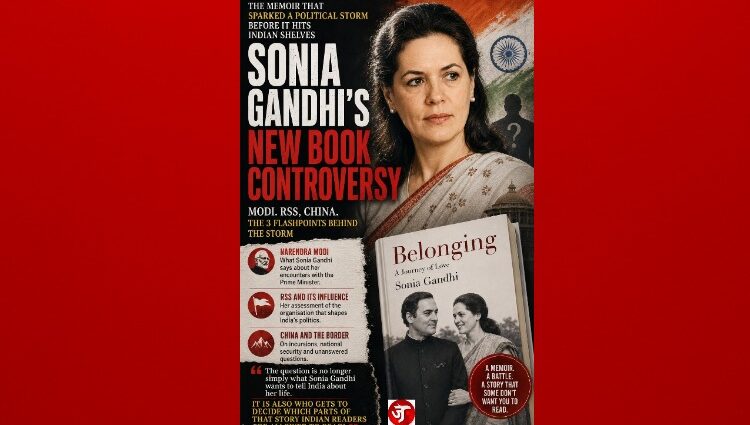
August 31: Sonia Gandhi’s much-anticipated memoir has become a political controversy before most Indian readers have even had the opportunity to turn its first page.
Belonging: A Journey of Love, described as Sonia Gandhi’s deeply personal account of her life, her marriage to Rajiv Gandhi and her long journey through the centre of Indian politics, was expected to offer an unusually intimate view of the woman who spent decades at the heart of the Congress and the Nehru-Gandhi family.
Instead, the book has become embroiled in a dispute over what should, and should not, appear in its pages.
Penguin Random House India’s decision to step away from publishing the memoir followed a disagreement over editorial changes and deletions reportedly sought in parts of the manuscript. Congress sources have alleged that some of the contentious material relates to Prime Minister Narendra Modi, the Rashtriya Swayamsevak Sangh and India’s tensions with China. Sonia Gandhi, according to these reports, refused to make the requested changes.
Those claims, however, need to be treated carefully because Penguin Random House India has disputed the way the episode has been portrayed.
The publisher has said that it is not the Indian publisher of Belonging and rejected the suggestion that it abandoned the project simply because Sonia Gandhi refused editorial changes. It has maintained that fact-checking and editorial recommendations are a normal part of publishing and said it remained willing to publish the book. The company has also declined to discuss confidential dealings with the author.
That leaves an intriguing gap between the two accounts, and it is precisely in that gap that the controversy has grown.
The reported references to Narendra Modi are particularly politically charged. Sonia Gandhi and Modi have occupied opposite sides of India’s political battlefield for years, and a memoir gives her an opportunity to describe the Prime Minister not through the language of an election speech or parliamentary confrontation, but through her own recollections of encounters with him.
Such personal observations can be far more revealing than public political rhetoric. According to reports, the manuscript contains Sonia Gandhi’s reflections on Modi and her experiences of dealing with him during their years in national politics.
The reported discussion of the RSS adds another layer of sensitivity. Sonia Gandhi has long represented a political tradition fundamentally opposed to the ideological worldview associated with the organisation. Any personal assessment of the RSS and its influence on Indian politics was therefore bound to attract attention, particularly when it appears in the memoir of a former Congress president.
Then there is China.
The manuscript reportedly discusses Chinese incursions and India’s handling of the border issue during the Modi years. The India-China frontier has become one of the most politically sensitive subjects in the country, with the government and opposition repeatedly clashing over questions of national security, territorial sovereignty and the handling of Chinese activity along the border.
If Sonia Gandhi’s memoir contains her recollections of how the issue was viewed within the Congress leadership, those passages could prove politically significant.
This is also why the fact that the international edition of the memoir is going ahead has added fuel to the controversy. Belonging is scheduled for international publication on November 10, 2026, through Alfred A. Knopf, a Penguin Random House imprint. The international publication means the book itself has not disappeared. The dispute concerns its publication in India.
Congress leaders have seized on that variance.
Former Rajasthan Chief Minister Ashok Gehlot has alleged that pressure was exerted on Penguin Random House to remove references concerning Modi, the RSS and China. Other Congress leaders have questioned why material considered problematic for an Indian edition could appear in an international publication.
But there is, so far, no publicly established evidence that the government ordered Penguin Random House to seek the alleged deletions. Political allegations are not proof, however irresistible the headline may be.
What makes the controversy particularly fascinating is that the book now risks becoming more politically important precisely because of the dispute surrounding it.
Readers who might otherwise have approached Belonging simply as the memoir of a former Congress president are now asking a very different set of questions. What exactly did the publisher want changed? Which passages were considered problematic? What does Sonia Gandhi actually say about Modi? What does she write about the RSS? And what does she reveal about China’s border incursions and the political response to them?
Those questions may become even louder if another publisher takes up the Indian edition.
There is already reportedly interest from HarperCollins India in publishing and distributing the book after Penguin’s involvement ended. If that happens, the controversy could give the memoir an audience far larger than it might otherwise have received.
There is a final irony to all this.
Sonia Gandhi’s life has been the subject of books, biographies, political attacks and controversies for decades. Javier Moro’s The Red Sari, a dramatised account of her life, became embroiled in a legal and political dispute when the Congress was in power. Now, years later, Sonia Gandhi is attempting to tell her own story in her own words, and the book itself has become the subject of a publishing battle.
The question is no longer simply what Sonia Gandhi wants to tell India about her life. It is also who gets to decide which parts of that story Indian readers are allowed to read!
And that may ultimately be the most consequential controversy surrounding Belonging.
JANPATH NEWS NETWORK (JNN)
Independent. Fearless. On the People’s Path.