










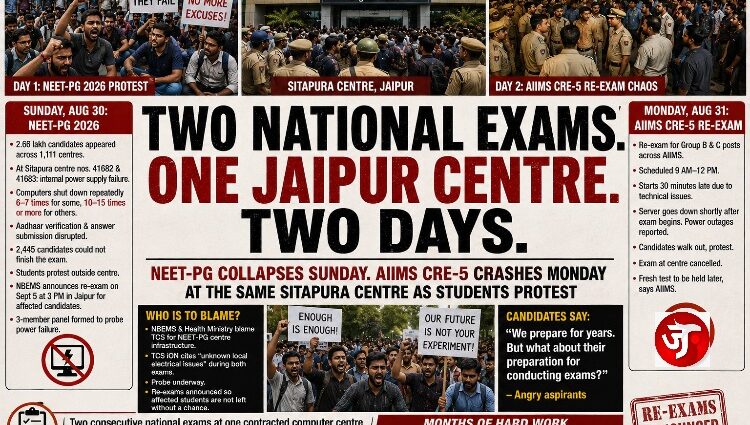
NEET-PG collapses on Sunday. AIIMS CRE-5 crashes the very next morning at the same Sitapura computer centre, leaving thousands of candidates furious
AUGUST 31: What was supposed to be a test of India’s brightest medical aspirants and government-job candidates instead became a test of how much technical failure students can endure.
At the same TCS iON Digital Zone centres in Sitapura, Jaipur, two high-stakes national examinations ran into serious technical trouble within roughly 24 hours of each other.
On Sunday, NEET-PG 2026, the national entrance examination for postgraduate medical seats, was disrupted at centre numbers 41682 and 41683. On Monday morning, the same venue was hit by another breakdown during the AIIMS CRE-5 re-examination.
For candidates who had spent months preparing, the message was brutal: the examination may be national, but the infrastructure apparently was not ready for the nation.
2,445 NEET-PG CANDIDATES LEFT UNABLE TO FINISH
NEET-PG was conducted on August 30 at 1,111 centres, with around 2.66 lakh candidates appearing nationwide. While the examination proceeded normally for the overwhelming majority, chaos erupted at the two Sitapura centres.
Officials cited an internal power-supply failure.
Candidates described a far more traumatic experience: computers repeatedly shutting down in the middle of the examination. Some reportedly saw their systems crash six or seven times, while others said the failures occurred 10–15 times or more.
Systems would restart, briefly return to the examination and then collapse again. Even basic processes such as Aadhaar verification and submission of answers were reportedly affected.
The final toll: 2,445 candidates were unable to complete the examination.
Angry students gathered outside the centre and protested.
The National Board of Examinations in Medical Sciences subsequently announced a re-examination on September 5 at 3 PM in Jaipur for the affected candidates.
NBEMS attributed the infrastructure failure to TCS Ltd, the agency operating the examination centres, and constituted a three-member committee to investigate the power failure.
And there is an especially awkward detail: NBEMS said a mock test under similar computer load had successfully been conducted at the same centre the previous day.
THEN CAME MONDAY MORNING
Barely had the NEET-PG controversy begun to settle when the same Sitapura venue was again placed under the spotlight.
On August 31, candidates arrived for the AIIMS Common Recruitment Examination-5 (CRE-5) re-examination, a recruitment test for Group B and C non-faculty positions across AIIMS institutions.
This examination was itself a re-test, following problems with an earlier CRE-5 examination. The test was scheduled to begin at 9 AM. Instead, candidates reportedly waited around 30 minutes because of technical problems.
Then, shortly after the examination finally began, the server went down.
Power disruptions were also reported.
Candidates walked out. Protests erupted. Police were deployed. The examination at the centre was subsequently cancelled, with AIIMS indicating that a fresh examination would be conducted later.
ONE CENTRE. TWO EXAMS. ONE VERY SERIOUS QUESTION.
TCS iON later said the Sitapura centre experienced “unknown local electrical issues” during both examinations. Vendor teams were working to resolve the problems, and the company expressed regret for the inconvenience. But for the candidates, regret comes rather late.
These were not casual classroom tests. NEET-PG determines access to postgraduate medical education. AIIMS CRE-5 determines access to government employment.
Thousands of candidates prepared for these examinations under enormous academic and personal pressure. Yet at one contracted computer-based testing facility, the most basic requirements of an examination centre, stable power, functioning computers and reliable servers, failed spectacularly on two consecutive days.
The incident now raises a much larger question about India’s dependence on outsourced digital examination infrastructure.
If a national examination can collapse because computers repeatedly lose power, and the very next national examination at the same venue can collapse because of server and power problems, who is ultimately responsible for the students who pay the price?
For the affected candidates, this is not merely a technical glitch.
It is months of preparation, anxiety and opportunity placed at the mercy of a power switch and a server. And that is an extraordinarily poor way to conduct a national examination.
JANPATH NEWS NETWORK (JNN)
Independent. Fearless. On the People’s Path.