








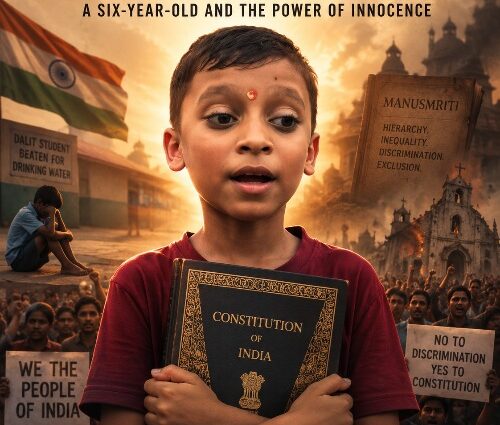
There is something deeply stirring about the image of a six-year-old boy holding the Constitution of India. People may think he is too young to understand every word in that enormous book, probably cannot explain Article 14, cannot debate constitutional jurisprudence, and he may not yet understand the full meaning of liberty, equality, fraternity or fundamental rights.
But perhaps he understands something far more elemental. This book is supposed to protect me. That is the power of the Constitution in the hands of a child.
The six-year-old Patna boy, Aditya Kumar, has become an unlikely face of protest after appearing at demonstrations by BPSC teacher-recruitment aspirants. He was seen carrying the national flag and questioning the treatment of protesters. Videos of his encounter with the police spread widely, and he later appeared with a red-covered copy of the Constitution, demanding justice for his parents.
Strip away the politics surrounding him for a moment and look at the child. Imagine him holding that book and, somewhere in his young mind, beginning to understand what it represents. Equality, dignity, freedom, and justice.
This book promises that the State does not own him, that his parents do not become less human because they are poor, and that a person’s caste, religion, birthplace or social status cannot determine the value of his life.
And perhaps, even without fully understanding it, the child senses another truth:
There are ideas in India that existed before the Constitution, and there are ideas that the Constitution was created to overcome.
One of the texts at the centre of India’s long and complicated history of caste and social hierarchy is the Manusmriti. It is important not to pretend that this ancient text is somehow legally replacing the Constitution today. It is not.
But the deeper question is not merely which book sits in a law library, the question is: Which vision of India wins on the ground?
A constitutional India in which every child is born equal? Or a society in which inherited hierarchy continues to determine who commands respect, who is humiliated, who is excluded and whose dignity can be casually violated?
That question becomes painfully real when we look beyond speeches.
In July, an under-construction church in Sonarpur, West Bengal, was vandalised after a mob allegedly entered the premises, threatened members of the congregation and damaged the building and crosses. Police registered an FIR and detained three youths.
In Madhya Pradesh, the National Human Rights Commission took suo motu cognisance after reports that a Class 4 Dalit child was beaten by a teacher and subjected to casteist slurs. The alleged incident reportedly began after the teacher objected to the child drinking water from his own bottle.
In Rajasthan, police registered an FIR after Dalit residents alleged that they were forced to leave chairs and sit on the floor during an Independence Day function.
These are not abstract arguments about ancient texts. This is what ideology looks like when it reaches the ground. When it reaches the schoolroom, villages, churches, dining spaces, children, and adults, parents, this is when even a six-year-old gets pulled into political battles.
But history has repeatedly shown something extraordinary about young people.
When adults become frightened, compromised or exhausted, children sometimes see injustice with terrifying clarity.
In 1707, Lutheran children in Silesia gathered to pray despite religious restrictions and threats from authorities. The movement became known as the Kinderbeten, or Children’s Prayer revival.
In the American Civil Rights Movement, thousands of Black schoolchildren marched in Birmingham in 1963 against segregation. Images of children facing police dogs and fire hoses shocked a nation and helped break through political complacency.
In 1976, students in Soweto rose against apartheid’s education policies. The protest was met with lethal force, but it became one of the defining moments of the struggle against apartheid.
In 1989, Chinese students became central to the enormous pro-democracy movement centred on Tiananmen Square.
Children and young people have repeatedly demonstrated something adults sometimes forget:
A conscience does not require a degree. A child can know that cruelty is wrong before an adult has finished explaining why it is politically inconvenient to say so.
And perhaps that is what makes the image of Aditya holding the Constitution so powerful.
The Constitution is not merely a book to be carried during protests, It is a promise to India’s children.
And if we allow that promise to become weaker in practice than the prejudices it was created to defeat, then the question will not be what India wrote in its Constitution.
Because one day that six-year-old will become an adult, he will look back at the book he once held in his tiny hands, and he will ask us what we did with the India we promised him
JANPATH NEWS NETWORK (JNN)
Independent. Fearless. On the People’s Path.