










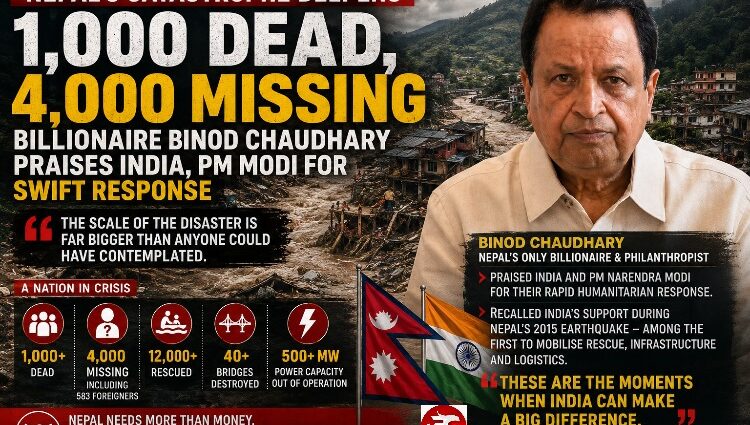
“The Scale of the Disaster Is Far Bigger Than Anyone Could Have Contemplated,” Binod Chaudhary.
September 2: Nepal is facing a devastating humanitarian and infrastructure crisis after catastrophic flash floods pushed the death toll past 1,000, with around 4,000 people still missing and thousands rescued from affected areas.
Nepal’s only billionaire and philanthropist Binod Chaudhary has described the disaster as unprecedented in scale, saying the destruction has wiped out villages, markets, schools and vital bridges, while crippling major parts of the country’s power infrastructure.
“The scale of the disaster is far bigger than one would have ever contemplated,” Chaudhary said, contrasting the devastation with floods that struck the same region last year.
The numbers paint a grim picture. According to Nepal’s National Disaster Risk Reduction and Management Authority, around 4,000 people, including 583 foreigners, remained missing, while approximately 12,000 people had been rescued. More than 40 bridges were reported lost, while over 500 megawatts of power-generation capacity had gone out of operation.
Chaudhary Singles Out India for Swift Response
Amid the devastation, Chaudhary singled out India and Prime Minister Narendra Modi for their rapid humanitarian response.
He praised the Nepalese government and security agencies, while acknowledging India in particular for moving quickly with relief supplies and assistance.
Chaudhary also recalled India’s response to Nepal’s 2015 earthquake, saying India was among the first to mobilise rescue arrangements, infrastructure, logistics and support. He argued that India’s growing capacity and infrastructure now allow it to respond to disasters on a much larger scale.
His appeal was direct: “These are the moments when India can make a big difference.”
Rebuilding Nepal Will Be Far Harder Than Counting the Dead
The crisis, Chaudhary warned, cannot be solved simply by sending money. Homes must be rebuilt. Markets must reopen. Bridges and power infrastructure must be restored. Communities that have lost their economic foundations must somehow begin functioning again.
He described reconstruction as a “gigantic” engineering challenge, warning that the disaster must also be viewed against the growing impact of climate change and glacier melt in the Himalayan region.
Nepal now faces a daunting double challenge: rescue those still missing and stranded, while preparing to rebuild a country whose infrastructure and communities have been devastated on a scale few anticipated.
For a nation already vulnerable to earthquakes, floods and landslides, the latest catastrophe is more than a natural disaster. It is a warning about how urgently the Himalayan region needs stronger infrastructure, disaster preparedness and international cooperation.
JANPATH NEWS NETWORK (JNN)
Independent. Fearless. On the People’s Path.