










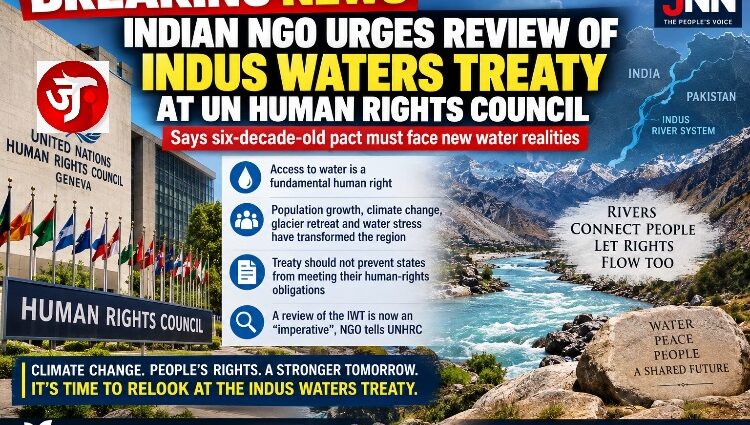
Indian NGO calls for review of Indus Waters Treaty at UNHRC, says six-decade-old pact must face new water realities
September 16: An Indian NGO has called for a review of the Indus Waters Treaty (IWT) between India and Pakistan, telling the United Nations Human Rights Council that dramatic changes in the region’s water-security environment require the 1960 agreement to be reassessed through a contemporary human-rights framework.
The Delhi-based organisation made the appeal in an oral statement during the 63rd session of the UN Human Rights Council, in an Interactive Dialogue with the Special Rapporteur on the human rights to safe drinking water and sanitation.
The NGO argued that access to water is inseparable from fundamental rights including life, health, food, housing, dignity and development. Referring to the UN recognition of safe and clean drinking water and sanitation as a human right, it said international water agreements should strengthen, rather than constrain, states’ ability to meet their human-rights obligations.
The organisation pointed to the profound changes since the IWT was signed more than six decades ago, citing population growth, climate change, glacier retreat, groundwater depletion and increasingly unpredictable river flows as factors that have transformed the region’s water-security landscape.
It maintained that treaty implementation should not prevent governments from fulfilling their responsibilities towards communities under their jurisdiction and argued that securing water for populations must remain a fundamental priority.
Against this backdrop, the NGO described a review of the Indus Waters Treaty as an “imperative”, particularly while the treaty remains in abeyance.
The statement also framed human rights and international cooperation as complementary, arguing that transboundary water governance should put people, dignity and fundamental rights at the centre.
The Indus Waters Treaty was signed by India and Pakistan on September 19, 1960, governing the utilisation of the waters of the Indus river system.
The latest appeal comes amid an escalating dispute over the treaty’s operation. India placed the IWT in abeyance following the Pahalgam terror attack, stating that it would remain suspended until Pakistan credibly and irrevocably ends support for cross-border terrorism.
On August 31, India rejected a recent pronouncement by a Court of Arbitration concerning the treaty, describing the body as illegally constituted. The Ministry of External Affairs said India had never recognised the court and maintained that its pronouncements could not affect India’s sovereign decisions concerning hydro-electric projects on the Western Rivers. The MEA reiterated that India’s decision to keep the treaty in abeyance remains in force.
The UNHRC intervention therefore places the treaty debate in a broader context: not merely India-Pakistan water sharing, but the growing pressure of climate change, population demands and human-rights obligations on one of South Asia’s most consequential water agreements.
JANPATH NEWS NETWORK (JNN)
Independent. Fearless. On the People’s Path.