










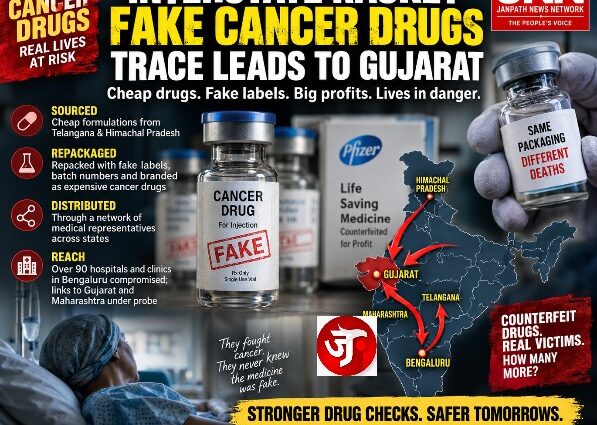
India’s counterfeit-medicine crisis has taken a disturbing turn, with investigators in Bengaluru uncovering a suspected network that allegedly pushed fake cancer drugs and critical-care injections into more than 90 hospitals and clinics, and cases in Gujarat and other states
The Bengaluru investigation began after an August 18 raid near Bidadi, where authorities seized suspected counterfeit and expired medicines valued at around ₹5 crore. The subsequent probe led a Special Investigation Team and the Drugs Control Department to Krupa Healthcare near Minerva Circle, Bengaluru, where a large stock of suspected counterfeit medicines was recovered. Pharmacy owner Veeresh Kumar Jain was arrested in connection with the case.
Investigators allege that the racket obtained inexpensive pharmaceutical formulations, including supplies linked to manufacturing centres in Telangana and Himachal Pradesh, and that medicines were subsequently repackaged or relabelled to resemble expensive imported products. Reports say the suspected network sold some of the medicines at discounts of up to 50 per cent, potentially making them attractive to distributors and healthcare establishments looking for cheaper supplies.
The scale of the Bengaluru operation is now under investigation. More than 15 medical representatives are suspected of facilitating the movement or distribution of medicines, while investigators examine bank transactions, purchase records and sales documents to establish the full supply chain. Police have also said that the suspected kingpin, identified as R Prashant, is absconding and is believed to have fled to Azerbaijan.
The Gujarat connection requires a crucial distinction.
A separate interstate counterfeit-medicine investigation in Gujarat has already resulted in arrests and seizures, but the drug involved was not a cancer medicine. Gujarat authorities uncovered counterfeit batches of Nicardia Retard 10, a medicine containing nifedipine and used to treat high blood pressure.
The investigation traced suspected counterfeit stock through distributors in Ahmedabad and Kutch. Police recovered 30 strips from Kishan Medical Store in Nadiad and additional quantities from Navkar Medical Agency and Mahadev Medical Agency in Bhuj. Investigators traced one supply route through Parshva Medical Agency in Paldi to Sena Medical in Lucknow, while the Kutch stock was allegedly linked to A.V.R. Medicos in Jaipur.
Three men were arrested in that Gujarat case: Ahmedabad resident Dashil Sanghvi, along with Lucknow residents Devendra Yadav and Umang Rastogi. Police allege that Sanghvi procured and distributed counterfeit stock in Gujarat, while the two Lucknow-based accused allegedly sourced the medicines at heavily discounted rates and arranged their supply into the state. The investigation remains ongoing.
Multiple interstate counterfeit and illegally diverted medicine networks operating through overlapping commercial channels and different states.
The wider danger is illustrated by another major investigation in Delhi. In August, the Delhi Crime Branch arrested 17 people in an alleged interstate racket involving counterfeit and illegally diverted high-value anti-cancer medicines. Police recovered 588 filled anti-cancer vials, six empty vials, seven empty boxes and more than 3,000 other medicines, with the seized medicines and related material valued at around ₹9 crore. The drugs included Keytruda, Darzalex, Imfinzi, Erbitux, Gazyva, Bavencio and Adcetris.
That investigation revealed several methods of obtaining the drugs. According to Delhi Police, the network allegedly sourced medicines from unauthorised suppliers, diverted medicines intended for patients from hospitals and diverted government-supplied medicines. Police also alleged that counterfeit drugs were manufactured using imitation packaging and false identifying details.
Court records from an earlier Delhi investigation provide an even more disturbing example: investigators alleged that empty vials labelled as Keytruda and Opdyta were filled with substances including sterilised water, fluconazole and dextrose before being sealed and presented as genuine anti-cancer injections.
For cancer patients, the consequences of such fraud are potentially catastrophic. These are not ordinary consumer products where a counterfeit handbag merely disappoints someone at a wedding. A falsified cancer injection can mean that a patient receives no effective treatment while believing that potentially life-saving therapy has been administered.
The Bengaluru, Gujarat and Delhi cases are now being investigated separately, but together they expose a broader vulnerability in India’s pharmaceutical supply chain: counterfeit medicines can cross state borders, move through legitimate-looking commercial channels and reach hospitals, clinics, pharmacies and ultimately patients before their authenticity is detected.
Authorities are still determining the full extent of the networks, the number of patients potentially exposed and the precise links between individual distributors. Those questions matter. The investigations have established serious suspected counterfeit-medicine operations, but it would be premature to claim that every interstate connection alleged in preliminary reports has been conclusively proved.
What is already clear is chilling enough: the counterfeit-drug trade is no longer merely a problem of fake pills appearing in isolated markets. Investigators are uncovering organised networks capable of moving high-value medicines across states, exploiting legitimate supply chains and targeting patients whose lives depend on the authenticity of every vial.
JANPATH NEWS NETWORK (JNN)
Independent. Fearless. On the People’s Path.