









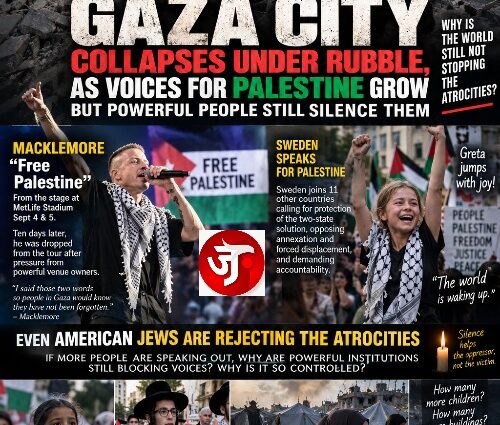
Gaza City collapses under rubble as voices for Palestine grow, while powerful institutions move to silence them…
Macklemore, American rapper, walked onto a stage at New Jersey’s MetLife Stadium on September 4 and 5 and said two words: “Free Palestine.” He performed Hind’s Hall, his protest song about Gaza, while footage from the conflict played behind him.
Ten days later, he was gone from the remaining U.S. dates of Ed Sheeran’s Loop Tour.
The sequence is documented. Tour promoter Messina Touring Group said venues on the remaining dates would not allow the shows to proceed with Macklemore on the bill. Robert Kraft, owner of the New England Patriots and Gillette Stadium, also confirmed that Macklemore would not perform at his venue, citing what he described as a broader history of antisemitic rhetoric and imagery. Macklemore has rejected the accusation and argued that criticism of Israel should not be equated with antisemitism.
Ed Sheeran subsequently said the decision was made by the promoter and venues, not by him, and said he had spent the week trying to find a middle ground. Several other opening acts later withdrew from the tour in solidarity with Macklemore.
Whatever one’s view of Macklemore’s politics, one fact is difficult to dispute: his public advocacy for Palestinians carried professional consequences.
And this week, Gaza City offered the most brutal punctuation mark imaginable: A war-damaged residential building collapsed overnight on September 16, killing at least 20 Palestinians, including five children, according to Palestinian rescue officials. Dozens more were reported missing or trapped beneath the rubble. The building had reportedly already been damaged by Israeli strikes, leaving families living inside a structure that was no longer safe because there was nowhere else to go. Rescue workers and residents searched through the wreckage, in some cases digging by hand.
The tragedy is not an isolated accident detached from the war. The United Nations human rights chief said this week that large parts of Gaza have been flattened by Israeli bombing or demolition and warned that continued clearing operations are taking place with “no respect for the dead” still buried beneath the rubble.
This is the Gaza reality against which the politics of speech now have to be measured. Something is becoming increasingly difficult to ignore. Across concert stages, streets, universities, Jewish communities and European capitals, more people are speaking openly for Palestinian civilians. Yet at the same time, some of the most powerful institutions capable of applying pressure appear more focused on controlling the language of protest than on stopping the devastation unfolding in Gaza.
And that raises a much larger question: Why does saying “Free Palestine” become a matter requiring intervention by promoters, venue owners and powerful donors, while the destruction being described by those words continues on an enormous scale?
The issue is not whether artists should be political. They have always been political. Nor is criticism of Israel automatically beyond legitimate debate. It is also important to distinguish criticism of the Israeli government and military from hostility toward Jewish people, because antisemitism is real and must be confronted.
But that should work both ways: Jewish identity cannot be used as a shield against scrutiny of government policy, just as Palestinian identity cannot be used to justify hatred of Jews.
And there are Jewish voices making precisely that distinction: In the United States, organisations including Jewish Voice for Peace and other Jewish activist groups have openly opposed Israeli government policies in Gaza and rejected the claim that criticism of Israel necessarily represents hostility toward Jews. Reporting has documented deepening divisions within American Jewish communities over Israel’s conduct in Gaza, with some Jewish organisations and activists demanding an end to the violence and rejecting the idea that Israel speaks in their name.
British actor Andrew Garfield says, “We have to care about every human life. People in P@lest!ne deserve support,” expressing compassion and concern for civilians affected by the conflict.”
So the question becomes even harder to avoid: If Jews themselves are publicly divided over Israel’s conduct, if Palestinians are describing devastation on an unprecedented scale, if artists are willing to risk their careers to speak about it, and if governments are increasingly calling for accountability, why does the machinery of destruction continue?
Europe, too, is shifting its language: Sweden joined Canada, Denmark, Finland, France, Iceland, Ireland, Norway, Poland, Portugal, Spain and the United Kingdom in a September 8 statement warning that Israeli actions in the West Bank are undermining the possibility of a two-state solution. The governments said they were considering or supporting restrictions on trade in settlement goods, opposed annexation and forced displacement, and called for accountability for alleged violations by Israeli forces. At the same time, they condemned the October 7 Hamas attack and reaffirmed Israel’s security interests.
That is not the same as Sweden newly recognising Palestine. It is, however, evidence that the diplomatic language surrounding Israel’s actions is changing.
And on the streets, the message is becoming harder to contain.
Greta Thunberg has repeatedly expressed support for Palestinian rights and participated in pro-Palestinian activism. Her visible reactions to chants of “Free Palestine” have become widely circulated images of the growing international protest movement.
The symbolism is striking: A child standing at a protest can say the violence did not begin on October 7. A teenager can ask why Palestinian children are dying. A Jewish activist can say, “Not in my name.” A rapper can stand before tens of thousands of people and say “Free Palestine.”
Yet the people with the greatest institutional power remain capable of deciding which voices enter the stadium, which artists remain on the bill, which political arguments are considered acceptable and which become professionally dangerous.
Just a few generations ago, the horrors of Hiroshima and Nagasaki and the Holocaust shook the conscience of humanity to its foundations. The scale of the suffering forced nations to confront what happens when human life is stripped of its value, and the world responded with institutions, conventions and solemn promises designed, at least in principle, to protect the vulnerable from the worst impulses of power.
So what happened to that outrage? When did the images of dead children stop shocking us? When did flattened homes become statistics, displaced families become numbers, and suffering become another item in the daily news cycle?
JANPATH NEWS NETWORK (JNN)
Independent. Fearless. On the People’s Path.