










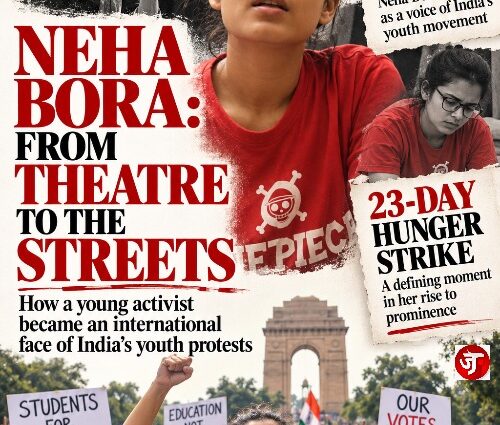
She studied how stories are performed. Now she stands amid a struggle over who gets to tell India’s story. Through Neha Bora’s journey from theatre to protest, we glimpse the restless mind of a generation questioning authority, confronting uncertainty and demanding a voice in the country’s future.
October 13, 2026
Before she became an international headline, she had become a young activist willing to put her own well-being on the line for a cause she believed in.
There is a moment in every compelling drama when the audience stops believing what it is being shown. The carefully constructed scene begins to crack. Questions arise that the script has no satisfactory answers for. And somewhere in the darkness, a spectator begins to wonder whether the story unfolding before them is the whole truth, or merely the version somebody wants them to see.
What happens when that spectator decides to walk onto the stage?
For Neha Bora, the question carries an unusual resonance. A doctoral researcher in theatre and performance studies at Jawaharlal Nehru University (JNU) and the national president of the All India Students’ Association (AISA), Bora occupies two worlds that may appear distant but share a central concern: how people understand power, how narratives shape perception and who gets to speak when the accepted story is challenged.
Her journey from theatre to the protest frontline is now attracting attention beyond India. Reuters has profiled her rise, while The Straits Times has examined her role in the youth movement. Her growing international visibility places her among the emerging faces of India’s student protests and raises a question larger than her individual political journey: what happens when young people refuse to remain spectators in the national conversation?
The theatre of power
Studying theatre does not automatically make someone a political revolutionary. But performance studies encourages questions that extend well beyond the stage. Who is speaking? Who is absent? What remains unsaid? Whose experiences are represented, and whose are ignored?
These questions are equally relevant to democracy.
Bora’s academic interests and political activism intersect around the ways people create, communicate and challenge meaning. The researcher who studies the relationship between performer and audience now participates in public confrontations over who gets heard, as citizens increasingly refuse to remain passive observers.
Her emergence also offers a window into the psychology of young Indians growing up amid extraordinary possibilities and persistent uncertainty.
For many, education is more than the acquisition of knowledge. It is a promise. Families invest years of effort, money and hope in the belief that hard work will open doors to employment, security and social mobility.
When allegations of examination-paper leaks, unfair recruitment or institutional failure arise, the anger can extend far beyond a single examination. It can become a crisis of confidence in the promise that effort will be rewarded fairly.
The underlying fear is devastatingly simple: what if the rules governing your future are not being applied fairly?
Frustration alone does not produce activism. A person must recognise a problem, discover that others share the same concern, believe collective action can make a difference and decide that speaking publicly is worth the risk.
Student leaders often stand at the intersection of these private disappointments and collective demands.
From personal grievance to collective identity
One of the most significant transitions in youth politics occurs when someone stops thinking, “This has happened to me,” and begins thinking, “This could happen to us.”
A personal grievance can isolate an individual. A shared grievance can create solidarity.
University campuses provide fertile ground for this transformation. Students from different regions, economic circumstances and social backgrounds encounter competing ideas and discover experiences that challenge their assumptions. Campuses can also become intensely ideological spaces, where group loyalties sometimes deepen divisions.
Yet universities remain important arenas for democratic debate. They allow young people to question how society is organised and what obligations public institutions owe their citizens.
Bora’s work through AISA belongs to this tradition of student mobilisation. Her activism has connected educational grievances with wider questions about institutional responsibility.
The issues may differ, but the central question remains: when institutions exercise power over people’s futures, what mechanisms exist to challenge their decisions?
Agreement with an activist is not necessary to recognise the legitimacy of scrutiny. Democracy depends on citizens being able to disagree without treating every disagreement as disloyalty.
Bora’s arguments deserve examination on their merits. So do the decisions of the institutions she challenges. Neither activists nor authorities should be exempt from accountability.
Twenty-three days that changed her public image
Before international headlines and images of confrontations with police barricades, there was a 23-day hunger strike at Delhi’s Jantar Mantar.
In July 2026, Neha Bora joined fellow student activists, including JNU scholars, in a prolonged fast over the examination crisis and demands for accountability following allegations of irregularities surrounding NEET-UG. The demands included calls for the scrapping of the National Testing Agency and the resignation of Union Education Minister Dharmendra Pradhan.
For Bora, the fast became a defining moment. A protest speech can capture attention; a slogan can travel across social media. But remaining on a hunger strike for 23 days carries a different weight. It makes a personal commitment visible, exposing the protester to physical hardship while keeping the cause in public view
When a barricade becomes a message
During protests, physical barriers can acquire powerful symbolic meaning.
For demonstrators, a barricade may represent exclusion from a public space. For police, it may be part of crowd control or the enforcement of restrictions. Whether it is justified depends on the law, the circumstances and the proportionality of the response.
When Bora called on supporters to regroup at Dilli Haat after they were prevented from reaching Jantar Mantar, her message, as reported by Reuters, was that the demonstration could continue elsewhere. Her subsequent detention brought the conflict between individual agency and institutional authority into sharper focus.
Detention does not automatically make a protester right. Nor does the existence of a public-order justification automatically make every restriction appropriate.
The democratic question is whether restrictions are lawful, proportionate, consistently applied and open to scrutiny.
When people believe peaceful expression is being unnecessarily restricted, the experience can reinforce their conviction that their concerns are being ignored. Authorities, meanwhile, have a responsibility to protect public safety without treating dissent itself as a threat.
For a young activist, detention may deepen commitment, provoke reflection or persuade someone that activism carries too high a cost. For the wider public, it can become a test of how power is exercised.
A generation watching everything
Today, a protest does not end at the site of the demonstration. Videos, photographs, speeches and eyewitness accounts can travel across the country and beyond within minutes.
This creates new opportunities for political participation. It also creates new risks.
A short video may expose conduct that would otherwise escape scrutiny, but it may also omit crucial context. An allegation can spread faster than it can be verified. Emotion travels quickly; evidence often takes longer.
Bora’s growing public profile belongs to this digital environment. Her words can reach audiences who encounter her first through a headline or a social-media post rather than through a full account of her demands.
International coverage gives her a wider platform, but visibility is not the same as universal endorsement. Nor does media attention establish the truth of every claim made by a protest movement.
The responsibility is shared. Activists must distinguish evidence from allegation. Institutions must explain their decisions. Citizens must question information that confirms their existing beliefs, not merely information they dislike.
Beyond the hero-and-villain narrative
It is tempting to turn a young activist into either a hero or a villain. Both are convenient stories. Neither is a substitute for understanding.
Bora is a political organiser with identifiable convictions and a role within a student organisation. Her methods and claims deserve scrutiny, just as the conduct of the authorities she challenges deserves scrutiny.
Democracy requires more than the courage to speak, and discipline to reconsider one’s position when the evidence points elsewhere.
India’s youth cannot be reduced to a single political identity. Many will pursue their ambitions quietly, work through legal channels or remain disengaged from protest. Others will support movements with very different ideologies.
But many share a fundamental concern: will effort be rewarded, will rules be applied fairly, and will institutions listen when challenged?
Bora’s journey gives that concern a recognisable face. It reminds us that young people do not necessarily enter politics because they have found every answer. Sometimes they enter because the answers they have been given no longer satisfy them.
When the audience walks onto the stage
Return, finally, to the theatre.
The lights rise. The actors speak their lines. The story moves towards its expected conclusion. Then someone asks a question the script never anticipated.
The question may expose an overlooked truth, or it may lead the audience in the wrong direction. It does not settle the argument. It begins one.
Neha Bora’s journey from theatre to protest offers a way to understand that moment in India’s public life.
Her story does not prove that an entire generation has turned against authority. It does not establish that every protest demand is justified. It does, however, invite us to examine why some young Indians are no longer content to observe the national drama from a distance.
They want to know who wrote the script, whose experiences were excluded and whether the story can be changed.
For institutions, the challenge is to respond to scrutiny with transparency and reasoned answers. For activists, it is to ensure that their claims are credible and their methods defensible. For citizens, it is to look beyond the performance and examine the evidence.
Neha Bora may have begun by studying the relationship between performer and audience. Her emergence as an activist brings that relationship into the public square.
The most consequential change may not be that she has stepped onto the stage.
It may be that a growing number of young Indians are asking why they were ever expected to remain in their seats.
JANPATH NEWS NETWORK (JNN)
Independent. Fearless. On the People’s Path.