










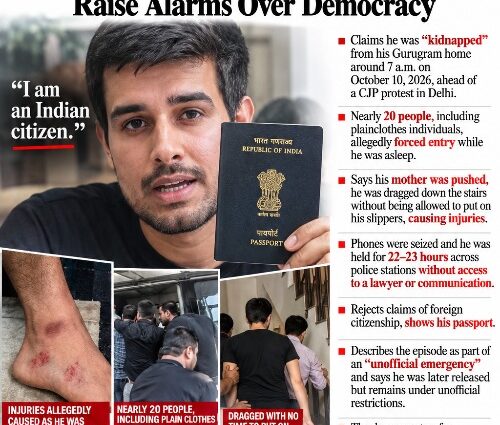
In a shocking account shared by @Amockx2022, YouTuber Dhruv Rathee alleges that he was “kidnapped” from his Gurugram home around 7 a.m. on October 10, 2026, ahead of a Cockroach Janata Party (CJP) protest in Delhi against Chief Election Commissioner Gyanesh Kumar.
According to Rathee, nearly 20 people, including individuals in plain clothes, forced their way into his home while he was asleep. He alleges that his mother was pushed, he was dragged down the stairs without being allowed to put on his slippers, sustaining injuries in the process, and his phones were seized. He further claims he was moved between police stations and held for 22–23 hours without access to a lawyer or the ability to communicate freely.
Displaying his passport, Rathee asserted that he is an Indian citizen and rejected claims questioning his citizenship. Describing the episode as part of an “unofficial emergency”, he warned of what he sees as an increasingly authoritarian climate in the country.
In the video, Dhruv Rathee directly addressed Prime Minister Narendra Modi with a line roughly translated as: “Do not frighten people so much that they stop being afraid.”
He framed the detention as part of an “unofficial emergency” and accused Modi of turning India into a “dictatorship,” while stating he would continue raising his voice despite the incident.
In a separate post before his detention, he had asked, “Why are you so scared, Modi?” regarding security measures around the protest.
Rathee says he has since been released but remains under what he describes as unofficial restrictions. He also thanked supporters who stood by him.
The central question is impossible to ignore: when a citizen alleges that he was taken from his home, denied legal access and held without communication, who ensures that the law itself has not been violated?
In a democracy, the distinction between a lawful arrest and an unlawful deprivation of liberty is fundamental. The allegations require independent scrutiny, a clear account from the authorities, and answers grounded in evidence rather than political rhetoric.
Democracy is not measured by how freely the powerful can act, but by how firmly the law protects the rights of those who challenge them.
JANPATH NEWS NETWORK (JNN)
Independent. Fearless. On the People’s Path.