










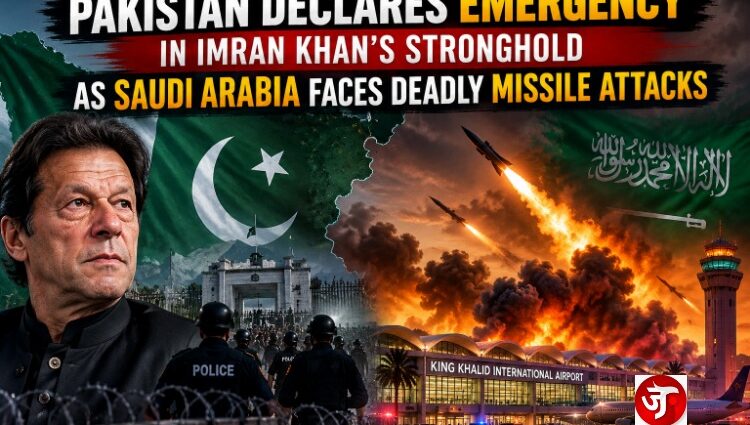
Islamabad imposes emergency rule in Khyber Pakhtunkhwa, while detaining hundreds of protestors supporting PTI ; Riyadh faces a mounting security crisis as regional defence cooperation intensifies.
October 13, 2026
Two major powers in the Muslim world are confronting mounting security challenges, both bound by the Saudi-Pakistan-Turkiye defence pact. Pakistan imposes emergency rule in a politically sensitive province and Saudi Arabia struggles to contain a wave of deadly missile attacks. The developments are unfolding against the backdrop of an expanding regional conflict involving Yemen’s Houthi movement and a new defence partnership linking Saudi Arabia, Pakistan and Turkiye.
While Pakistan’s crisis is rooted in internal political conflict and militant violence, Saudi Arabia is facing a direct threat to critical infrastructure. Together, the developments raise urgent questions about regional stability, military preparedness and the possibility of a wider confrontation.
Pakistan: Emergency rule shakes Imran Khan’s political stronghold
Pakistan’s political crisis has reached a dangerous new threshold. The federal government has imposed emergency rule in Khyber Pakhtunkhwa, suspended the provincial administration led by jailed former prime minister Imran Khan’s Pakistan Tehreek-e-Insaf (PTI), and detained Chief Minister Sohail Afridi and several other political figures.
The government insists that the extraordinary intervention is necessary to combat escalating Islamist militancy. But the timing, the scale of the measures and the detention of opposition leaders have raised a fundamental question: Is Pakistan confronting a genuine security emergency, or is the fight against terrorism becoming entangled with a struggle to control political opposition?
An elected government removed from power
Khyber Pakhtunkhwa is not simply another province in Pakistan’s political map. It has been governed by PTI since 2013 and remains a crucial centre of support for Imran Khan, who has been imprisoned since 2023.
On October 11, President Asif Ali Zardari approved emergency measures recommended by Prime Minister Shehbaz Sharif’s federal cabinet. The provincial government was suspended, and the governor was placed in charge of its functions.
The federal government argues that the provincial administration failed to demonstrate sufficient commitment to counterterrorism operations. Officials have also alleged that the PTI leadership was linked to militant groups, accusations the party denies.
Yet the consequences extend far beyond the political leadership. The province’s elected administration has lost its authority, the chief minister has been detained, and the federal government has assumed direct control over a region where PTI holds a strong electoral mandate.
This is where the democratic alarm begins.
When voters elect a government, can that mandate be set aside by the federal executive without the decision being subjected to rigorous, transparent and independent scrutiny?
Emergency provisions may exist in the Constitution, but their existence does not automatically make every application democratic in spirit. The legality of a measure and its proportionality are separate questions, and both deserve scrutiny.
The crackdown on dissent
The emergency was declared after PTI supporters spent days mobilising for a march to Islamabad to demand Imran Khan’s release and access to medical treatment.
Hundreds of supporters were reportedly detained ahead of the planned demonstration. Khan’s three sisters were also among those detained, according to news reports. The chief minister and several cabinet members were subsequently taken into preventive custody.
Authorities have defended the detentions on public-order grounds. Federal ministers have said that those facing criminal cases will be charged and tried, while others may be released.
Amnesty International warned on October 12 that reports of arbitrary detentions, including that of the provincial chief minister, and internet disruptions in parts of Khyber Pakhtunkhwa raised serious questions about the proportionality of the emergency measures.
The organisation cautioned that an emergency must not become a licence to silence dissent, restrict human rights or concentrate power.
Internet disruptions also raise concerns because they can obstruct access to information, prevent journalists from reporting freely and make it harder for families to communicate during a political crisis.
Security operations may sometimes require temporary restrictions. But those restrictions should be necessary, proportionate, time-limited and subject to independent oversight. Otherwise, emergency governance risks becoming a mechanism for suppressing the very freedoms a constitutional state is supposed to protect.
The government’s argument: Terrorism cannot be ignored
A fair examination of this crisis must also confront Pakistan’s security situation. Khyber Pakhtunkhwa has experienced a growing number of militant attacks. The federal government says the provincial administration failed to cooperate adequately in the fight against terrorism and that stronger central control is required to protect civilians.
These concerns cannot simply be dismissed. The state has a duty to protect lives, prevent attacks and pursue those responsible for violence. Citizens living in conflict-affected districts deserve security as much as citizens elsewhere in the country.
But there is a crucial distinction between confronting armed groups and restricting lawful political opposition. Fighting terrorism is a responsibility of the state. Protecting democracy is another. One cannot simply be sacrificed in the name of the other.
The PTI maintains that the government is attempting to suppress its political movement rather than resolve the dispute through dialogue.
The suspension of Khyber Pakhtunkhwa’s government marks a significant escalation in Pakistan’s prolonged political struggle. At its centre is Imran Khan, the former cricket star and prime minister whose imprisonment has become a rallying point for millions of supporters and a source of continuing tension between his party and the establishment.
Saudi Arabia: Riyadh is in Shock Facing a Deadly Challenge
Recently, a deadly Houthi drone and missile strike on Riyadh’s King Khalid International Airport killed at least 12 to 13 people and injured more than 300 others. Saudi Arabia is confronting a separate and increasingly dangerous crisis. Repeated missile attacks attributed to Yemen’s Iran-backed Houthi movement have struck the King Khalid International Airport complex in Riyadh, disrupting aviation and raising fears about the vulnerability of the kingdom’s critical infrastructure.
The Associated Press reported that a Saturday attack killed 12 people and injured more than 300. A further projectile struck the airport complex on Sunday, killing a Pakistani national and injuring 11 others, according to the AP. Reuters has separately reported at least 18 deaths across a series of attacks, illustrating the difficulty of reconciling casualty figures across different incidents and reports.
The attacks have raised concerns about Saudi Arabia’s ability to protect airports, energy facilities and other strategic assets. They have also disrupted the kingdom’s efforts to project stability while pursuing its economic ambitions.
In another troubling development, Reuters reported on October 12 that Saudi Arabia’s public early-warning system had stopped issuing alerts before the latest attacks. The system had previously provided warnings by mobile phone and social media. Saudi authorities resumed issuing alerts on Monday, warning of potential threats in Riyadh and southern cities.
The Saudi government has not publicly explained the prolonged silence before the attacks. The absence of warnings has prompted questions about public safety and the communication of security threats.
The United States has also raised its travel advisory for Saudi Arabia to Level 3, advising travellers to reconsider travel because of risks associated with missile and drone attacks, armed conflict and terrorism.
The Saudi-Pakistan-Turkiye defence pact: A potential turning point
The crisis has acquired wider geopolitical significance because Saudi Arabia and Pakistan are bound by a new joint defence agreement involving Türkiye.
The Mecca Joint Defence Agreement, signed in August, establishes a framework for collective defence. The agreement treats an attack on one member as an attack on the others, potentially strengthening military coordination and deterrence.
The Financial Times reported on October 7 that the pact had been activated in response to attacks on Saudi targets. Reuters reported on October 8 that Pakistan had agreed to deploy additional troops to Saudi Arabia under the defence arrangement, although the precise scope of the deployment and its operational role have not been publicly detailed.
Türkiye has also signalled support for Saudi Arabia. President Recep Tayyip Erdoğan said on October 12 that Türkiye would submit the agreement to parliament for ratification, a necessary step before its full participation under the pact can be established.
Pakistan’s involvement is particularly significant. The country is dealing with escalating militancy at home while deepening its security commitments abroad. Any expanded military role in Saudi Arabia could have consequences for its regional diplomacy, domestic security priorities and relations with neighbouring Iran and Afghanistan.
The pact does not automatically mean that all three countries will enter a full-scale war. Its practical consequences will depend on the nature of the attacks, the members’ decisions and the military measures they ultimately undertake.
What happens next?
Three developments will be critical to watch.
First, Pakistan’s political crisis. Whether the emergency in Khyber Pakhtunkhwa remains a limited counterterrorism measure or becomes a wider confrontation with PTI will shape the country’s domestic stability.
In Pakistan, an elected provincial government is suspended, its chief minister detained, and political supporters swept up ahead of a planned march. Islamabad says it is fighting terrorism. But who protects democracy when emergency powers threaten the right to dissent?
Second, Saudi Arabia’s ability to secure its territory. The restoration of public warning alerts is significant, but the attacks have exposed difficult questions about air defence coverage, protection of critical infrastructure and the safety of civilians and travellers.
Third, the response of the new defence alliance. Any substantial deployment or direct military action could widen the conflict beyond Yemen and place additional pressure on an already fragile regional balance.
JANPATH NEWS NETWORK (JNN)
Independent. Fearless. On the People’s Path.