










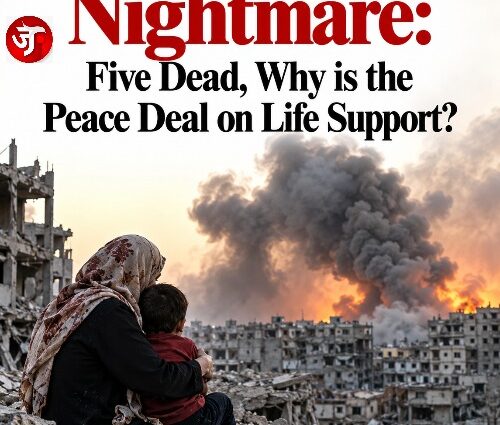
A ceasefire was supposed to offer Gaza a chance to breathe. Instead, the killing continues, families remain trapped in uncertainty, and the promise of peace grows more distant with every new strike
Monday, October 12, 2026
The latest news from Gaza is grim: the ceasefire has not stopped the killing, and hopes for lasting peace remain stalled. Israeli strikes killed at least five Palestinians in two incidents over Sunday and Monday, according to local medical officials. Israel said it had targeted militants; Palestinian officials reported the deaths.
What is happening now?
Deadly strikes continue: On October 12, Reuters reported that an Israeli strike in southern Gaza killed at least two Palestinians. A separate strike on a tent in the Mawasi area of Khan Younis late Sunday killed three people, according to medics. Israel said it had targeted militants.
The humanitarian crisis remains severe with around two million Palestinians caught in a devastated territory. Many are living in tents, damaged buildings or the rubble of their former homes. Reconstruction has barely progressed, and access to essential supplies remains a major concern.
Gaza health authorities say at least 1,400 Palestinians have been killed by Israeli fire since the ceasefire took effect in October 2025. The UN has independently verified 1,076 conflict-related deaths through the end of July 2026, a narrower figure covering deaths it has verified.
Why is the peace deal deadlocked?
The five main reasons
1. The biggest obstacle is who moves first.
Israel insists Hamas must be fully disarmed before Israeli troops withdraw. Hamas says disarmament must be linked to a phased Israeli withdrawal and an end to attacks. Each side fears making concessions without receiving its promised return. This sequencing dispute is at the heart of the deadlock.
2. Israel wants security guarantees; Hamas wants an end to Israeli military control.
Israel says it cannot withdraw while Hamas retains the ability to rearm or threaten Israeli forces. Hamas has indicated willingness to place weapons in storage under a Palestinian administrative body, but rejects terms that would leave its weapons under Israeli or other non-Palestinian control. The sides have not agreed on what disarmament would mean in practice.
3. Who will govern Gaza remains unresolved.
The plan envisages a Palestinian technocratic administration taking over civilian governance, supported by international arrangements. But Hamas remains influential in areas it controls, Israel continues to control substantial territory, and the proposed new administration has not been able to assume full authority across Gaza. An international stabilisation force intended to support security and the transition has also not been fully deployed.
4. Reconstruction is caught in the political stalemate.
Gaza needs enormous investment to rebuild homes, hospitals, water systems and basic infrastructure. But donors and international agencies need workable security arrangements, access and clarity about who will govern. With Israeli withdrawal and the future security structure unresolved, large-scale reconstruction remains stalled.
5. Domestic politics are narrowing the room for compromise.
Israeli Prime Minister Benjamin Netanyahu faces pressure from hard-line political allies who oppose concessions on Gaza, as Israel approaches elections on October 27. That creates political risks for any agreement requiring withdrawal before Hamas is completely disarmed. Meanwhile, Hamas is reluctant to surrender its weapons without guarantees that Israel will withdraw and attacks will stop.
What could break the deadlock?
A workable path would require a phased, independently monitored arrangement that links verifiable steps on weapons and security to Israeli troop withdrawals, protection for civilians, increased humanitarian access and the transfer of governance to a credible Palestinian administration. It would also need a clear timetable and consequences for violations by any party.
The US and other mediators would have to press both sides to implement the agreement rather than allow each to make the other’s compliance a precondition for every next step.
The bottom line: the ceasefire has reduced the scale of the war, but it has not resolved the conflict. Until the parties agree on security, withdrawal, governance and reconstruction as parts of one enforceable plan, Gaza risks remaining trapped between a peace agreement that exists on paper and a reality in which people continue to die
The UN warned on October 12 that Palestinians continue to face deadly attacks even a year after the ceasefire announcement, raising serious concerns about possible violations of international humanitarian law. The UN has called for accountability and stronger protection for civilians.
The central reality is this: a ceasefire has not brought safety, a political agreement has not delivered Gaza its reconstruction, and civilians are still paying the price.
JANPATH NEWS NETWORK (JNN)
Independent. Fearless. On the People’s Path.