










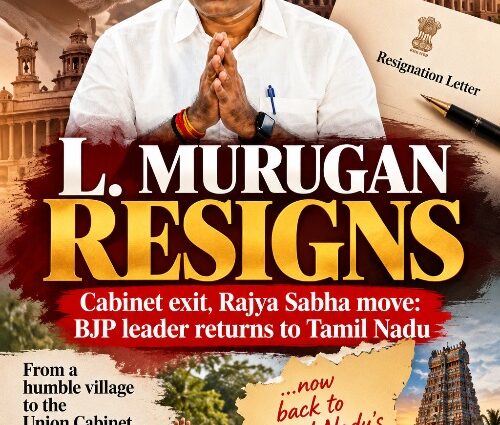
L, Murugan Union Minister’s five-page letter traces his journey from a family of daily-wage labourers to the Union Cabinet, praises Modi’s engagement with Tamil culture, and signals a renewed BJP push in Tamil Nadu ahead of the 2029 Lok Sabha elections.
October 13, 2026
In Indian politics, a resignation letter can sometimes reveal more through its praise than through its declaration of departure. Union Minister of State L. Murugan’s five-page letter to Prime Minister Narendra Modi, dated October 13, is one such document.
L. Murugan has announced his resignation from the Union Council of Ministers and his intention to relinquish his Rajya Sabha membership, explaining that he wants to return to grassroots politics and devote himself full-time to strengthening the BJP in Tamil Nadu ahead of the 2029 Lok Sabha elections.
But the letter is more than a formal farewell. It is a personal account of political ascent, an emphatic endorsement of Modi’s leadership, and a carefully articulated argument for the BJP’s place in Tamil Nadu’s political landscape.
At its heart lies a simple declaration: L. Murugan wants to return to the political ground from which his career began.
“Now, I wish to return to the grassroots, stand with our karyakartas and dedicate myself full-time to strengthening the BJP in Tamil Nadu ahead of the 2029 Lok Sabha elections,” he writes.
The statement provides his stated reason for leaving ministerial office. It does not, by itself, establish whether any other political considerations influenced the decision.
From a poor family to the Union Cabinet
One of the most personal passages in the letter concerns L. Murugan’s family background. He emphasises that his journey did not begin in a political dynasty or a family of privilege.
“I do not come from a political family. I come from a very poor family,” he writes.
His parents, he says, worked as daily-wage labourers and cattle grazers and continue to live a simple life in Konur Village.
“They could never have imagined that their son would one day serve in the Union Government,” he adds.
The passage places his political journey within a narrative of social mobility and organisational opportunity. Murugan credits the BJP leadership with giving him responsibilities he had never imagined, including serving as Vice-Chairman of the National Commission for Scheduled Castes, becoming a Rajya Sabha member twice, and joining the Union Council of Ministers.
He also recalls his nearly three decades in the Akhil Bharatiya Vidyarthi Parishad (ABVP) and the BJP, identifying his guiding principle as:
“Nation First, Party Next, Self Last.”
That motto now frames his decision to leave the national government and return to state-level party work. Whether this move will translate into a stronger electoral position for the BJP in Tamil Nadu remains to be seen.
Modi’s Tamil Nadu visit and the decision to return
L. Murugan begins his letter by reflecting on Modi’s recent visit to Tamil Nadu. He describes the crowds’ reception and the enthusiasm he witnessed at the Prime Minister’s public engagements as a source of renewed determination.
“Your recent visit to Tamil Nadu has left a deep impression on me,” he writes. “At every stop, I witnessed the affection with which people welcomed you and the hope your presence inspired.”
He says the experience renewed his resolve to do more for Tamil Nadu, the BJP and the country.
The opening passage is significant because it connects Murugan’s personal decision to the party’s wider political ambitions in the state. His stated goal is not simply to leave ministerial responsibilities but to work directly with party cadres as the BJP prepares for the next general election.
Tamil Nadu has long been shaped by powerful regional parties and a distinctive political culture. Building a stronger BJP organisation there is a substantial challenge, and Murugan’s return signals that the party’s grassroots machinery will remain a central focus of its strategy.
The letter, however, does not provide electoral projections or establish that a particular new position has been promised to him.
A sustained tribute to Modi’s relationship with Tamil culture
Much of the letter is devoted to Modi’s engagement with Tamil language, literature, history and cultural identity.
L. Murugan recalls that the Prime Minister visited his residence three times to participate in Pongal celebrations, describing the gesture as something he would never forget.
“I can never forget your special gesture of coming to my residence three times to participate in Pongal celebrations,” he writes.
He also praises Modi for invoking the Tamil expression “Yaadhum Oore, Yaavarum Kelir” at the United Nations. The phrase, commonly understood as “Every place is our home, everyone is our kin,” expresses a universal vision of human kinship.
L. Murugan cites the Subramania Bharati Chair at Banaras Hindu University, the Kashi Tamil Sangamam and the Saurashtra Tamil Sangamam as initiatives that have celebrated Tamil heritage and strengthened its connections with the rest of India.
He also refers to the Prime Minister’s interest in the Thirukkural, the classical Tamil text attributed to Thiruvalluvar, and the presentation of the work to Russian President Vladimir Putin.
“The installation of the Sengol in Parliament holds a special place in our hearts, giving Tamil Nadu’s heritage a place of honour at the very centre of our democracy,” Murugan writes.
These references reveal the cultural argument running through the letter: that Tamil identity and national politics need not be treated as competing loyalties, and that the BJP’s outreach to Tamil heritage forms part of its broader political engagement with the state.
For Murugan, this is not merely a question of cultural recognition. It is part of his explanation for why he believes the party can deepen its roots in Tamil Nadu.
He mentions Chennai Metro, the expansion of Tuticorin Port, highway development and the redevelopment of 26 railway stations under the Amrit Bharat Station Scheme.
He further refers to support for deep-sea fishing vessels and the development of deep-technology ventures emerging from IIT Madras.
The minister presents these initiatives as evidence that the Centre has addressed both traditional livelihoods and future economic opportunities.
“I have been deeply touched by how much personal interest you take in fulfilling the aspirations of our State,” he writes.
These are L. Murugan’s assessments of the government’s record rather than an independent evaluation of each project. Nevertheless, the emphasis is revealing: his case for the BJP in Tamil Nadu combines cultural recognition with infrastructure, employment and economic development.
He also praises Modi’s response to requests concerning Tamil Nadu, including the safety of Tamil people stranded in conflict zones and the welfare of Indian fishermen.
According to Murugan, the Prime Minister has ensured that such matters receive urgent attention.
The wider political message
The letter also draws attention to Tamil Nadu figures who have received prominent constitutional responsibilities.
Murugan cites La. Ganesan and C. P. Radhakrishnan, who were entrusted with gubernatorial roles, and highlights Radhakrishnan’s elevation to the vice-presidency. He also refers to former Tamil Nadu BJP president Tamilisai Soundararajan’s appointments as Governor and Lieutenant Governor.
His own departure from the Union Cabinet is framed against this backdrop of opportunity and recognition. He describes his ministerial responsibilities as expressions of the Prime Minister’s trust, recalling his work across Information and Broadcasting, Parliamentary Affairs, Fisheries and Animal Husbandry.
“Every responsibility has been an expression of your trust,” he writes.
He also reflects on five years in the Council of Ministers, praising Modi’s patience, compassion and dedication. To illustrate the qualities he admires, Murugan invokes Thiruvalluvar, describing a ruler who combines generosity, just governance and care for the people as a light among rulers.
The language is unmistakably appreciative. Across the pages available, Murugan offers no criticism of the Prime Minister or the government and gives no indication of a public falling-out.
A resignation, but not yet the whole story
The timing of L. Murugan’s departure may invite questions about the Union government’s political calculations and the BJP’s plans for Tamil Nadu. Speculation about a possible Cabinet reshuffle has also surrounded the development.
Yet speculation must remain distinct from established fact. The publicly stated explanation is that Murugan wants to return to grassroots work and strengthen the BJP ahead of 2029. The pages of the letter available for examination do not establish that a reshuffle prompted the decision, nor do they disclose any private negotiations over his next role.
L. Murugan’s letter is therefore best read as both a personal account and a political statement.For now, his message is clear: he is presenting his resignation not as a retreat from politics, but as a return to the political battlefield he wants to help the BJP win.
JANPATH NEWS NETWORK (JNN)
Independent. Fearless. On the People’s Path.