










Barricades breached, security tightened, a petition moves towards the Supreme Court. At the heart of the confrontation lies one urgent question: can every eligible Indian trust that their vote will count?
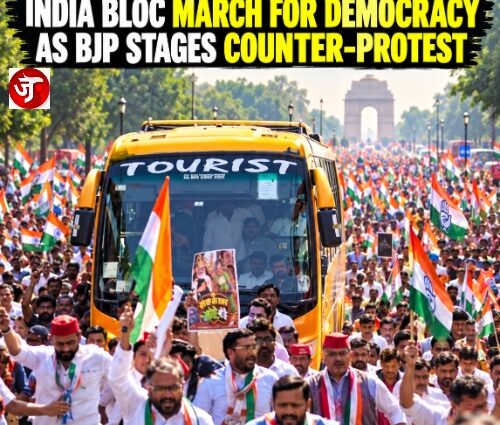
The “Chalo Delhi – March for Democracy” is no longer just a street protest. it has become a major INDIA Bloc mobilisation, with several prominent leaders joining hands, over electoral transparency, the independence of constitutional institutions, and the right to dissent. As of Monday, October 12, 2026, INDIA Bloc leaders led by Rahul Gandhi are taking their challenge over voter-list revisions to the Supreme Court, while the BJP is staging a counter-protest outside Congress headquarters.
While Rahul Gandhi and Mallikarjun Kharge had sought a meeting with Chief Justice Surya Kant to submit their concerns, he declined to discuss matters already before the court and indicated that the leaders should use formal judicial proceedings. Later reporting says a small Congress delegation was permitted to enter the court premises to file a petition. This was not a rejection of the petition itself.
This did not deter the INDIA Bloc to take on their “march for democracy.”
Four air-conditioned buses carried the INDIA bloc leaders and MPs from the Constitution Club to the Barakhamba Road junction, after which they continued the march largely on foot toward the Supreme Court.
There was an open bus (or open-top bus) that several senior leaders boarded. Reports describe Rahul Gandhi, Priyanka Gandhi Vadra, Akhilesh Yadav, Neha Bora, and others riding or standing on it so they could stay visible to the crowd and media as the procession moved through central Delhi. When police barricades stopped the march (around Bhagwan Dass Road), some leaders also climbed onto a vehicle to address people from above.
By the afternoon, India Today reported that marchers breached the first police barricade near Le Méridien Hotel as the procession moved towards Barakhamba Road and Feroz Shah Road. Later reporting said the march was stopped by police, while a small opposition delegation was allowed to enter the Supreme Court to submit a petition.
Delhi is under heavy security with police and paramilitary personnel setting up layered barricades and restricted movement in parts of central Delhi. Six Metro stations had entry and exit closures scheduled from 6 a.m. to 4 p.m. Section 163 BNSS restrictions applied in designated areas; this should not be described as a blanket order covering every part of Delhi.
In the midst of all this, BJP stages a counter-protest where BJP women workers and MPs protested outside Congress headquarters, burning effigies of Rahul Gandhi and Congress MP Bimol Akoijam. The BJP demanded action against Akoijam over allegations linked to a sexual-harassment case at JNU. This is a separate political confrontation taking place alongside the INDIA Bloc march.
The legal stakes are important too. On October 11, the Supreme Court directed authorities to review barricades, maintain normal public transport unless restrictions were necessary, and prevent illegal detention of peaceful, unarmed protesters outside areas where prohibitory orders applied.
What is the real issue behind the march?
- The Opposition’s allegation: Large-scale voter-list revisions and the SIR process may have wrongly excluded eligible voters and undermined electoral fairness.
- The Election Commission and BJP’s position: The revisions are intended to remove duplicate and ineligible entries; they deny politically motivated manipulation.
- The constitutional question: How can authorities protect public order while ensuring that peaceful protest, public movement and access to legal remedies are not unnecessarily restricted?
The march is a test of both electoral accountability and the state’s response to dissent.
JANPATH NEWS NETWORK (JNN)
Independent. Fearless. On the People’s Path.