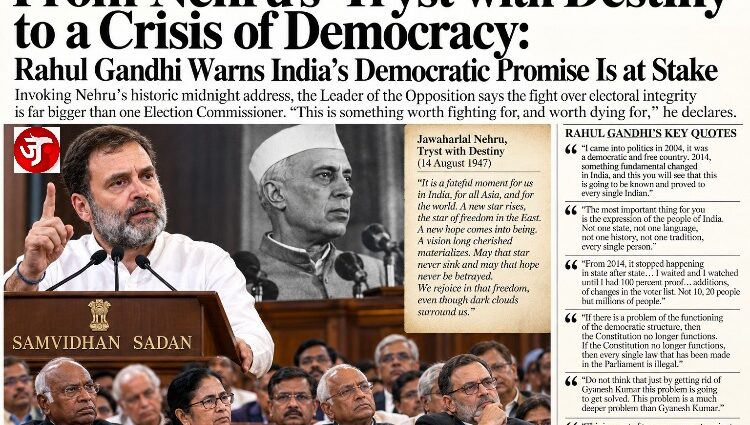
Invoking Nehru’s historic midnight address, the Leader of the Opposition says the fight over electoral integrity is far bigger than one Election Commissioner. “This is something worth fighting for, and worth dying for,” he declares.
October 11, 2026
There was a time when Jawaharlal Nehru’s words at the dawn of Independence captured the promise of a nation beginning its journey as a free country. Nearly eight decades later, Rahul Gandhi has returned to that historic moment, using Nehru’s Tryst with Destiny speech to frame what he describes as a fundamental crisis confronting Indian democracy.
On October 9, 2026, addressing Opposition leaders at the Central Hall of Samvidhan Sadan, Gandhi welcomed Congress president Mallikarjun Kharge, West Bengal former Chief Minister Mamata Banerjee and other senior leaders. He thanked the Opposition for its actions over the preceding three to four days, as its confrontation with the Election Commission intensified.
But his speech was not merely a message of political solidarity. It was an argument about the very purpose of democracy, the sanctity of the vote and the relationship between the Constitution and the institutions entrusted with protecting it.
By invoking Nehru, Gandhi placed the present confrontation against the aspirations of the Independence movement, asking, in effect, what remains of that promise if citizens cannot trust the process through which they choose their government.
Nehru’s promise brings the question of what India has become: Gandhi recalled that Nehru delivered his famous Tryst with Destiny address on August 14, 1947, from the same historic parliamentary complex.
He referred to Nehru’s vision of freedom as a new star rising in the East, a long-cherished dream becoming reality, and the hope that this light would never be extinguished or betrayed.
Nehru’s message, as Gandhi presented it, was not that Independence would eliminate every difficulty. It was that freedom created a responsibility: the promise of a new nation had to be protected, even when dark clouds gathered around it.
Gandhi then brought that historical promise into the present. ““I came into politics in 2004,” he said, recalling a time when, in his experience, India was a democratic and free country. 2014, we did not even understand it then. Something fundamental changed in India,” he said.
That assertion formed the turning point of his address. Gandhi argued that the change was not simply about which party held power. He described it as a transformation in the functioning of the democratic system itself.
For him, the central question was whether India’s institutions continued to protect the ability of every citizen to express a political choice.
As a child, these words were instilled in him:
“The most important thing in your life is going to be protecting the expression of the people of India”
One of the most significant passages in Gandhi’s speech concerned the values he said had been instilled in him from childhood.
“I was taught when I was small, it was drilled into my mind, every day that the most important thing for you is the expression of the people of India,” he said.
He recalled being taught the names of every state and its capital, but argued that the deeper lesson was that India’s diversity must be protected rather than subordinated to a single political or cultural identity.
“Not one state, not one language, not one history, not one tradition, every single person,” he said.
This was the democratic principle he said had brought him into politics: the belief that every Indian, regardless of language, region, history or tradition, must have an equal place in the country’s political life.
And the institutional framework for that principle, he argued, was democracy itself. The significance of this passage lies in the distinction Gandhi drew between winning political power and protecting the system that makes the exercise of that power legitimate. A party may win an election, but democracy requires that citizens remain free to change their minds and remove that party through another election.
Gandhi acknowledged that every political leader understands the uncertainty of elections.
“We have seen elections. We have fought elections,” he said, referring to leaders such as Mamata Banerjee and Mallikarjun Kharge, who have contested election after election.
“There is not a single politician in this room who does not think, ‘My God, one day maybe I might lose the elections.’ That is the nature of democracy.”
That observation cuts to the heart of representative government. Elections are meaningful precisely because their outcomes are not supposed to be predetermined. Political parties must remain answerable to voters, and governments must accept the possibility of defeat.
Gandhi alleged that, from 2014 onwards, something had changed, pointing to state elections in Madhya Pradesh, Gujarat, Haryana and Maharashtra. He said he had initially resisted even asking whether Indian democracy had been damaged.
“For me, democracy is the fundamental pillar not only of India but the fundamental pillar of my entire being,” he said.
He went on to say: “Frankly, I must tell, I could not even bring myself to ask the question that is it possible that Indian democracy has been destroyed. For me, this is the fundamental pillar not only of India but the fundamental pillar of my entire being. And so, even though I suspected it might be getting destroyed, I never said it. Many people would ask the question I never said. It was only when I got proof, 100 percent proof, because I value the democratic structure of India. For me, to raise a question of the democratic structure is not something to be done lightly. And so, I waited and I watched….
The voter rolls then got at the centre of the confrontation: Gandhi said people working on electoral issues across several states had examined voter lists and brought him what he described as documentary evidence of additions and changes involving large numbers of voters.
He alleged that the issue went far beyond isolated cases, claiming that the changes affected millions of people. These allegations have become central to the Opposition’s campaign against Chief Election Commissioner Gyanesh Kumar and the Election Commission’s Special Intensive Revision (SIR) of electoral rolls.
He said that when he had concrete proof of additions and of changes in the voter list, which amounted to not just ten or twenty people but millions of people, he then started to raise the question that there is a problem, there is a problem of the functioning of the democratic structure.
Gandhi then advanced the most sweeping argument of his speech.
He said: “Please understand that if there is a problem of the functioning of the democratic structure, then the Constitution no longer functions. If the Constituion no longer functions, then every single law that has been made in the Parliament is illegal.
Every position that has been placed is illegal, We have never entered this space before, ever. and we are entering it, so we started to ask, and slowly slowly more and more people started to to believe. And today, most of India believes, as you have seen.”
This is a political and constitutional argument, and reveals the scale of the crisis Gandhi believes the country is facing.
His concern is that constitutional institutions cannot operate in isolation from the democratic process that gives elected governments their mandate. If that process is compromised, public trust in the institutions built upon it may also be damaged.
That is why, in his framing, the controversy cannot be resolved simply by replacing one official.
Gandhi used language of national responsibility to describe what he believes is at stake.
Most of India believes that the star of indian democracy, the star of Indian freedom has set. Somebody said that we have to think about electorol reforms. Do not think that just by getting rid of Gyanesh Kumar this problem is going to get solved. This problem is a much deeper problem than Gyanesh Kumar. This problem will require the termination of the current government and will require years of repairing the damage that has been done.
Please understand that this is an act of treason. This is an act against everything that we stand for. It is an act against the expression of every single Indian, an act against the soul of this country. I can tell you about myself, and I am certain that all of you feel the same. This is something worth fighting for, and worth dying for.”
These words were among the most forceful of his address. They cast the dispute not simply as a contest between the ruling party and the Opposition, but as a struggle over whether citizens retain the power to determine their own political future.
“Please understand, he is a service provider to us, he is not some king,” he said of the Chief Election Commissioner.
“His job is to provide service to the people of India and the elected representatives of the people of India.”
The remark expresses a democratic distinction between public office and personal authority. Constitutional officials hold positions of responsibility; they are not monarchs standing above the citizens whose rights they are meant to protect.
Gandhi pointed to the Opposition MPs’ earlier attempt to meet the Election Commission, which ended with legislators being detained. He said the Opposition represented the voice of a substantial section of the electorate and should not be treated as though its elected representatives had no right to be heard.
The confrontation has since become emblematic of the wider dispute: the Opposition says its attempts to raise questions about electoral integrity have been obstructed, while the authorities have imposed restrictions around demonstrations and public gatherings.
Gandhi’s challenge is direct: institutions that serve democracy must be willing to answer questions about their conduct.
A warning to the government, and a call to the Opposition
Gandhi told the assembled leaders that their actions over the previous days had shaken the government’s foundations.
“You are right now underestimating what you have done,” he said.
He added: “If we continue to push, the same way we may push in the last three-four days, I guarantee this government will fall.”
It was an unmistakably political declaration, delivered to an Opposition facing the task of maintaining unity across parties with different priorities and constituencies.
But the speech’s larger significance lies in how Gandhi connected that political struggle to the democratic principle he had invoked throughout: the Opposition, he argued, could not achieve anything on its own. Its legitimacy depended on the people whose rights it claimed to defend.
“We are not anything without the people of India,” he said, expressing confidence that the Opposition had the support of the public.
The unfinished promise of Independence
Gandhi’s return to Nehru’s Tryst with Destiny gave the address its historical weight.
Nehru spoke at the moment India emerged from colonial rule, when the country faced the enormous task of building institutions capable of sustaining freedom. Gandhi used that memory to ask whether the democratic promise of Independence is being honoured today.
The comparison is politically charged. The India of 1947 and the India of 2026 face very different circumstances. Yet the underlying question remains relevant: what does freedom mean if citizens cannot trust the institutions through which their voices are counted?
For Gandhi, the answer is inseparable from the vote, the Constitution and the ability of people to remove a government peacefully through elections.
His warning is that democracy cannot be reduced to the holding of elections alone. It also requires fair procedures, independent institutions, accountability and respect for the right of every eligible citizen to participate.
The dispute over electoral rolls will ultimately have to be assessed through verifiable evidence, transparent investigation and the applicable law. But the principle at its centre is not the property of the Congress, the BJP or any political alliance. It belongs to every Indian voter.
Nehru’s historic speech marked the beginning of a promise. Gandhi’s address asks whether that promise is being kept.
And beneath the political confrontation lies a question that should trouble every democratic society: if the people’s voice is the foundation of government, who protects that voice when the institutions responsible for counting it come under suspicion?
JANPATH NEWS NETWORK (JNN)
Independent. Fearless. On the People’s Path.